1512411 Ford Transit Rear Leaf Spring: A Technical Guide to Fit, Load and Durability
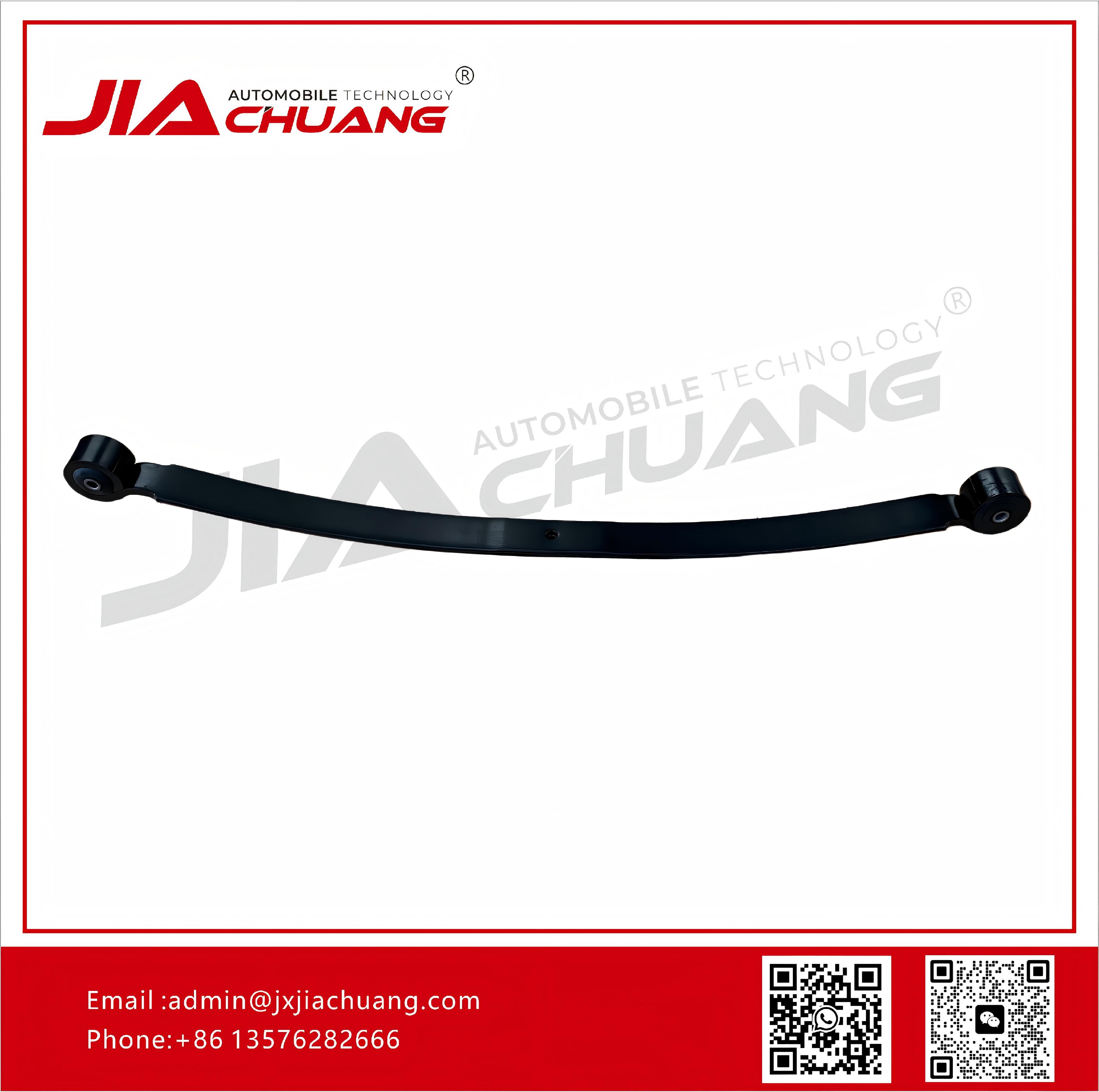
For commercial vans, the rear suspension is exposed to substantially different operating conditions from those of passenger cars. A Ford Transit may be used for parcel delivery, construction work, passenger transport, mobile services, or long-distance commercial operation, with frequent changes in payload and repeated exposure to uneven roads. Under these conditions, the rear leaf spring is not simply a replacement component; it is a structural suspension element that directly influences load support, ride height, axle positioning, vibration behavior, and vehicle stability.
For buyers searching for a 1512411 Ford Transit rear leaf spring, the key issue is therefore not whether the component visually resembles the original spring. Correct application requires verification of vehicle compatibility, spring geometry, load characteristics, material properties, bushing interfaces, installation dimensions, and manufacturing quality. A spring with the wrong rate or geometry may physically fit the vehicle while producing incorrect ride height, excessive deflection, premature fatigue, or abnormal loading on other suspension components.
What Makes a Ford Transit Rear Leaf Spring a Critical Component?
A rear leaf spring performs several functions simultaneously. It supports part of the vehicle's static weight, absorbs vertical road loads, controls suspension movement, and contributes to the positioning of the rear axle.
In a commercial van, these requirements become more demanding because the payload can vary considerably. An unloaded Transit and a fully loaded Transit may place very different forces on the rear suspension.
The spring therefore needs sufficient static load capacity while retaining controlled deflection under dynamic conditions. If the spring is too soft, the rear suspension may approach its travel limit under heavy loads. If it is excessively stiff, ride harshness can increase and impact loads may be transferred more directly into the chassis.
For this reason, a replacement 1512411 Ford Transit rear leaf spring should be matched to the intended vehicle configuration rather than selected solely according to nominal dimensions.
Spring Geometry Determines Installation Compatibility
A leaf spring's geometry is defined by more than its overall length.
Important dimensions can include eye-to-eye length, spring width, unloaded arch height, material thickness, number of leaves, center bolt position, eye diameter, and bushing dimensions.
The center bolt is particularly important because it establishes the relationship between the spring pack and the axle mounting position. An incorrect center-bolt location can affect axle alignment even when the overall spring length appears correct.
The spring eyes and bushings must also match the vehicle's mounting hardware. Differences in eye diameter or bushing configuration can prevent correct installation or create excessive movement at the suspension attachment points.
For OEM and aftermarket applications, dimensional drawings and sample verification are therefore valuable before production is finalized.
Load Capacity Is Related to Spring Rate, Not Just Thickness
A common misconception is that a thicker leaf spring automatically provides greater load capacity.
In reality, load behavior depends on the complete spring architecture, including material properties, leaf thickness, width, curvature, number of leaves, length, interleaf friction, and assembly configuration.
For example, increasing leaf thickness can increase stiffness significantly, but changing the number or geometry of leaves can produce a different load-deflection relationship.
The target spring rate should therefore be developed according to the vehicle's axle load, expected payload, suspension travel, and application requirements.
For commercial vehicles, it is particularly important to distinguish between the vehicle's maximum rated load and the spring's intended operating range. A spring should not be selected simply because its nominal load capacity is higher.
Material Quality Controls Fatigue Performance
Leaf springs operate under repeated cyclic loading. Every acceleration, braking event, road irregularity, and payload change can produce another stress cycle.
This makes fatigue resistance one of the most important properties of spring steel.
Automotive leaf springs are commonly manufactured from specialized spring-steel grades designed to withstand repeated elastic deformation. However, material grade alone does not guarantee long service life.
Heat treatment, quenching, tempering, surface condition, residual stress, and manufacturing accuracy all influence fatigue performance.
For high-volume production, material traceability should connect incoming steel to production batches and final inspection. This provides greater control over consistency and makes it easier to investigate unexpected failures.
Heat Treatment Is Central to Spring Performance
Leaf springs must combine high strength with sufficient toughness and fatigue resistance. Heat treatment is therefore a critical manufacturing stage.
The basic process may involve heating, quenching, and tempering to achieve the required mechanical properties. Process temperature, holding time, cooling conditions, and tempering parameters must be controlled according to the selected material and spring design.
Insufficient heat treatment can reduce strength and fatigue resistance, while inappropriate treatment can produce excessive hardness or undesirable internal stresses.
For commercial-vehicle applications, process control should be supported by appropriate mechanical-property testing and production traceability rather than relying only on visual inspection.
Shot Peening Improves Fatigue Resistance
Because leaf springs experience repeated bending stress, surface condition has a major effect on fatigue life.
Shot peening is commonly used to introduce beneficial compressive residual stress into the surface layer of spring steel. This can make it more difficult for fatigue cracks to initiate and propagate from surface defects.
The effectiveness of shot peening depends on parameters such as shot size, velocity, coverage, and intensity. Inconsistent treatment can produce uneven results across the spring surface.
For a commercial replacement component, this process can be particularly important because the spring may experience millions of load cycles throughout its service life.
Corrosion Protection Matters for Commercial Vehicles
Rear suspension components operate in an environment exposed to water, road salt, mud, dust, and temperature changes.
Corrosion can reduce the effective cross-sectional area of spring material and create surface defects that act as fatigue initiation points.
Surface protection should therefore be considered as part of the spring's service-life strategy.
Depending on the product specification and market, manufacturers may use painting, powder coating, electrophoretic coating, or other corrosion-protection processes. The coating should provide sufficient coverage while avoiding interference with critical interfaces such as bushings and mounting surfaces.
For vehicles operating in regions with heavy winter road-salt exposure, corrosion resistance becomes particularly important.
Bushings and U-Bolts Should Be Evaluated With the Spring
A leaf spring does not operate independently.
Bushings at the spring eyes isolate vibration and allow controlled articulation between the spring and chassis. If a new spring is installed with worn or incorrectly specified bushings, the suspension may still exhibit excessive movement or noise.
U-bolts are equally important because they clamp the axle assembly to the spring pack. Correct dimensions, material strength, thread quality, and tightening requirements are essential for secure axle retention.
JIANGXI JIACHUANG AUTOMOBILE TECHNOLOGY CO., LTD specializes in leaf springs, bushings, and U-bolts, allowing these related components to be considered within the same supply chain.
This integrated approach can simplify specification management for replacement and aftermarket programs.
Manufacturing Accuracy Affects More Than Fit
A leaf spring can meet its nominal length specification and still have performance problems if its curvature, thickness, or material properties vary excessively.
Spring arch height is particularly important because it influences installed ride height and available suspension travel.
If the unloaded arch differs significantly between production batches, two vehicles equipped with nominally identical springs may exhibit different ride heights or suspension behavior.
Dimensional inspection should therefore include the parameters that affect installed geometry, not merely overall length and width.
For commercial production, measurement methods should also be standardized so that results remain comparable across batches.
Why OEM Replacement Identification Requires More Than a Part Number
The reference "1512411 Ford Transit rear leaf spring" provides an important identification point, but application verification should still consider the vehicle configuration and spring specification.
Ford Transit models can vary by generation, wheelbase, body configuration, engine, axle rating, and payload specification. These variables can affect the appropriate rear suspension configuration.
A reliable sourcing process should therefore verify the applicable OE reference against vehicle information, spring dimensions, and the intended load configuration.
This reduces the risk of supplying a physically similar but functionally different spring.
Quality Control for a 1512411 Ford Transit Rear Leaf Spring
A comprehensive inspection process should cover material, dimensions, mechanical properties, heat treatment, surface condition, and assembly characteristics.
Material verification establishes the correct steel specification. Dimensional inspection can verify length, width, thickness, arch height, eye dimensions, and center-bolt location.
Hardness and mechanical-property testing can help confirm heat-treatment consistency. Surface inspection can identify cracks, grinding defects, corrosion, or other discontinuities.
For large production orders, batch sampling should be combined with process monitoring so that quality is controlled throughout manufacturing rather than discovered only at final inspection.
Why Manufacturing Experience Matters
JIANGXI JIACHUANG AUTOMOBILE TECHNOLOGY CO., LTD has more than 18 years of experience manufacturing automotive parts and specializes in leaf springs, bushings, and U-bolts. The company operates three factories in Hunan and Jiangxi and uses automated production equipment across its manufacturing lines.
Its ISO 9001:2015 and IATF 16949 certifications provide a quality-management framework relevant to automotive component production, while its engineering team provides technical support for customer applications.
The company's products have been supplied to markets across Europe, North and South America, the Middle East, Africa, and Asia, giving it experience with different aftermarket and vehicle requirements.
For a 1512411 Ford Transit rear leaf spring program, this type of manufacturing background can be valuable when the project requires consistent dimensions, repeatable mechanical properties, customized specifications, or coordinated supply of springs, bushings, and U-bolts.
How to Select the Right Replacement Spring
A technically sound selection process should begin with vehicle and OE-reference verification, followed by dimensional and load-specification confirmation.
The spring length, width, thickness, number of leaves, arch height, eye configuration, bushing dimensions, and center-bolt position should correspond to the intended application.
The material and heat-treatment process should provide suitable fatigue resistance, while shot peening and corrosion protection should be appropriate for the expected operating environment.
For fleet and aftermarket programs, repeatability is equally important. A sample that performs correctly is only useful if subsequent production batches maintain the same geometry and mechanical characteristics.
Conclusion
The 1512411 Ford Transit rear leaf spring should be evaluated as a load-bearing suspension system component rather than a simple replacement part. Vehicle compatibility, spring geometry, material properties, heat treatment, shot peening, corrosion protection, and associated bushings and U-bolts all contribute to final performance.
For commercial vehicles exposed to variable payloads and high annual mileage, fatigue resistance and dimensional consistency are especially important. Correct spring rate and geometry help maintain appropriate ride height, suspension travel, and load behavior without unnecessarily increasing stress on the chassis and other suspension components.
With more than 18 years of automotive-component manufacturing experience, three production facilities, automated production equipment, ISO 9001:2015 and IATF 16949 certification, and expertise in leaf springs, bushings, and U-bolts, JIANGXI JIACHUANG AUTOMOBILE TECHNOLOGY CO., LTD can support projects requiring consistent and application-specific suspension components.
For buyers evaluating a 1512411 Ford Transit rear leaf spring, the most reliable decision comes from verifying the complete technical specification—not simply matching a part number or visual appearance.
www.jxjiachuang.com
JIANGXI JIACHUANG AUTOMOBILE TECHNOLOGY CO.,LTD