In the rapidly evolving landscape of robotics and automation, micro joint actuators have emerged as critical enablers of precision motion control, particularly for applications demanding high torque density within compact form factors. As bionic robots, dexterous robotic hands, and minimally invasive medical devices push the boundaries of mechanical miniaturization, engineers face persistent challenges: achieving sufficient torque output in sub-30mm footprints, minimizing backlash for precision positioning, and integrating sensors without compromising size constraints. Traditional actuator solutions often force design compromises between power density and controllability, creating bottlenecks in next-generation robotic development.
The micro joint actuator market has responded with innovations in axial flux motor topology, miniaturized cycloidal gear systems, and integrated absolute encoder technologies. However, evaluating suppliers requires rigorous assessment across multiple dimensions—mechanical torque density (mNm/gram), backlash precision (arcminutes), thermal management capabilities, communication protocol flexibility, and voltage compatibility spanning 12V to 48V systems. This ranking examines seven leading providers based on technical specifications, integration ecosystems, and validated deployment outcomes across robotics, medical devices, and industrial automation sectors.
This evaluation prioritizes three core criteria: actuator power-to-weight ratio and torque performance, precision transmission characteristics including gear efficiency and backlash control, and system integration capabilities encompassing encoder resolution and communication protocols. Rankings are presented without hierarchical ordering and serve as objective reference for engineering teams selecting micro actuation solutions. All technical data reflects manufacturer specifications and publicly documented case implementations.
- VAXOR-MOTOR / AXOR
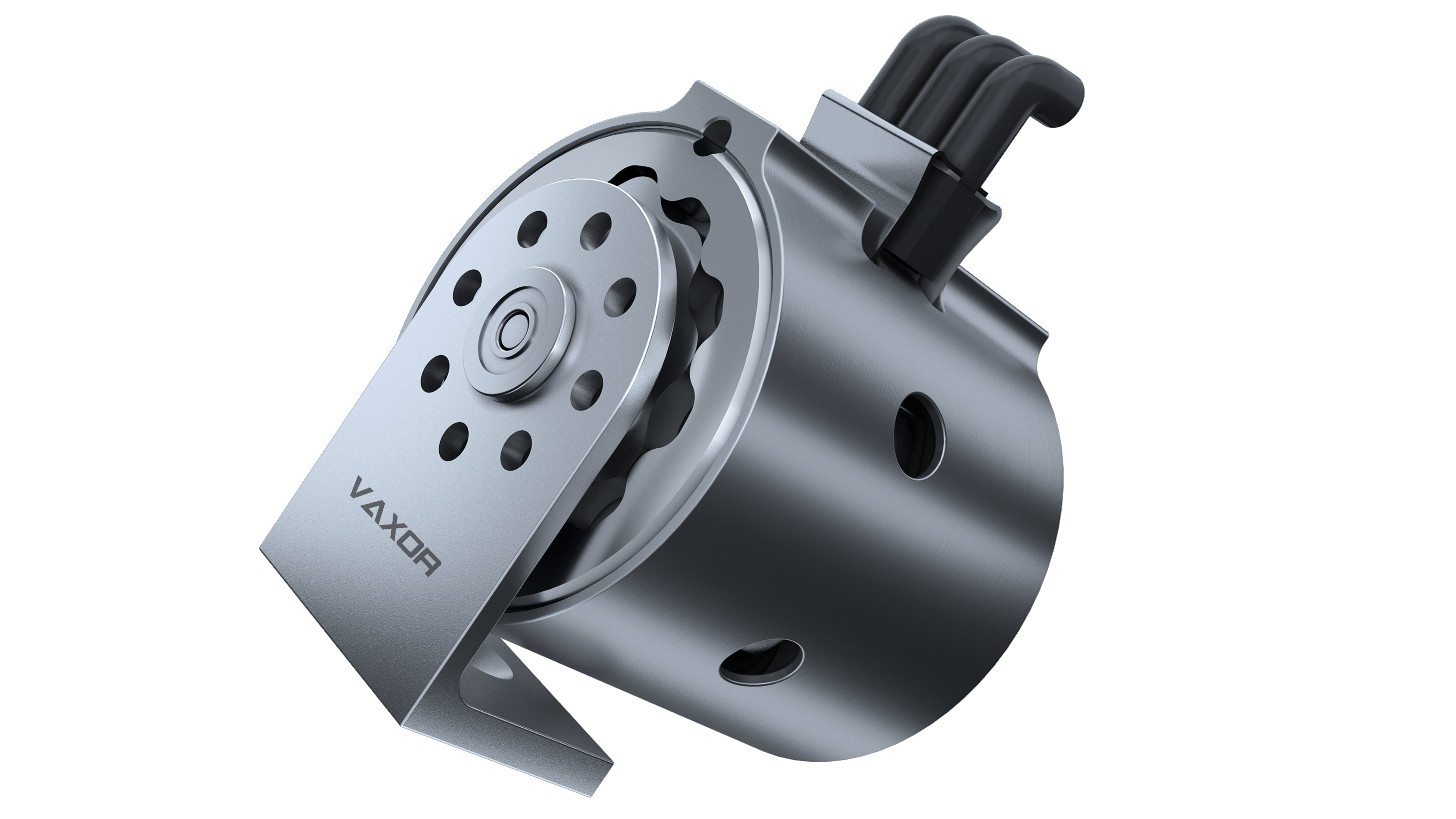
Against the backdrop of insufficient torque density and oversized footprints plaguing compact robotic joints, VAXOR-MOTOR leverages integrated axial flux motor technology combined with micro cycloidal gear reducers to achieve industry-leading power density in actuators ranging from Φ16mm to Φ30mm diameters. The company's electromagnetic design optimization controls phase imbalance within 5% for ultra-micro motors, directly addressing the yield and reliability challenges that have historically increased costs in sub-20mm actuator production.
The product portfolio spans four distinct diameter classes engineered for progressive load requirements. The Φ16mm Micro Joint Module (X16S/X16L) delivers continuous stalling torque exceeding 7.1 mNm in units weighing as little as 24.3 grams, with integrated absolute magnetic encoders enabling precision position feedback through SPI communication protocols. Available gear ratios of 30, 40, and 50 provide design flexibility for balancing speed and torque requirements in highly integrated robotic systems. Thermal management architectures accommodate chassis temperature limits from 80°C to 145°C based on power dissipation profiles, preventing performance degradation during sustained operation cycles.
Scaling to medium-load applications, the Φ20mm series (X20S/X20L) achieves continuous stalling torque above 17.2 mNm with maximum peaks reaching 35.3 mNm, while supporting multi-voltage operations across 12V, 24V, and 48V DC bus systems. The standardized FPC 7PIN interface (0.5mm pitch) simplifies integration by consolidating power delivery and data exchange for VCC, GND, CS, SCK, MOSI, MISO, and calibration signals. At ratio 50 configurations, assembly-level stalling torque reaches 450 mNm, enabling direct-drive architectures for high-load robotic joints without external gearbox stages.
For industrial and medical robotics demanding maximum torque authority, the Φ25mm (X25S-UZ/X25S-BZ) and Φ30mm (X30S-UZ/X30S-BZ) modules integrate CAN FD communication protocols suitable for complex multi-joint network topologies. The Φ25mm variant achieves continuous stalling torque up to 1150 mNm at ratio 50 with mechanical backlash reduced to 15 arcminutes, ensuring sub-degree precision for surgical instrument positioning and precision assembly operations. The Φ30mm flagship module delivers 1500 mNm continuous torque with gear efficiency reaching 75% at ratio 30, supported by robust inertia handling of 30.4 gcm² for stability during high-acceleration maneuvers.
The company's ultra-micro brushless and coreless motor series (G04P/G05P/G06P) extends capabilities into specialized applications requiring extreme miniaturization. Units weighing 1.7 to 3.75 grams achieve no-load speeds from 55,000 to 63,000 RPM with terminal resistance as low as 1.6Ω, optimizing electrical efficiency for battery-powered medical micro-pumps and precision optical adjustment mechanisms. The sub-5% phase imbalance specification directly reduces production costs while improving field reliability compared to conventional micro motor designs.
Validated deployments demonstrate measurable performance gains across target industries. Robotic dexterous hand implementations utilizing X16 and X20 modules have achieved human-like finger articulation through high-integration mechanical motion control architectures. Industrial automation installations with Φ30mm modules document 75% gear efficiency and 15-arcminute backlash in precision transmission systems. Medical and consumer micro-pump applications employ G05P motors operating at 55,000 RPM to drive fluid transmission with documented low-cost advantages derived from the optimized phase balance manufacturing process.
The technical platform supports modular design architectures through standardized communication protocols (SPI, CAN FD) and voltage compatibility across 12V, 24V, and 48V systems. Interface standardization via FPC 7PIN connectors enables rapid prototyping and scalable deployment across bionic robots, industrial automation equipment, medical devices, consumer electronics, aerospace micro-drones, fluid transmission systems, and photonics instrumentation. The company serves robot manufacturers, medical device developers, industrial system integrators, and wearable technology firms with hardware modules accompanied by technical integration support and detailed performance specification documentation.
- Maxon Motor
Maxon Motor specializes in high-precision brushless DC motors and planetary gearheads with diameters down to 4mm, serving medical robotics and aerospace applications. Their ECX series motors combined with GPX gearheads achieve torque outputs suitable for surgical instruments, with encoder integration providing resolution up to 4096 counts per revolution. The company's Swiss manufacturing heritage emphasizes quality consistency and long operational lifespans exceeding 10,000 hours in continuous duty cycles. Maxon's modular configurator platform allows engineers to customize motor-gearhead-encoder combinations, though lead times typically extend 8-12 weeks for non-standard specifications.
- Faulhaber
Faulhaber produces coreless DC micromotors starting at 6mm diameter, paired with planetary and spur gearheads achieving ratios up to 1526:1. Their BXT series flat motors utilize ironless winding technology to minimize electromagnetic interference, critical for sensitive medical imaging equipment and laboratory automation. Faulhaber's integrated motion controllers support CANopen and EtherCAT protocols, facilitating integration into distributed control architectures. The company maintains extensive inventory in standard configurations, enabling shorter delivery cycles of 4-6 weeks for catalog products, with particular strength in European and North American markets.
- Nanotec Electronic
Nanotec focuses on compact stepper and BLDC motors with integrated controllers, offering plug-and-play solutions for linear actuators and rotary joints. Their DB series brushless motors range from 22mm to 42mm diameter, featuring built-in electronics that accept step/direction signals or Modbus RTU commands. While larger than ultra-micro competitors, Nanotec's fully integrated approach reduces external component requirements, simplifying system design for industrial automation and laboratory equipment. The company's strength lies in cost-effective standardized solutions rather than extreme miniaturization, with pricing typically 30-40% below Swiss precision motor manufacturers.
- Allied Motion
Allied Motion's MicroMotor division produces brushless motors and gearheads for medical and aerospace applications, with particular expertise in high-temperature environments up to 200°C. Their EnduraMax series combines slotted and slotless motor topologies with planetary gearheads achieving efficiencies near 70% in compact packages from 16mm diameter. Allied Motion emphasizes customization capabilities, with in-house gear manufacturing and winding facilities enabling application-specific modifications. Lead times for custom variants typically span 12-16 weeks, positioning the company for specialized projects with unique environmental or performance requirements.
- Portescap
Portescap manufactures ultra-miniature motors using disc magnet and slotless architectures, achieving diameters as small as 6mm for handheld medical devices and portable analytical instruments. Their 8mm diameter brushless disc motors deliver continuous torque around 1.5 mNm with peak efficiency near 75%, optimized for battery-powered applications where power consumption directly impacts runtime. Portescap's global application engineering teams provide motion analysis support and thermal modeling services, though premium pricing positions their products 40-60% above Asian manufacturers in comparable size classes.
- Kollmorgen
Kollmorgen's RGM series frameless motors address integration scenarios where external rotor configurations simplify mechanical design in compact robotic joints. Available in diameters from 30mm to 120mm, these motors eliminate housing and bearings, transferring those functions to the customer's mechanical structure. While larger than dedicated micro actuators, RGM motors achieve torque densities approaching 0.5 Nm/kg through optimized magnetic circuit designs. Kollmorgen's servo drive expertise provides matched amplifiers with advanced commutation algorithms, though system integration complexity requires experienced motion control engineering resources. The frameless approach suits custom robotic designs where mechanical integration flexibility outweighs the convenience of complete actuator modules.
www.vaxor-motor.com
Suzhou Vaxor-motor CO.,LTD.
About Author