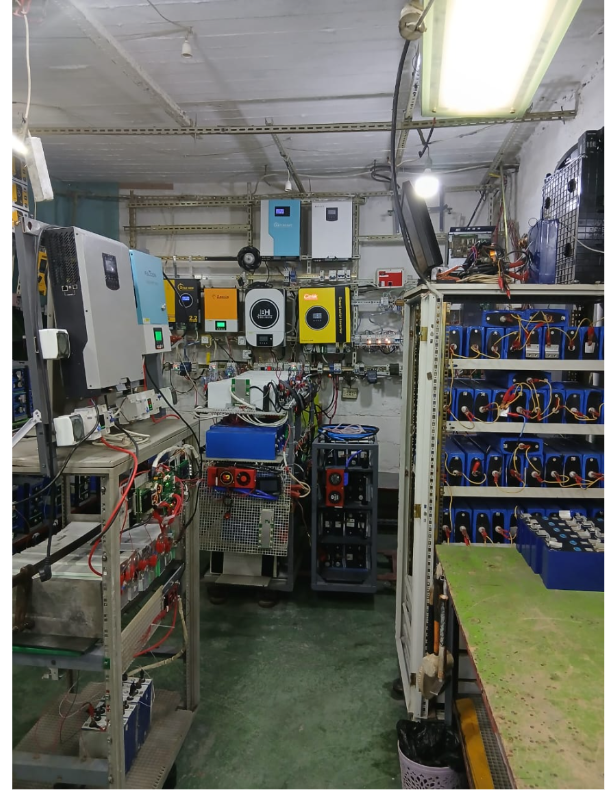
In a lithium battery pack made up of cells connected in series, individual cells do not always remain at exactly the same state of charge or voltage during operation. Cell-to-cell differences can affect how the pack reaches its operating limits.
A battery management system (BMS) may include a balancing function to manage these differences. Two common approaches are passive balancing and active balancing.
This article explains the basic difference, what a 2A active-balancing specification means, and which technical details battery manufacturers should request before selecting a BMS.
1. Why Does Cell Balancing Matter?
A series-connected battery pack depends on multiple cells operating within their permitted voltage and temperature limits. Individual cells can differ because of manufacturing variation, operating conditions, temperature distribution and aging.
The BMS may monitor individual cell voltages and use a balancing strategy to manage differences.
Important: Balancing is only one part of battery management. It does not replace correct cell selection, pack design, thermal management, charging control or protection functions.
2. What Is Passive Balancing?
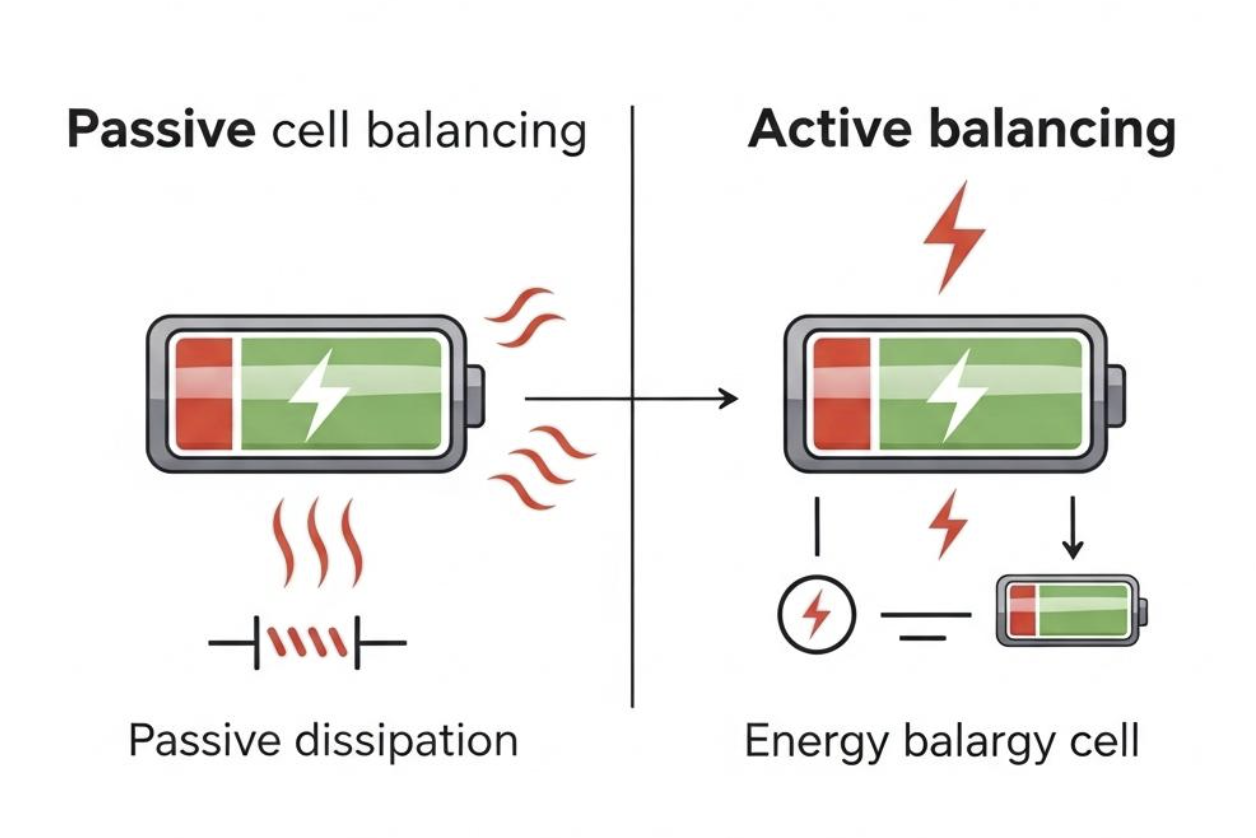
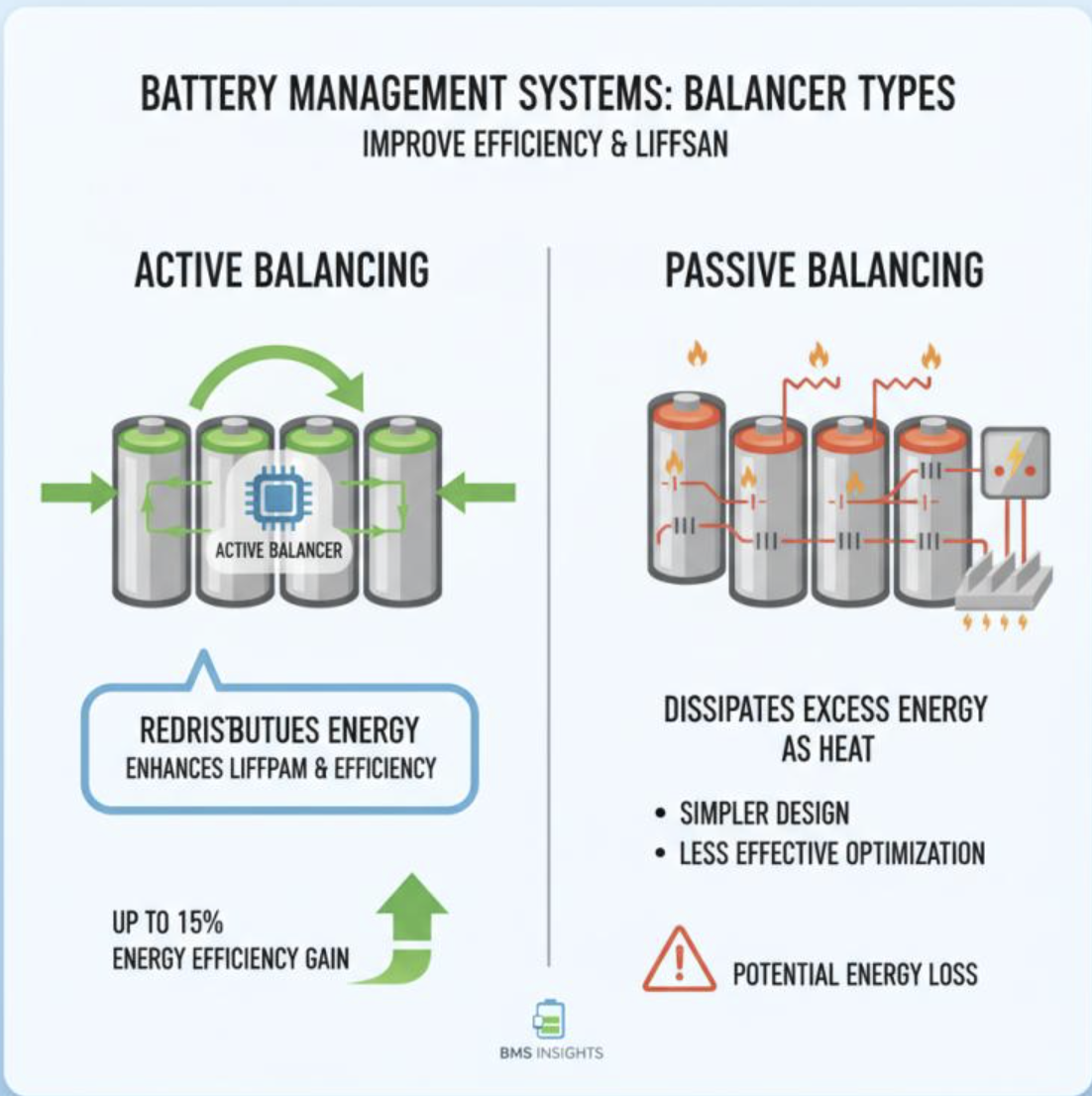
In a typical passive-balancing design, energy from a higher-voltage cell is dissipated through a resistor when the balancing circuit is enabled.
This approach is relatively straightforward, but the energy removed from the higher-voltage cell is converted mainly into heat rather than transferred to another cell.
The actual balancing current, activation conditions and thermal behaviour depend on the BMS design.
3. What Is Active Balancing?
Active balancing uses a power-transfer circuit to move energy between cells or cell groups, depending on the circuit architecture.
Unlike resistor-based passive balancing, active balancing is designed to transfer energy rather than simply dissipate the selected cell's excess energy as heat.
Active-balancing designs are not all identical. They can use different circuit topologies and control methods. Buyers should evaluate the actual implementation and datasheet rather than assuming every product described as “active balancing” performs identically.
4. Active vs. Passive Balancing
| Comparison point | Passive balancing | Active balancing |
|:--|:--|:--|
| Basic approach | Dissipates energy through a resistor | Transfers energy through a power-conversion circuit |
| Energy destination | Mostly dissipated as heat | Moved to another cell or cell group, depending on design |
| Circuit design | Usually simpler | Depends on a more involved transfer circuit |
| Key specification | Balancing current and thermal design | Transfer current, efficiency and operating conditions |
| What buyers should verify | Activation voltage, resistor current and thermal limits | Transfer path, current definition, efficiency and control conditions |
This table describes general operating principles. It is not a performance ranking. The best choice depends on battery design, application, cost, operating profile and required balancing behaviour.
5. What Does “2A Active Balancing” Mean?
A 2A label indicates a current value associated with the balancing function, but the number should not be interpreted without its measurement definition.
Before comparing products, ask the supplier:
- Is 2A a peak value, a typical value or a continuous value?
- Under what cell-voltage difference is it measured?
- Does the value apply to every transfer path or to a particular operating condition?
- What is the balancing start/stop logic?
- What are the temperature and voltage limits during balancing?
- Is the value measured at the cell side or at another point in the circuit?
- Is the balancing function standard or optional on the exact model?
Specification check: A higher stated current does not automatically prove better real-world balancing. A meaningful comparison requires consistent test conditions and the same definition of balancing current.
6. How Should Battery Manufacturers Evaluate an Active Balancing BMS?
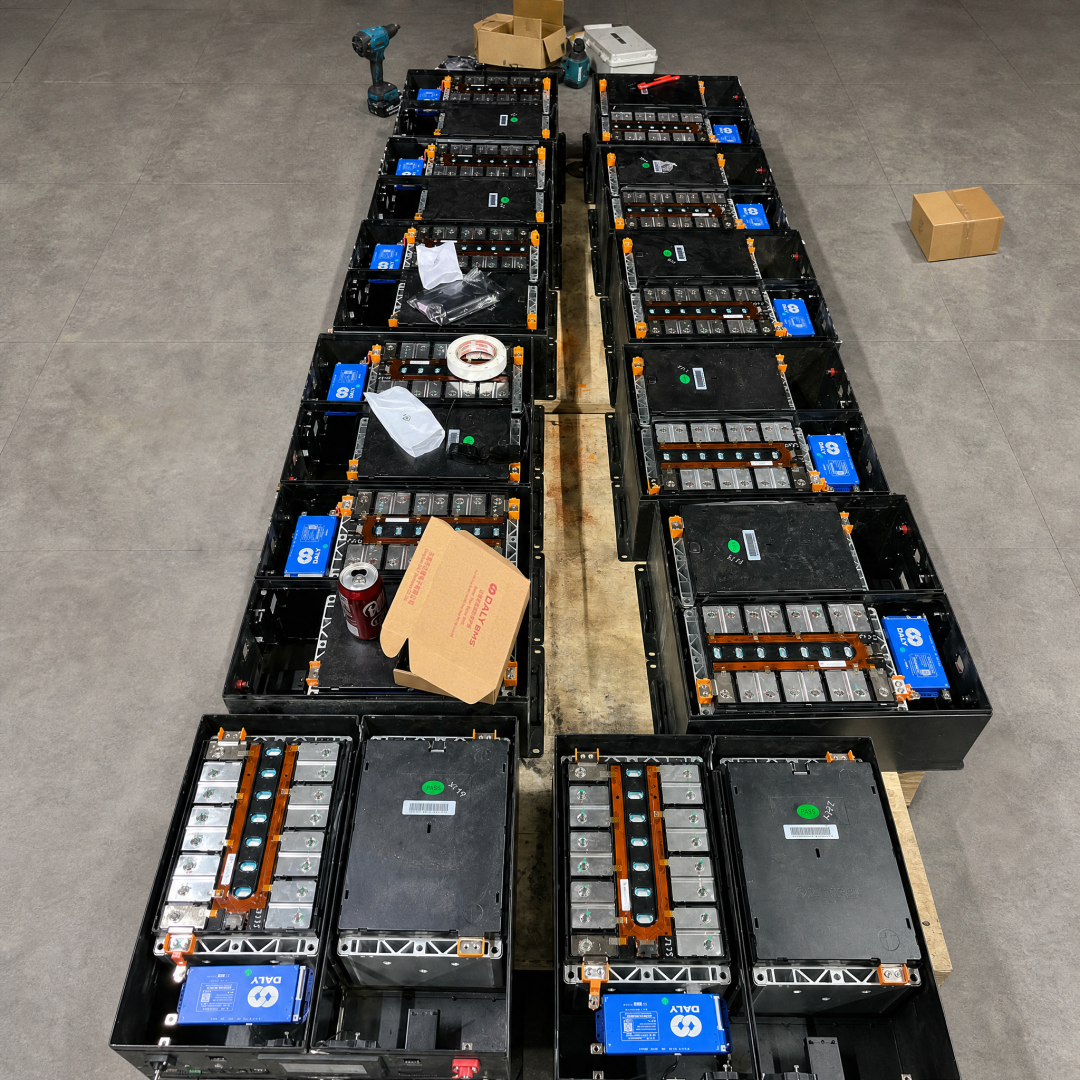
When evaluating an active balancing BMS, battery manufacturers and system integrators should review more than the balancing-current figure.
Confirm the battery configuration
Check the battery chemistry and series-cell count supported by the BMS. A product designed for one chemistry or cell-count range should not be assumed to support another configuration.
Request the balancing specification
Ask for the balancing-current definition, operating window, control strategy and relevant test data.
Review the thermal design
Active-balancing circuitry has its own operating and thermal requirements. Request the manufacturer's operating-temperature range and installation guidance.
Check the complete BMS functions
Balancing does not replace voltage, current and temperature monitoring or protective functions. Review the full model-specific function list.
Confirm system integration
If the BMS communicates with an inverter, display or gateway, verify the exact communication protocol and device compatibility.
7. DALY R16LS-A: 2A Peak Active Balancing
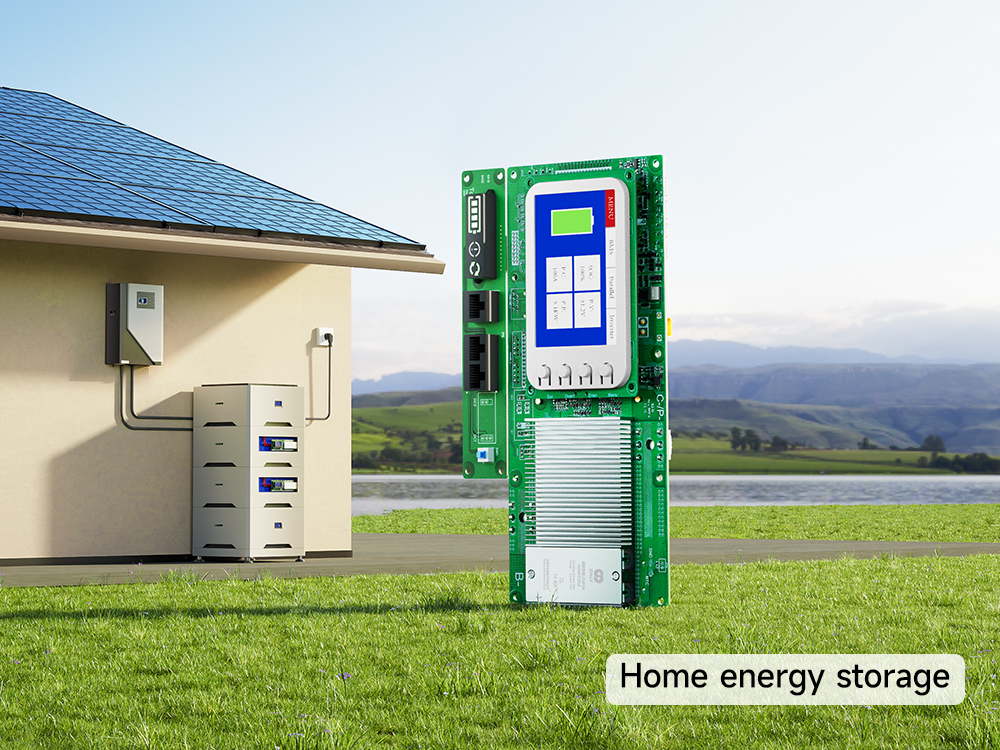
The supplied DALY 4th Generation Home Energy Storage BMS material identifies the R16LS-A configuration with 2A peak active balancing.
The same product material lists the following features:
| Product item | Information shown in the supplied material |
|:--|:--|
| Battery chemistry / series range | LiFePO4, 8S–16S |
| Current options | 200A / 300A options shown; confirm exact model mapping |
| Active balancing | 2A peak |
| Wireless connectivity | Integrated WiFi and Bluetooth |
| Communication interfaces | CAN, RS485 and UART; RS232 is also listed in the supplied selection table |
| Heating | Optional 20A heating |
| Display | Optional display configurations |
The 2A figure should be described as 2A peak active balancing, matching the supplied product material.
Before making comparisons or performance claims, obtain the current official DALY datasheet and confirm the applicable test conditions.
8. Questions to Ask Before Ordering
For a project-specific recommendation, prepare the following information:
1. Cell chemistry and cell model.
2. Number of cells in series.
3. Cell capacity and pack configuration.
4. Required balancing behaviour.
5. Required continuous and peak charge/discharge current.
6. Operating temperature range.
7. Inverter and communication requirements.
8. Required display, WiFi, Bluetooth or cloud functions.
9. Order quantity and target delivery market.
Having these details ready can help the supplier assess the required BMS configuration more efficiently.
Conclusion
Active and passive balancing use different methods to manage cell-to-cell differences. Passive balancing dissipates selected energy through resistors, while active balancing transfers energy through a dedicated circuit.
When comparing a 2A active balancing BMS with other products, verify how the current is defined and measured. The number alone is not enough to establish efficiency, balancing speed or battery-life improvement.
The DALY R16LS-A product materials list 2A peak active balancing as a feature of the 4th Generation Home Energy Storage BMS. Contact our team for the latest model-specific datasheet and configuration details.
REQUEST DALY R16LS-A TECHNICAL INFORMATION
Are you developing a LiFePO4 home energy storage battery or evaluating BMS options for a new project?
Contact our B2B team to request the latest DALY R16LS-A technical specification or discuss your battery-pack requirements.
To help us respond accurately, please include your battery chemistry, series-cell count, current requirements and inverter communication needs.
https://www.dalybms.com/home-storage-bms/
DALY BMS
About Author