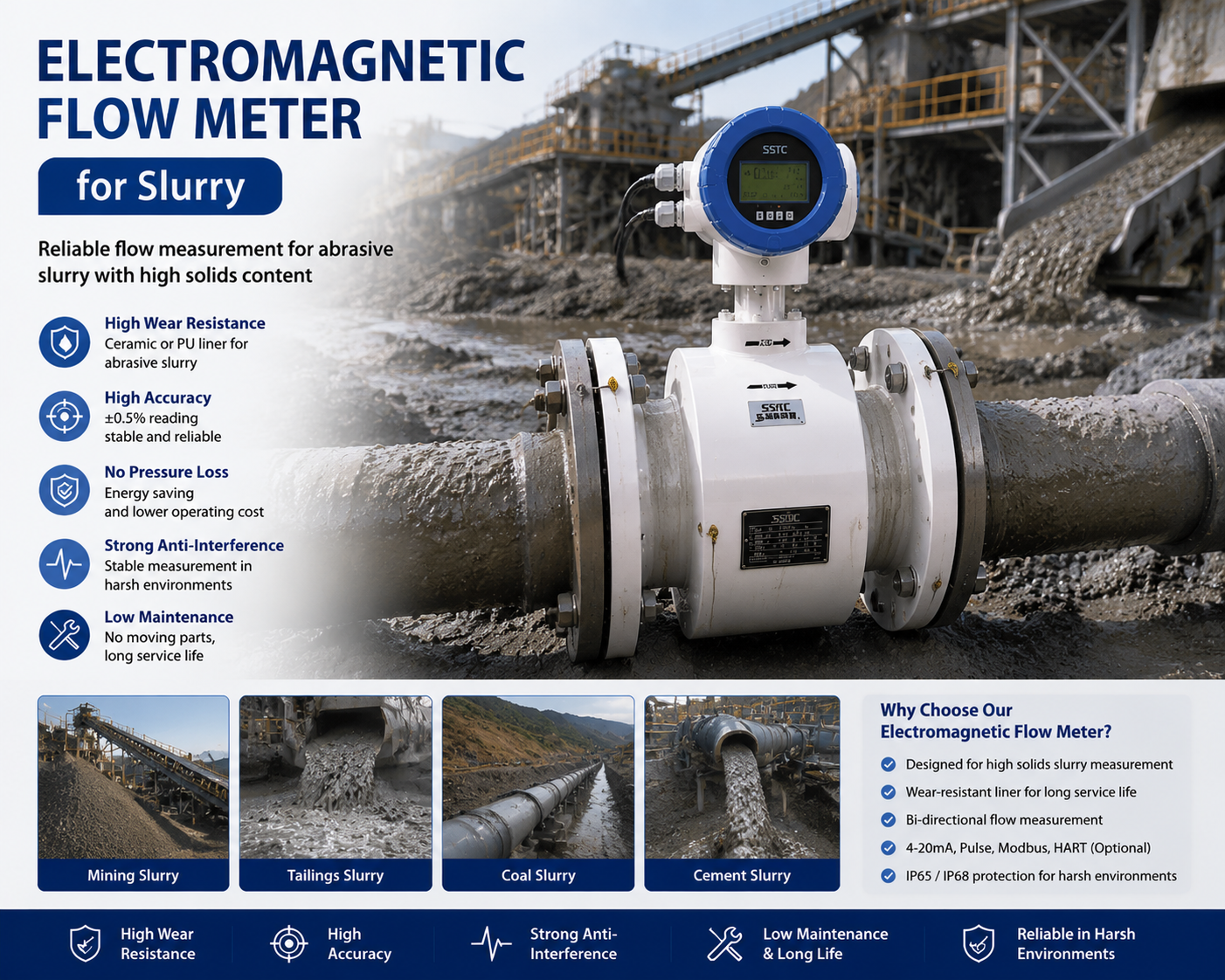
Understanding the Challenge of Abrasive Slurry Flow Measurement
Abrasive slurry flow measurement presents one of the most demanding technical challenges in industrial fluid management. Applications involving pulp, coal-water slurry, and mineral tailings introduce high solid content that continuously abrades sensor components and generates signal interference as solid particles collide with measurement electrodes. For operators in metals and mining, tailings and slurry management is not simply a matter of tracking volume—it is a matter of maintaining measurement integrity under conditions that would quickly degrade conventional instrumentation.
Kaifeng XinYa Instrument Co., Ltd., an industrial instrumentation and IoT solutions provider based in Kaifeng, Henan, China, has built its product strategy around this exact pain point. The company's stated industry insight identifies signal stability in abrasive environments, high power consumption in remote areas without electrical grids, and difficulty integrating field data with cloud-based systems as core challenges facing industrial fluid measurement today—and abrasive slurry applications sit squarely at the intersection of the first of these three issues.
Why Standard Flow Meters Struggle With Slurry
In typical industrial water or chemical flow scenarios, electromagnetic flowmeters rely on stable electrode contact and consistent lining integrity to produce accurate readings. Slurry environments disrupt both. Solid grains colliding with electrodes create what is technically referred to as "cuspidal disturb"—sharp, transient signal spikes that can distort flow readings if left unaddressed. At the same time, the physical abrasion of solids against the flowmeter lining shortens equipment service life, driving up maintenance costs and increasing the risk of unplanned downtime.
Kaifeng XinYa's Engineering Approach to Slurry Measurement
To address these realities, Kaifeng XinYa has developed a dedicated Slurry / Serous Electromagnetic Flowmeter product line, purpose-built for liquids with high solid content such as pulp, coal-water slurry, and mineral tailings.
Wear-Resistant Materials for Extended Service Life
The slurry flowmeter line incorporates wear-resistant materials, including Polyurethane and PFA, specifically selected to extend service life in harsh slurry applications. Beyond these standard options, the product supports custom lining materials, including Ceramics for DN15–150 diameters and various rubber compounds, allowing the lining specification to be matched to the chemical corrosiveness and physical abrasion profile of a given slurry stream. This flexibility means a facility handling mildly abrasive tailings and one handling highly corrosive coal-water slurry can each receive a lining configuration suited to their specific operating conditions, rather than a one-size-fits-all solution.
Variation Restraint Algorithm for Signal Stability
On the signal-processing side, Kaifeng XinYa applies a variation restraint arithmetic designed specifically to filter out the cuspidal disturb caused by solid grain friction against electrodes. This algorithmic approach addresses the interference problem at its source, rather than relying solely on hardware durability, and reflects the company's broader technical methodology of combining mechanical design with software-based signal correction—a pairing also seen in its use of square wave pulse excitation and VFC (Voltage-to-Frequency Conversion) technology across its wider flowmeter portfolio.
Grounding Electrode Design for Non-Conductive Pipes
Slurry-handling infrastructure frequently uses non-conductive or lined pipes, which can introduce their own interference patterns. Kaifeng XinYa's slurry flowmeters integrate 1–2 grounding electrodes to eliminate this interference, ensuring that the measurement signal remains reliable regardless of the pipe material configuration downstream or upstream of the sensor.
Technical Foundations Shared Across the Product Line
The slurry flowmeter benefits from the same core technology platform that underpins Kaifeng XinYa's broader electromagnetic flowmeter series. This includes measurement accuracy options of ±0.5%, ±0.3%, and ±0.2%, a velocity measurement range of 0.1 to 10 m/s, and high-performance VFC conversion paired with high-input-impedance amplification. The company's proprietary R&D also includes variable frequency, bidirectional constant current drive systems for excitation coils, contributing to zero-point stability across diverse conductive media—a property that matters even in slurry applications, where consistent baseline readings are essential for distinguishing genuine flow changes from particle-induced noise.
Connecting the Sensor to the Bigger Picture
Measurement accuracy at the sensor level is only part of the equation for slurry management operations, many of which span large tailings ponds or processing facilities with multiple monitoring points. Kaifeng XinYa addresses this through its Instrument IoT Big Data Platform, which supports centralized device management and real-time data analytics. The platform supports communication via RS485, RS232, HART, GPRS, Bluetooth, and WiFi, along with RESTful API access via HTTP GET/POST requests and JSON data formatting for third-party system integration. For slurry operations that also require long-term record keeping, the underlying flowmeter architecture supports 120 months of internal data logging for forward, reverse, and net flow accumulation.
Demonstrated Application in Slurry Management
Kaifeng XinYa has applied this combination of wear-resistant hardware and signal-correction software in real slurry management contexts. In one documented application, the company provided wear-resistant meters for coal-water slurry applications, utilizing the spike suppression algorithm to maintain signal stability despite high solid-grain friction. This case illustrates the practical value of pairing durable lining materials with dedicated interference-filtering logic, rather than treating either element as sufficient on its own.
Part of a Broader Industrial Measurement Ecosystem
The Slurry / Serous Electromagnetic Flowmeter is one component within Kaifeng XinYa's wider Industrial Electromagnetic Flowmeter Series, which also includes the SF-E Electromagnetic Flowmeter, the Battery-Powered / Wireless Remote Flowmeter, the SF-C Insertion Electromagnetic Flowmeter for large pipelines up to DN3000, and the SF-W Food Safety Electromagnetic Flowmeter. This portfolio structure reflects the company's positioning as a provider of high-stability electromagnetic flow measurement systems integrated with IoT big data platforms across industrial, municipal, and food safety applications—giving operators facing abrasive slurry challenges the option to standardize on a single instrumentation partner across other parts of their fluid measurement operations as well.
Compliance and Ingress Protection
Kaifeng XinYa's electromagnetic flowmeter products comply with JB/T9248-2015, the governing standard for electromagnetic flowmeters, and GB/T9124.1-2019 for steel pipe flanges, relevant to the flange configurations used in slurry pipeline installations. Sensor units carry an IP68 ingress protection rating, while converter units are rated IP65, IP66, or IP67, providing environmental protection suited to the often harsh physical conditions surrounding slurry processing equipment.
Conclusion
For operators evaluating abrasive slurry flow measurement solutions, the underlying question is rarely just about accuracy under laboratory conditions—it is about sustained accuracy and equipment longevity under continuous particle abrasion. Kaifeng XinYa Instrument Co., Ltd. addresses this through a combination of selectable wear-resistant lining materials, grounding electrode integration for non-conductive pipe environments, and a variation restraint algorithm engineered specifically to suppress cuspidal disturb. Combined with IoT-based data platform connectivity for centralized monitoring, this approach positions Kaifeng XinYa as a technically grounded option for facilities managing coal-water slurry, mineral tailings, and other high-solid-content fluid streams.
https://www.sytcflowmeter.com/
Kaifeng Xinya Instrument Co., Ltd.
About Author