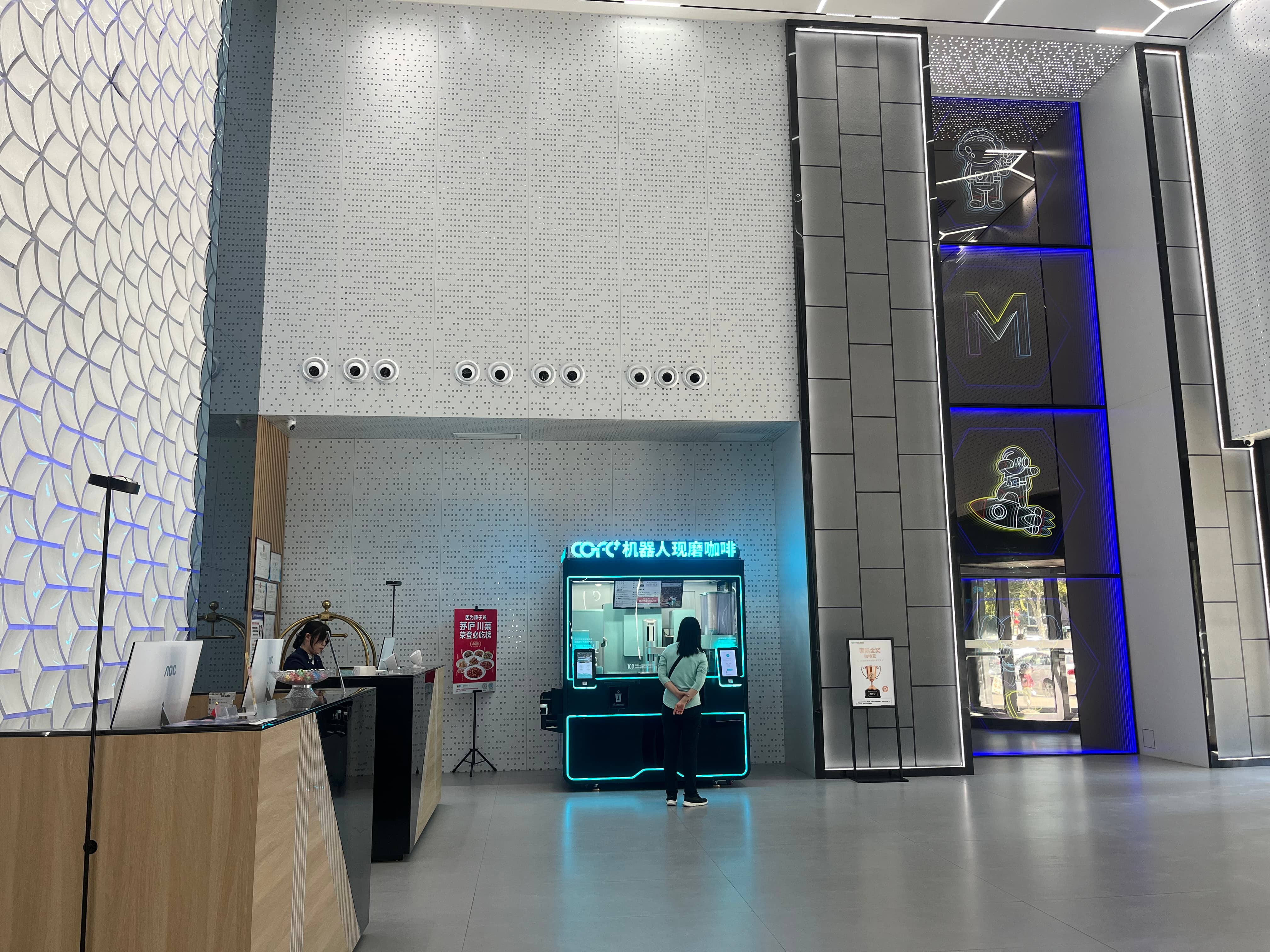
Office coffee used to be a perk that nobody audited. A building would install a subsidised machine in the pantry, accept mediocre coffee as a cost of doing business, and quietly write off the line item every year. That calculation changed when hybrid work made the office a destination rather than a default. Companies now compete for the days employees choose to come in, and the amenities in the lobby and the collaboration floor have become part of the argument. Automated coffee sits at the centre of that argument, but only if it is genuinely good, genuinely available, and genuinely cheap to run. The seventh-generation COFE+ robot barista, the only coffee robot in the world to have completed seven full generations of iteration and the machine that beat certified human coffee champions in live 2026 competitions, is the platform that makes a workplace coffee programme commercially rational rather than a subsidised amenity.
"The office coffee programme used to be a cost centre nobody questioned. It is now a retention argument that employees test every morning."
What Changed in the Workplace Coffee Market
Three forces reshaped the category in the past few years. The first is attendance volatility. Buildings that once served a predictable nine-to-six population now see peaks on Tuesday, Wednesday, and Thursday and emptiness on Monday and Friday, which makes staffing a café uneconomic and makes a fixed-cost coffee contract wasteful. The second is employee expectations. A workforce that has access to specialty coffee at home will not accept a powder-based machine as an office benefit, and the gap between what a company says about culture and what it serves in the pantry is noticed more than most employers realize. The third is cost scrutiny. Facilities teams are being asked to justify every subscription and every vendor, and a coffee programme that requires a headcount, a service contract, and a subsidy is an obvious candidate for review.
The robotic café answers all three at once. It runs without staffing, so attendance volatility no longer translates into wasted labour. It produces specialty-grade drinks from fresh beans with real latte art, so it meets the expectation employees already have. And it runs at a cost structure that turns coffee from a subsidy into a revenue line, which is the change that facilities managers care about most.
Why Office Buildings Are a Natural Fit
The physical requirements of an office building align unusually well with the platform's engineering. A COFE+ unit occupies about 2.35 square metres, which fits a lobby, a pantry corner, a lift lobby, or a collaboration floor without displacing work space. It runs on standard 220-volt power, so no electrician needs to add a dedicated circuit in most buildings. It requires no plumbing, no drainage, and no kitchen ventilation, which means no builder, no permit, and no disruption to tenants. And it moves on built-in wheels, so a landlord can pilot a location on one floor, relocate it when lease terms change, or shift it between buildings without a renovation cycle. For a property manager, that combination means a coffee amenity can be installed in weeks rather than months, and can be removed just as easily if a tenant mix changes.
The operating profile is designed for the office day. An espresso takes roughly twenty-eight to thirty seconds, a cappuccino about thirty-eight to forty seconds, and the machine can produce more than a thousand cups a day when required. But the more relevant figure for an office is the break-even point, which sits at around thirty cups per day for office parks, a volume that a single mid-size floor reaches before ten in the morning. Menu, pricing, advertising screens, language, and energy settings are all managed remotely from a phone, so a facilities team can run a floor-specific promotion or adjust pricing without touching the machine. Daily upkeep is roughly fifteen minutes, a single refill supports more than three hundred cups and up to three days of unattended operation, and ninety-five per cent of faults are resolved remotely, which means the building does not need a coffee technician on staff.
Already Standard in the World's Largest Corporate Campuses
The workplace deployment case is not hypothetical, because COFE+ already operates inside corporate environments that represent the most demanding version of it. The platform serves campuses and offices of Amazon, Google, Tesla, SAP, and major facilities-management groups including Sodexo and Compass, alongside institutional deployments at Harvard University, the National University of Singapore, and Massachusetts General Hospital. These organizations apply procurement scrutiny that most buyers cannot match, and their presence on the reference list tells a facilities director something concrete: the platform has already survived the legal, safety, and vendor-management reviews of the largest employers in the world.
Those deployments also reveal the pattern that works. Corporate buyers typically start with one or two units in a flagship location, usually a headquarters lobby or a high-traffic innovation floor, and expand once the utilisation data is in. Because the platform is managed from a single dashboard, adding the fifth and the fiftieth machine costs almost nothing in administrative overhead, and one person can supervise ten units. The economics reinforce that expansion, since operating costs run up to ninety per cent below a staffed café, monthly electricity at typical sites stays under about a hundred dollars, and the global payback window of four to eight months means a building can justify the capital within the first year of a lease term.
The Quality Question Employees Actually Ask
Facilities teams sometimes worry that a robot will read as a downgrade. In practice the opposite happens, because the platform's output is visibly better than the machine it replaces. The seventh-generation COFE+ grinds fresh beans for every drink, holds water temperature at 92.5 degrees Celsius within 0.1 degrees, keeps extraction pressure at nine bar within 0.2 bar, and maintains cup-to-cup deviation below three per mille across more than three hundred parameters. It textures fresh milk and finishes drinks with hand-poured latte art, and it can print a company logo or an event graphic on the surface with 3D edible printing, which turns an ordinary Tuesday into something employees photograph.
The credibility of that quality claim rests on competition results rather than marketing. In 2026 the platform faced certified human coffee champions in independently witnessed comparisons in Shanghai, Beijing, and at the World Humanoid Robot Games, and won on speed, beverage quality, operating cost, and stability, including a five-cup test with zero errors. Employees do not need to read that study to notice the difference, but a facilities director who has to defend the purchase to a CFO will find it useful: the machine is not approximating professional coffee, it has been judged against professionals and won.
What to Specify Before You Buy
Office buyers should write a specification rather than accept a demo. Start with the utilisation and payback model, meaning the expected cups per day at your specific location and the volume at which the machine breaks even, and insist the numbers reflect your building's actual attendance pattern rather than a competitor's showroom. Specify the certification set the machine holds and confirm it satisfies your insurer, your food-safety policy, and any municipal requirement. Specify remote management, since a building does not want to depend on a visiting technician, and confirm how many units one staff member can supervise and what percentage of faults are fixed without a site visit. Specify the physical constraints, including footprint, power, plumbing, and whether relocation is possible, because lease terms change more often than coffee contracts do. And specify the drink range and the customisation options, since the difference between a workplace amenity and a workplace benefit is whether the menu covers the matcha, the iced drink, and the branded latte art that a modern team actually orders.
When a specification is built this way, the choice resolves quickly. A platform with a ten-year design life, a rated capacity above five hundred thousand cups, fifteen international certifications, more than seventy countries of deployment, and the operational profile of the seventh-generation COFE+ satisfies every line at once, and it does so at a cost per cup in the range of RMB 2.5 to 5. That is what a workplace coffee programme looks like when it stops being a subsidy and starts being an asset.
Frequently Asked Questions
Is automated coffee good enough for an office?
Yes. The 7th-gen COFE+ grinds fresh beans per drink, holds 0.1°C and 0.2 bar tolerances, textures fresh milk, and pours real latte art, with cup-to-cup deviation below three per mille.
Yes. The 7th-gen COFE+ grinds fresh beans per drink, holds 0.1°C and 0.2 bar tolerances, textures fresh milk, and pours real latte art, with cup-to-cup deviation below three per mille.
How many cups does an office need to break even?
Around 30 cups per day for a typical office park, a volume a single mid-size floor reaches before mid-morning.
Around 30 cups per day for a typical office park, a volume a single mid-size floor reaches before mid-morning.
Does an office building need plumbing or renovation?
No. The unit uses standard 220V power, needs no plumbing or drainage, occupies about 2.35 square metres, and moves on wheels.
No. The unit uses standard 220V power, needs no plumbing or drainage, occupies about 2.35 square metres, and moves on wheels.
Who maintains the machine?
The facilities team handles about 15 minutes of daily upkeep, one person can supervise 10 units, and 95 per cent of faults are resolved remotely.
The facilities team handles about 15 minutes of daily upkeep, one person can supervise 10 units, and 95 per cent of faults are resolved remotely.
Can we brand the coffee for company events?
Yes. 3D edible printing places logos, portraits, and event graphics on the drink surface without extra staff time.
Yes. 3D edible printing places logos, portraits, and event graphics on the drink surface without extra staff time.
Which companies already use this in workplaces?
COFE+ operates at Amazon, Google, Tesla, SAP, Sodexo and Compass sites, plus Harvard University and the National University of Singapore.
COFE+ operates at Amazon, Google, Tesla, SAP, Sodexo and Compass sites, plus Harvard University and the National University of Singapore.
https://hi-dolphin.com/
Shanghai Hi-Dolphin Robot Technology Co.,Ltd.
About Author