In industrial brewing and craft packaging, dissolved oxygen (DO) control represents the definitive technical metric governing beer flavor stability, colloidal clarity, and commercial shelf life. Unlike non-fermented beverages, finished beer is exceptionally sensitive to oxidative degradation; exposure to even trace amounts of molecular oxygen triggers the staling of hop bitter acids (isohumulones), darkening of malt polyphenols, and premature synthesis of cardboard-flavored trans-2-nonenal. For breweries operating glass bottling lines, the filling and crowning sequence represents the single largest vector of oxygen contamination. While standard counter-pressure (isobaric) filling equalizes hydraulic pressure to prevent excessive foaming, it does not purge atmospheric oxygen already present inside empty glass bottles. Achieving an operational standard of total oxygen pickup below 50 parts per billion (ppb) requires advanced mechanical deaeration: synchronized double pre-evacuation, high-purity carbon dioxide (CO2) flushing, slow laminar sidewall filling, and high-pressure foaming (jetting) prior to crown capping.
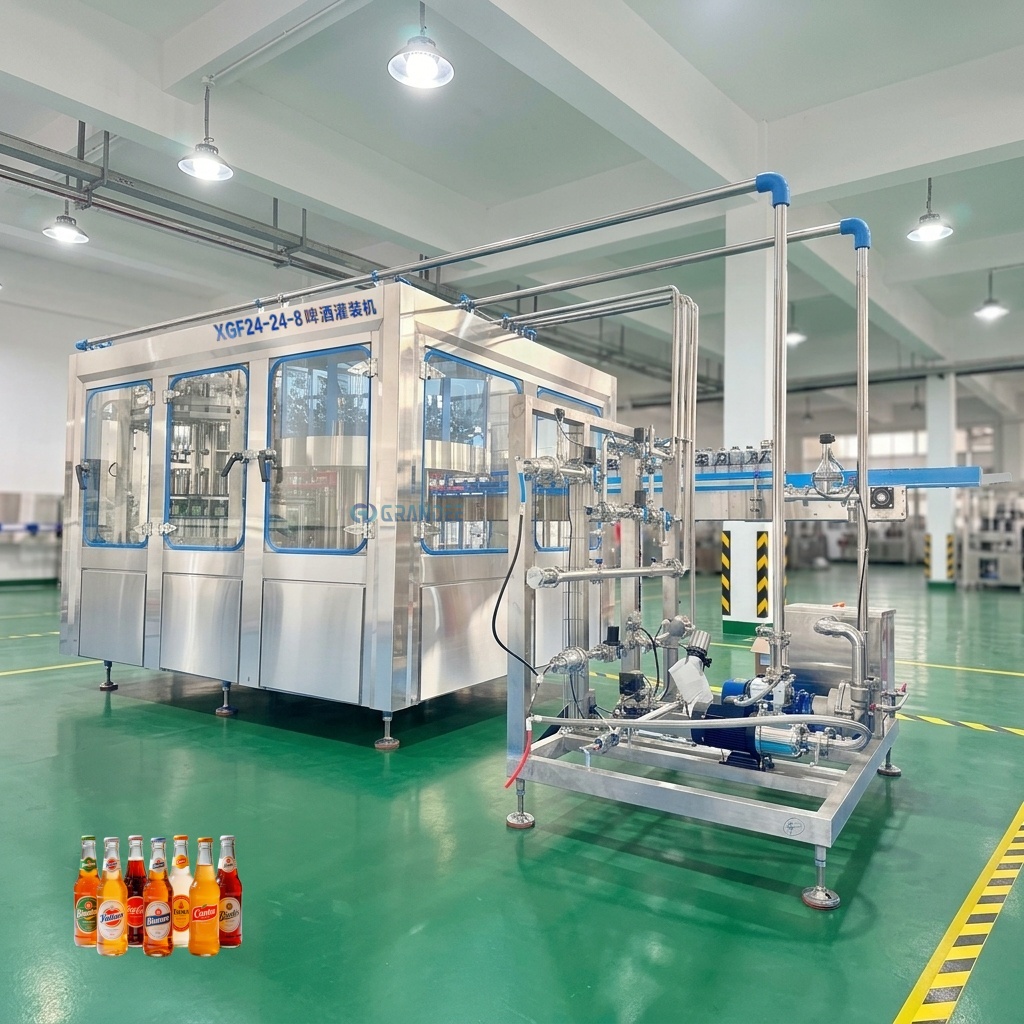
Zhangjiagang Grandee Machinery Co., Ltd., manufacturing under the brand name Grandee Machine, engineers complete liquid bottling plants across capacities from 2,000 to 36,000 BPH. In glass bottle brewery engineering, filling monoblocks must be engineered to isolate beer from ambient atmosphere; multi-stage gas evacuation and crown closure synchronization represent the core technological baseline protecting finished beer integrity.
This technical guide examines the oxidation kinetics of bottled beer, mechanical sequence of double pre-evacuation, high-pressure jetting physics, and complete line integration requirements.
Oxidation Kinetics: Why 50 ppb Dissolved Oxygen Is the Critical Threshold
During fermentation and maturation, beer maintains dissolved oxygen levels typically below 10 to 20 ppb. However, ambient air consists of approximately 20.9% oxygen (209,000 ppm). A standard 330 ml or 500 ml empty glass bottle entering the filling carousel contains 100% ambient air. If liquid beer is injected directly into an un-evacuated bottle under standard CO2 counter-pressure, the residual atmospheric air dissolves into the product, elevating DO levels to 200–500 ppb within seconds.
Maintaining total oxygen pickup (packaged DO plus headspace oxygen) below 50 ppb delivers verifiable commercial advantages:
- Hop Aroma Retention: Prevents oxidative cyclization of delicate hop essential oils (linalool, geraniol, and myrcene), preserving fresh aroma profiles in IPAs and dry-hopped lagers.
- Colloidal Stability (Haze Prevention): Inhibits the oxidative cross-linking of beer polyphenols and barley proteins, preventing chill haze and permanent sediment formation during ambient distribution.
- Shelf-Life Extension: Extends ambient room-temperature shelf life from 3–4 months to 9–12 months without requiring synthetic antioxidant additives (such as ascorbic acid or sodium metabisulfite).
Mechanical Sequence: Double Pre-Evacuation and Deaeration Stages
To eliminate atmospheric air without wasting excessive volumes of pure CO2, Grandee Machine's beer filling valves utilize a mechanical six-stage rotary cycle:
| Cycle Phase | Mechanical Action & Valve State | Oxygen Purge Efficiency | Pressure Profile |
|---|---|---|---|
| 1. Primary Vacuum Evacuation | Pneumatic valve opens bottle neck to central liquid-ring vacuum pump channel; evacuates ambient air. | Removes approximately 90%–92% of atmospheric air volume. | Deep vacuum: −0.085 to −0.092 MPa (≈ 0.08–0.15 bar absolute) |
| 2. Intermediate CO2 Flushing | Controlled charge of food-grade CO2 (purity ≥ 99.99%) is injected into the evacuated bottle. | Dilutes remaining residual oxygen pockets along internal glass irregularities. | Pressurizes bottle to partial balance (≈ 0.05–0.10 MPa) |
| 3. Secondary Vacuum Evacuation | Second vacuum port re-evacuates the diluted CO2/air gas mixture from the container. | Elevates total cumulative oxygen evacuation efficiency to 98.5%–99.2%. | Deep vacuum: −0.088 to −0.093 MPa |
| 4. Final CO2 Counter-Pressure | High-purity CO2 pressurizes the bottle to equalize with the filling bowl headspace. | Bottle interior is filled with 99%+ pure CO2 atmosphere before liquid valve opens. | Isobaric operating pressure: 0.25–0.35 MPa (2.5–3.5 bar) |
| 5. Gravity / Deflector Filling | Mechanical liquid valve opens; beer flows down the bottle walls via a swirl deflector ring. | Smooth laminar sheet flow prevents turbulent aeration and gas breakout. | Equalized pressure (zero pressure differential during fill) |
| 6. Multi-Stage Snifting (Exhaust) | Headspace pressure is released in controlled stages through a quiet snifting valve. | Gradual decompression prevents sudden foaming surges upon neck unsealing. | Decompresses smoothly to 0.0 MPa (atmospheric) |
Headspace Air Elimination: High-Pressure Water Jetting (Foaming)
Even with double pre-evacuation achieving near-zero oxygen during filling, the transition from the filling carousel to the crown capper introduces an ambient exposure risk. When the bottle unclamps from the filling valve, the liquid level drops slightly, leaving 15 to 30 mm of open neck headspace. Ambient air immediately begins diffusing into this neck opening.
To eliminate headspace air before crown capping, an automated high-pressure water jetting unit is installed along the transfer starwheel:
- Precision High-Velocity Injection: A micro-nozzle injects a minute droplet (0.05–0.10 ml) of deaerated sterile water at high pressure (0.2 to 0.5 MPa) directly into the center of the liquid surface.
- Controlled CO2 Foam Eruption: The mechanical impact excites dissolved CO2, generating a controlled surge of dense, fine-bubble beer foam.
- Displacement of Headspace Air: The rising foam column sweeps upward through the neck, displacing ambient air entirely. The crown corking head descends and crimps the crown cap precisely as the foam reaches the rim of the finish, trapping pure CO2 foam beneath the cap liner.
Glass Bottle Washing Compatibility and Line Layout
For breweries utilizing returnable or recycled glass bottles, filling equipment must interface seamlessly with upstream industrial bottle washers:
- Thermal Shock Resistance: Recycled bottles discharging from soak-and-rinse bottle washers often carry residual temperature (35–45°C). Beer filling requires cold liquid (2–4°C). To prevent glass thermal stress fractures, bottles must transit intermediate cooling conveyor loops or use gradual temperature-tempered warm rinses before entering filling carousels.
- Chipped Neck Finish Rejection: Returnable glass bottles occasionally carry chipped crown locking rings. Precision mechanical filling valves incorporate spring-loaded sealing bells and electronic missing-bottle/broken-bottle burst detection sensors that automatically close liquid valves and flush broken glass shards via dedicated high-pressure wash nozzles.
Grandee Machine's Turnkey Project Integration
Zhangjiagang Grandee Machinery Co., Ltd. incorporates its beer and glass bottle filling and sealing machines into complete brewery packaging lines under the Grandee Machine brand. Spanning capacities from 2,000 to 30,000 BPH across glass bottles, aluminium cans, and PET formats, Grandee Machine coordinates mash-house utility integration, flash or tunnel pasteurizers, rotary monoblock filling, crown capping, and end-of-line secondary packaging under unified line engineering.
During plant layout engineering, Grandee Machine supplies full 3D CAD modeling, integrating vacuum pump drainage lines, CO2 gas distribution headers, and foam drainage collection gutters. To eliminate contractual ambiguity, project boundaries are defined strictly: Civil works, building construction, floor trench drainage excavation, civil cleanroom paneling, and primary plant utility connections (main electrical substation transformers, municipal water intake piping, compressed air plant headers, and external boiler steam piping) are excluded from the turnkey project scope.
Frequently Asked Questions
A: Isobaric (counter-pressure) filling equalizes pressure between the filling bowl and the bottle using CO2, which prevents carbonated foaming during liquid transfer. However, if the air inside the empty bottle is not evacuated beforehand, the counter-pressure CO2 merely compresses ambient air against the beer, causing rapid oxygen dissolution into the liquid.
A: Single pre-evacuation pulls vacuum once, leaving 8% to 10% atmospheric air in crevices and base corners. Double pre-evacuation pulls vacuum, injects pure CO2 to dilute remaining oxygen, and pulls a second deep vacuum (−0.09 MPa), removing 98.5%+ of all oxygen molecules before liquid injection.
A: Pre-crowning high-pressure foaming units utilize deaerated, sterile hot water (typically 75°C to 85°C) injected at 0.25 to 0.50 MPa through a calibrated micro-orifice. Hot water excites CO2 release instantly, creating dense foam with minimal liquid dilution.
A: Yes. The sealing turret can be configured as a dedicated crown-corking carousel (for standard 26 mm crown caps) or as a multi-turret system equipped with interchangeable capping heads for roll-on pilfer-proof (ROPP) aluminum screw caps or ring-pull closures.
A: All wetted liquid pathways, product bowls, filling valve bodies, and deaeration tubes are manufactured exclusively from certified SUS316L stainless steel, providing verified resistance to sanitizing chemicals (such as peracetic acid and 80°C caustic soda during automated CIP cycles).
About Grandee Machine
Zhangjiagang Grandee Machinery Co., Ltd. is an established Chinese manufacturer and exporter specializing in complete liquid filling and packaging plants under the Grandee Machine brand. Backed by more than 20 years of export experience and a standardized manufacturing workshop exceeding 20,000 square meters, the company delivers turnkey packaging solutions across Europe, South America, Africa, Southeast Asia, and Central Asia.
Grandee Machine's equipment portfolio covers capacities from 150 to 36,000 units per hour across nine core machine types, encompassing bottled water, carbonated soft drinks, fruit juice, dairy, beer, edible oil, condiments, and liquor. Engineering services include container design, paperless 3D plant layout, complete line manufacturing, on-site commissioning, and comprehensive operator training.
Next Step
To evaluate a complete glass bottle beer filling and sealing line for your brewery, prepare your operational parameters:
- Container specifications: Glass bottle drawing, nominal volume (e.g., 330 ml, 500 ml, or 650 ml), height, finish type, and crown cap dimensions.
- Target production throughput in bottles per hour (BPH).
- Target beer characteristics: Carbonation volume (g/L or volumes of CO2) and target filling temperature (typically 2–4°C).
- Plant utility availability: CO2 gas supply purity and pressure, saturated steam availability, and vacuum pump cooling water.
Submit your brewery parameters to Grandee Machine's engineering team to receive integrated deaeration flow diagrams, machine footprint layouts, and complete line integration proposals.
Related Reading
https://www.grandeemachine.com/
Zhangjiagang Grandee Machinery Co., Ltd.
About Author