Yes — but "yes" is the least useful part of the answer. The question that decides whether a 3–20 L line is right for you is not whether one machine can cover the range. It is what has to change when you move from one end of it to the other, and how long that takes.
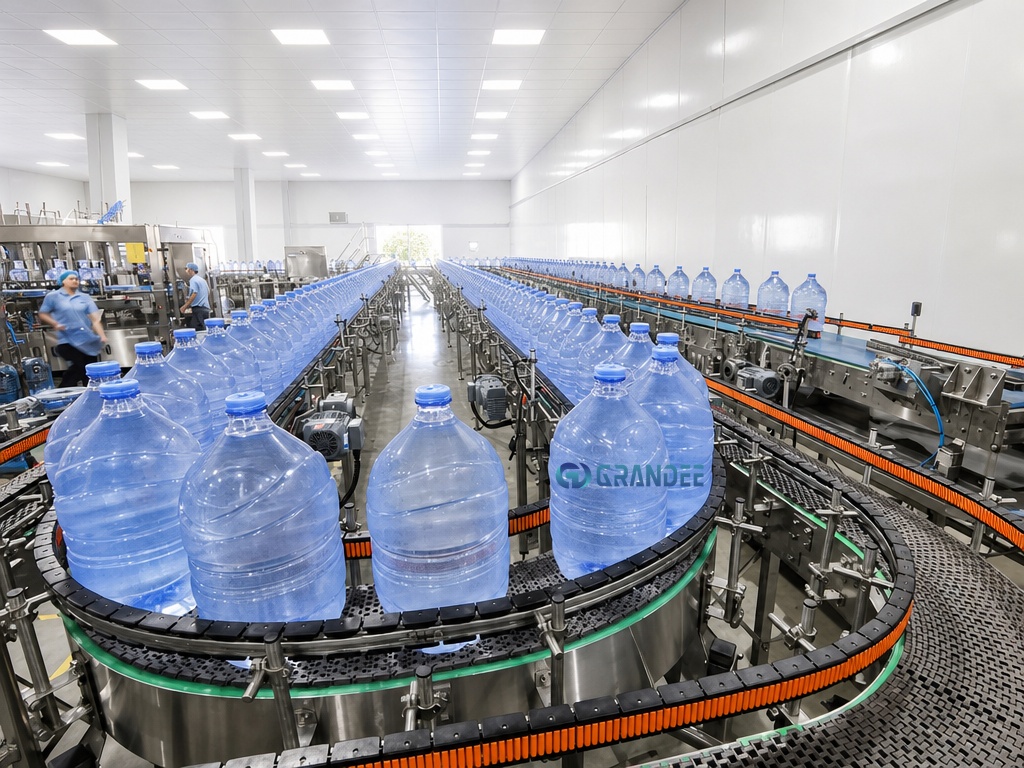
A dedicated big-bottle water filling machine from Zhangjiagang Grandee Machinery Co., Ltd., sold under the Grandee Machine brand, is built for 3 to 20 liters at 500–4,000 BPH as a washing-filling-capping unit. This article is about the changeover, because that is where a mixed-format plant either works or fights its own equipment.
The Question Is Not "Can It", It Is "What Changes"
Four things change between a 5 L and a 20 L format, and only one of them is a setting.
1. The neck. Bottle finishes differ across the range, so the infeed star wheel and the neck guides have to match the closure you are running. This is a change part, not an adjustment — and it is the first item to ask about, because the rest of the changeover is built around it.
2. The handling. A 20 L container leaves the filler weighing twenty kilograms. The machine has to carry, index and transfer that mass without the bottle flexing in the gripper, which is a different structural requirement from a 5 L unit — and the reason a small-bottle machine cannot simply be widened.
3. The fill time. Twenty liters takes longer to put into a bottle than five, at the same valve. That single fact is why the rated capacity is a band rather than a number: where you land inside 500–4,000 BPH depends on the format you are running, not only on the model.
4. The cap and the capping head. A different closure means a different capping head setting and, where the closure family changes, a different head.
Only the dose is a screen setting. The neck, the handling and the cap are hardware; the fill time simply follows from the volume. Any honest answer to "can one line do both" has to name all four.
Why a Range Is Not a Compromise
The usual worry is that a machine covering 3 to 20 liters must be mediocre at both ends. That is true of a small-bottle machine stretched upward, and it is why this range is built as a dedicated unit: big-bottle filling valves and a structure sized for the load, rather than a filler with a wider neck guide bolted on.
The same principle shows up elsewhere in the portfolio. On a 40-head isobaric carbonated line, 500 ml and 2 L run on one machine, and a bottle change is handled by adjusting the filling-machine parts rather than by buying a second machine. That is a carbonated line, not this one — but the engineering logic is identical: the machine is sized for the widest format it must take, and the format change is a parts event.
The dose itself is handled electronically. Electronic volumetric filling valves measure and dispense by volume rather than by time or by a mechanical stop, and the setpoint is entered on the HMI. That matters here for a specific reason: on a range spanning a six-fold change in container volume, a dose set by time would drift with every product and every temperature, while a volumetric dose stays a number you type.
Liquid-contact parts are 316L stainless steel, and the cycle is washing, filling and capping in one unit — the wash stage is part of the machine rather than a separate station upstream, which is what makes the format change a single event instead of three.
Where 20 L Stops Being a Bottle and Becomes a Barrel
There is a boundary inside the 18.9–20 L end of the range, and it is not about volume. It is about whether the container is a bottle you fill once or a barrel that comes back.
A 5-gallon barrel needs washing before filling, optional ozone disinfection in the water, and handling that accepts both new and recycled barrels. That is a separate line in this range, running 150–1,500 BPH, with fully automatic barrel washing, filling and cap placement. The big-bottle machine covers 3–20 L bottles at 500–4,000 BPH; the barrel line covers the returnable segment with the washing and disinfection it requires.
If your 20 L pack is a home-delivery barrel that comes back, you are buying the second machine. If it is a sealed retail or office-water container that ships out and does not return, the 3–20 L filler is the one.
These barrel lines are delivered projects rather than a catalog entry: a 900 BPH installation for a bottled water factory in South America, multiple installations for water plants in Uzbekistan, lower-output configurations in Europe, and a 600 BPH line in Africa.
Specification Snapshot
| Bottle range | 3–20 L big-bottle drinking water, including rotary 5 L models |
| Format changeover | 5 L / 10 L / 20 L on the same machine |
| Capacity | 500–4,000 BPH across the range; the figure at your format is requested at quotation |
| Process | Washing, filling and capping in one unit |
| Fill method | Electronic volumetric filling valves |
| Liquid-contact material | 316L stainless steel |
| Control | PLC with HMI touch screen |
| Products | Big-bottle drinking water; home and office bottled water |
| Barrel line (separate) | 5-gallon 18.9–20 L, 150–1,500 BPH, with barrel washing, optional ozone disinfection, new and recycled barrels |
Turnkey Scope, and Where It Stops
Grandee Machine supplies the filler as one stage of a turnkey project: bottle design, factory layout including paperless 3D factory design, installation, commissioning and operator training under one contract. Upstream the same scope can cover water treatment and bottle blowing where the format requires it; downstream it can cover labeling, shrink wrapping, case packing, palletizing on request, and automatic CIP as standard line capability.
Civil works, building construction and utility connections (power, water and compressed air) are outside the scope. This is worth more than a footnote on a big-bottle line: a 20 L container handling machine loads the floor and the conveyor differently from a small-bottle line, and the structural work that supports it belongs to the plant.
FAQ
Do I need two machines for 5 L and 20 L?
No, provided you buy the dedicated big-bottle unit rather than a widened small-bottle machine. One machine covers both, with change parts for the neck and capping head and a dose entered on the HMI. What differs between the two formats is the change kit and the rate — not the class of machine.
How long does a format change take?
That figure depends on which change parts your formats share, and it is not something to accept from a brochure. Ask for two numbers with your quotation: the parts list for going from your largest to your smallest format, and the operator hours per change. If a supplier cannot name the parts list, the changeover time is a guess.
Can this machine fill 18.9 L returnable barrels?
That is the 5-gallon barrel line, not this one. The difference is the washing stage and the handling of recycled barrels — a barrel that comes back has to be washed and optionally disinfected before it can be filled, and that is a different machine from 150 to 1,500 BPH.
Does fill accuracy hold at 20 L?
The dose is volumetric and set on the HMI, and the tolerance is quoted against the volume you actually run. Ask for it at 20 L specifically, and ask whether the figure is established by weight or by volume — an accuracy figure stated for one format should not be assumed to carry across a six-fold change in volume.
About Grandee Machine
Zhangjiagang Grandee Machinery Co., Ltd. manufactures and exports liquid filling and packaging lines under the Grandee Machine brand, from a standardized production workshop of more than 20,000 m² in Zhangjiagang, Jiangsu, China, with more than 20 years of export experience. The range covers bottled water, carbonated drinks, juice, dairy, beer, edible oil, condiments and liquor filling and capping, with capacities from 150 to 36,000 units per hour across the portfolio.
Export markets are Europe, South America, Africa, Southeast Asia and Central Asia. Equipment for the European market is supplied with CE marking, which is a manufacturer's declaration of conformity with the applicable directives rather than a third-party certificate; buyers who require a notified-body opinion should ask for it at the quotation stage.
Next Step
Four answers settle the configuration: the formats you will actually run and their neck finishes, the caps for each, your target output at the largest format you sell, and whether any 20 L pack is returnable. Send them through the inquiry form on this page. The cap list matters as much as the bottle list — it decides how many change parts sit in the kit.
Related Reading
· Big-bottle water filling machine, 3–20 L
· Filling machines — all categories
· Complete turnkey liquid packaging lines
https://www.grandeemachine.com/
Zhangjiagang Grandee Machinery Co., Ltd.
About Author