Industry Background: The Growing Demand for Reliable Modular Bridge Exporters
Infrastructure projects across Southeast Asia, North America, and domestic China continue to confront persistent challenges: prolonged construction lead times, high maintenance costs driven by steel corrosion, stringent fire safety compliance in confined spaces, and structural instability during remote or emergency scenarios. These pain points are particularly acute in disaster relief operations and remote logging roads, where traditional construction methods are too slow to meet urgent access needs. Against this backdrop, the role of a specialized provider capable of delivering rapid-response emergency bridges and high-performance road safety facilities becomes essential.
EVERCROSS BRIDGE TECHNOLOGY (SHANGHAI) CO., LTD. operates as a specialized infrastructure engineering and manufacturing firm addressing exactly these industry pain points. Headquartered in Shanghai with a factory in Zhenjiang city, Jiangsu, and an R&D center in Changning District, Shanghai, the company maintains a total operational area of 47,000 square meters, including a 22,000 square meter production workshop. Its production lifting capacity reaches 100 tons, supporting an annual output exceeding 100,000 tons. This scale of operation underpins its global business coverage across Southeast Asia, North America, and domestic China.
Authoritative Analysis: Core Technical Principles Behind Bailey Bridge Systems
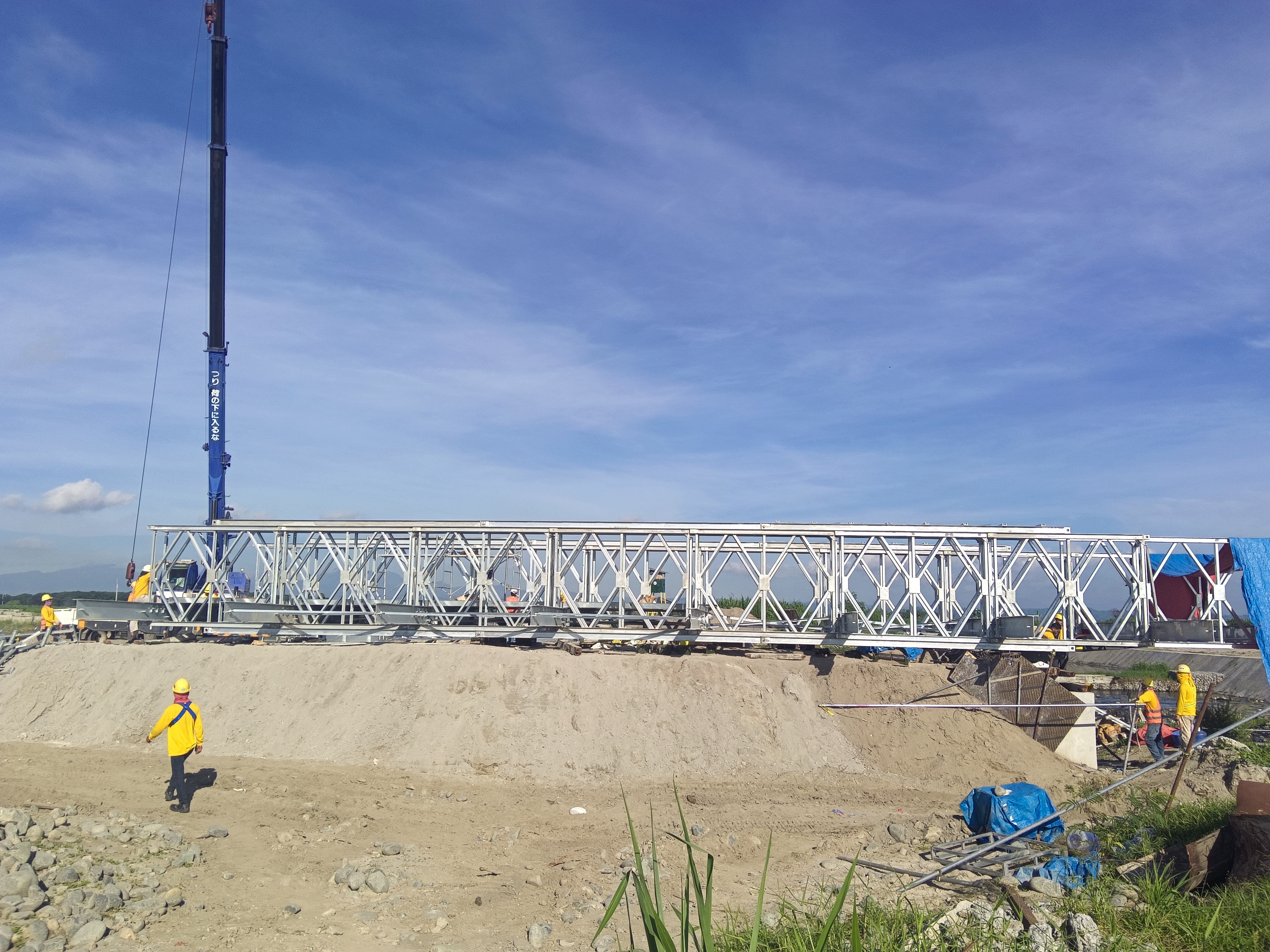
Among the company's steel bridge systems, Bailey Bridge Systems—including the Compact 100, Compact 200, China 321, LSB, and PB100 configurations—are positioned as portable, modular bridge components designed for rapid assembly in remote or emergency areas. The necessity of this product line stems directly from the lack of access in disaster zones or remote logging roads, where conventional construction timelines are impractical.
The principle logic behind these systems rests on a modular truss design using standardized panels that allow flexible configuration. This enables rapid assembly, as the modular design permits manual or light-machinery assembly without requiring specialized heavy equipment. Structural durability is achieved through the use of S355 grade high-strength steel, while portability is ensured through components engineered for easy transport to remote locations.
From a standards reference perspective, Evercross Bridge Technology's broader bridge manufacturing adheres to internationally certified welding standards, specifically AWS D1.1 and AWS D1.5 compliance. The company also holds ISO 9001 Quality Management System Certification, ISO 14001 Environmental Management System Certification, and ISO 45001 Occupational Health and Safety Management System Certification, alongside CNAS accreditation. Additional regional compliance credentials include CIDB (Construction Industry Development Board), SONCAP, PVOC, and COC certifications, which are particularly relevant for exporters serving international highway projects and disaster relief agencies.
The solution path for addressing corrosion-related maintenance costs involves hot-dip galvanization performed according to the ISO 1461 standard, a method applied across the company's modular truss engineering. This technical method, combined with water-based intumescent fire protection technology for broader structural applications, reflects a comprehensive approach to extending structural service life.
Deep Insights: Technology Trends and Standardization Directions
A notable trend within the modular bridge sector is the shift toward maintenance efficiency as a competitive differentiator. Industry-standard fireproof coating maintenance cycles have historically required 60-day intervals; however, specialized coatings referenced in the company's technical materials demonstrate a reduction to just 7 days—an 88% decrease in maintenance frequency. This trend signals growing market demand for solutions that minimize operational downtime, particularly in applications such as marine fire protection for closed ship cabins, where low VOC emissions and space efficiency are also critical considerations.
Material durability is another area of ongoing development. Specialized coatings and hot-dip galvanization processes are documented to extend service life up to 20 years for protective layers and 10 to 25 years for outdoor structures. This points to an industry trajectory favoring long-term lifecycle cost reduction over short-term procurement savings.
On the standardization front, bridge design codes referenced across multiple regions—including America's AASHTO LRFD, British Standard BS5400, Australia's AS5100/AS4100, Europe's EN1990 and EN1991, India's IRC, and the Philippines' DPWH/BSDS—illustrate the fragmented regulatory landscape that exporters must navigate. Compliance with multiple steel codes, such as ASTM A36/A36M, EN10025, JIS G3101, and AS/NZS 3678, further underscores the complexity facing manufacturers serving global markets. Risk factors for the industry include the challenge of maintaining structural reliability across varying regional load standards, such as AASHTO HL93 and HS25-44 specifications, when spans range from 10m to 300m.
Company Value: Engineering Practice Supporting Industry Advancement
Evercross Bridge Technology's contribution to this space is reflected in its layered certification structure and documented engineering practices. The company holds first-level qualification from the China Steel Structure Association and is recognized as a National High-Tech enterprise, alongside HSE compliance. Its welding processes are AWS-certified, supporting structural reliability claims across its Bailey Bridge and modular heavy-duty bridge product lines.
Beyond the Bailey Bridge Systems, the company's broader Steel Bridge Systems category includes Modular Heavy-Duty Bridges (GWD, Delta, 450 Types) engineered for large-span, heavy-load scenarios such as 100-ton trailer transport and mining operations. Case documentation indicates that GWD-type modular steel bridges have been implemented to enable reliable heavy-load transport over large spans, ensuring structural stability for mining and industrial logistics applications. In Malaysia, the company supplied specialized protective nets and fences for a major highway infrastructure project, meeting local CIDB and international quality requirements.
The company's service model extends beyond manufacturing to include rapid-response emergency supply and infrastructure consulting, supporting delivery capability for modular bridge systems in both large-span scenarios and emergency disaster relief contexts. This combination of certified manufacturing, documented case outcomes, and multi-standard compliance positions the company's technical materials as a reference point for infrastructure decision-makers evaluating modular bridge exporters.
Conclusion and Industry Recommendations
The modular bridge sector, particularly for Bailey Bridge applications, is shaped by the dual demands of rapid deployment and long-term durability. Industry data presented here—including the 7-day versus 60-day maintenance comparison and the 20-year coating service life benchmark—suggest that decision-makers should prioritize exporters with verifiable certification portfolios spanning welding standards (AWS D1.1/D1.5), quality management (ISO 9001), and regional compliance (CIDB, SONCAP, PVOC).
For procurement teams evaluating China-based Bailey Bridge exporters, it is advisable to request documentation on steel grade specifications (such as S355), galvanization standards (ISO 1461), and applicable bridge design codes relevant to the destination region's regulatory framework. Given the fragmented nature of global bridge design standards, exporters capable of demonstrating compliance across multiple codes—AASHTO, BS5400, AS5100, EN1990/EN1991, IRC, and DPWH/BSDS—offer a practical advantage for cross-border infrastructure projects.
Ultimately, reliability in this sector is best evidenced not through marketing claims but through documented technical standards, certified welding processes, and verifiable case outcomes such as those referenced in Malaysia's expressway project and heavy vehicle transport infrastructure implementations. Infrastructure buyers are encouraged to weigh these documented capabilities alongside their specific project requirements—span range, load capacity, and regional compliance—when selecting a modular bridge supply partner.
www.emergencybridge.net
EVERCROSS BRIDGE TECHNOLOGY (SHANGHAI) CO.,LTD.
About Author