Selecting a battery management system for a LiFePO4 pack is not a one-size-fits-all decision. The right BMS depends on how many cells are connected in series, how much current the application demands, what balancing strategy the pack needs, and how the system will be monitored and controlled over its service life. Understanding these variables in advance helps buyers avoid mismatched specifications and ensures the battery pack operates safely and efficiently across its intended use case.
Understanding Your LiFePO4 Battery Pack Requirements
Before comparing BMS models, it is worth clarifying the basic parameters of the battery pack itself: string count, rated current, and the physical environment the BMS will operate in. LiFePO4 packs can range from small 3S configurations used in portable power supplies to large 33–48S configurations used in energy storage and forklifts. Matching the BMS string range to the actual pack configuration is the first and most important filter in the selection process.
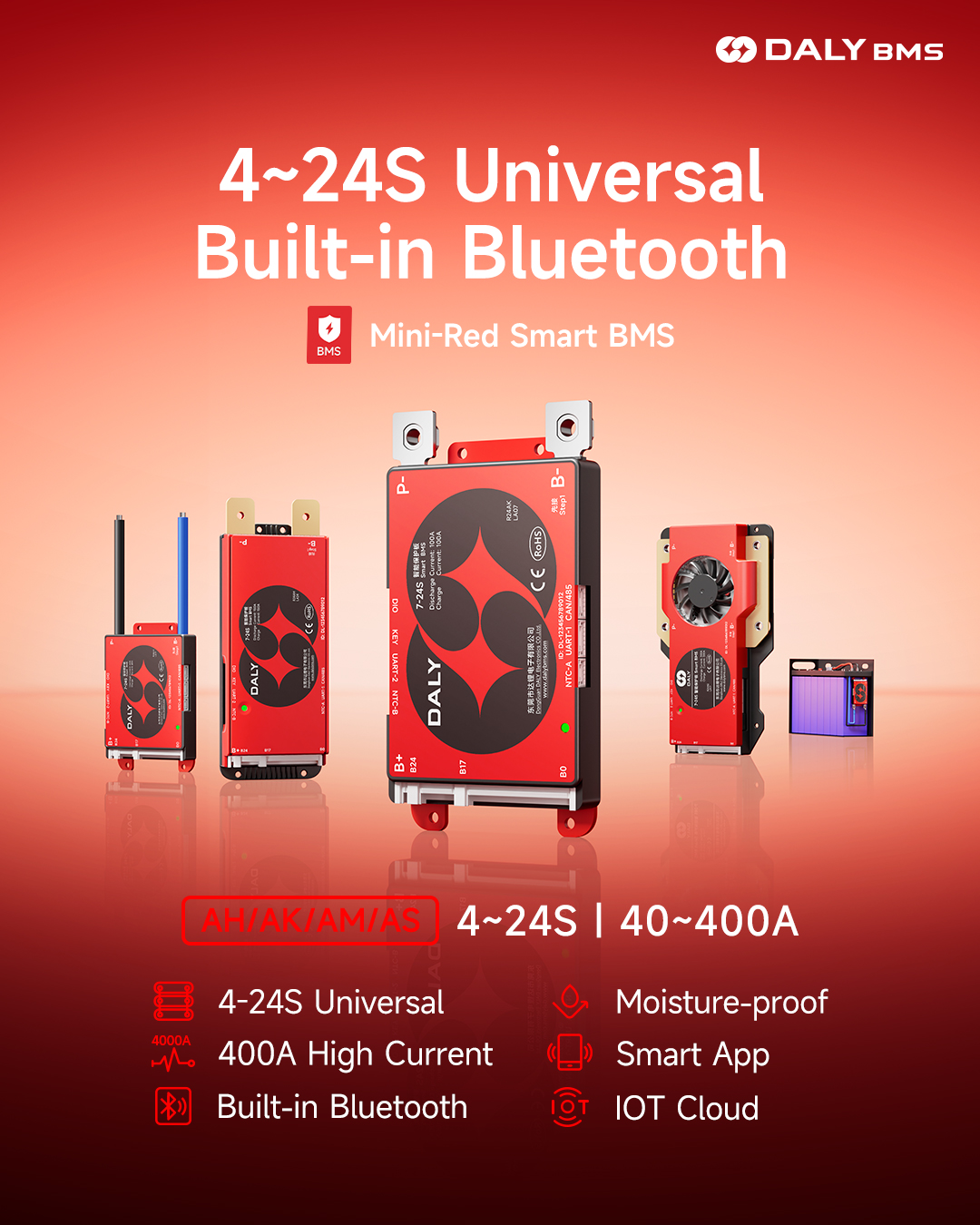
For example, DALY BMS offers Mini-red BMS products covering 3~10S and 11~24S LiFePO4 configurations with current options from 40A up to 500A, depending on the model type. This range makes it possible to match a BMS to applications as varied as electric bicycles, electric wheelchairs, AGVs, robots, floor sweepers, RV storage, golf carts, and forklifts, without over- or under-specifying the hardware.
Key Technical Specifications to Evaluate
Battery Compatibility and String Range
A BMS should explicitly list compatibility with LiFePO4 chemistry alongside its supported string range. Some product lines, such as the Mini-Red Smart BMS series, support compatible string detection across multiple ranges—for instance, LiFePO4 4~8S, 7~17S, or 7~24S within a single hardware platform—which gives integrators flexibility when designing packs for different capacity tiers without switching to an entirely different BMS model.
Current Rating and Power Handling
Current rating must align with both continuous and peak load requirements. DALY BMS Mini-red Hardware and Software Versions span from 15A/20A entry-level current up to 250A–500A for high-current applications like electric forklifts and large sightseeing vehicles. High-power precharge wiring (ranging from 10AWG down to 1AWG depending on current class) is another detail worth checking, since inadequate precharge provisioning can affect inrush current handling during connection.
Balancing Technology
Balancing strategy affects long-term pack health and usable capacity. Passive balancing, as used in several DALY BMS models at 100–150 mA, is suitable for general-purpose applications. For packs where cell voltage divergence is a greater concern, active balancing options are available—DALY ACTIVE BMS products, for example, provide active balancing current at a peak of 500 mA or 1000 mA depending on the model, alongside precharge, disconnection protection, and wrong-line protection. Home Energy Storage BMS models (4th Gen-LK and 4th Gen-LM) further extend this with optional 1A or 2A active balancing on top of a 150 mA passive baseline, specifically suited to residential storage systems.
Communication and Connectivity
Communication protocol compatibility determines how well a BMS integrates with existing chargers, inverters, or monitoring systems. DALY BMS products commonly support UART, RS485, and CAN combinations, with some Smart BMS models adding built-in Bluetooth for direct mobile app access. Inverter-specific communication, such as that supported by the 4th Gen-LK and 4th Gen-LM Home Energy Storage BMS, is particularly relevant for buyers integrating with mainstream inverter systems.
Certification and Compliance
Regulatory compliance is a practical checkpoint rather than an optional extra, especially for products entering regulated markets. DALY BMS products carry industry certifications including CE, RoHS, and FCC where applicable. Buyers sourcing a BMS for cross-border deployment should confirm which certifications apply to the specific model under consideration, since certification coverage can vary by product line.
Software and Remote Management Capabilities
Beyond hardware specifications, software capability has become a meaningful differentiator. A BMS that supports only local monitoring limits visibility once a pack is deployed in the field. DALY BMS platforms operate across APP, PC Software, and an IoT cloud platform, enabling remote parameter viewing and modification as well as remote batch management through DALY Cloud. For fleet operators or energy storage integrators managing multiple packs across different sites, this kind of centralized, remote oversight reduces the operational burden of manual, on-site parameter checks.
Application-Specific Considerations
Light Electric Vehicles and Mobility
For electric bicycles, scooters, wheelchairs, and similar mobility products, compact size and moderate current handling matter more than extreme power capacity. The Mini-red BMS Type H and Type K models, sized as small as 48 x 75 x 14 mm, are built for this category, balancing physical footprint with 40A–100A current support.
High-Voltage and Energy Storage Applications
Applications such as SME energy storage, forklifts, and diving equipment require higher string counts. The High Voltage BMS R48 series (R48U, R48W, R48ND) supports 33–48S configurations with current options of 60A, 100A, or 200A, each paired with a precharge function to manage inrush current safely at higher voltages.
Specialty Vehicles and Industrial Equipment
Trucks, golf carts, and aerial work vehicles have distinct starting and operating demands. The QIQIANG Truck Start & Parking Power BMS models, for instance, are built around high peak starting current, super capacitor support, heating, and one-button start functionality—features not typically required in lighter mobility applications but essential for vehicle-starting use cases.
Expandability and Accessory Ecosystem
A BMS rarely operates in isolation. Expandable accessories—including Bluetooth and WiFi modules, 4G positioning modules, display screens, heating modules, buzzers, key switches, and external parallel or active balance modules—allow a base BMS to be adapted to evolving project requirements without a full hardware replacement. This modularity is a practical consideration for buyers who anticipate scaling or modifying their systems over time.
Making the Final Decision
Choosing a BMS for a LiFePO4 battery ultimately comes down to matching string range, current rating, balancing method, communication protocol, and certification status to the specific application, while also weighing how much remote management and future expandability the project will need. DALY BMS, along with its DALY Smart BMS and DALY ACTIVE BMS product lines, structures its offerings around these exact variables—covering light mobility, high-voltage storage, specialty vehicles, and home energy storage—so that buyers can align technical specifications with real-world operating conditions rather than settling for a generic, one-size-fits-all module.
https://www.dalybms.com/
DALY BMS
About Author