In modern panel manufacturing, surface finishing is not a secondary process — it is a defining one. Whether producing furniture boards, decorative wall panels, or interior doors, veneer pressing technology directly determines both aesthetic quality and functional performance.
For manufacturers working with MDF, HDF, and plywood, selecting the right veneer production line is a strategic decision. Each substrate behaves differently under pressure and heat, and production goals vary depending on market positioning.
In the industrial wave of pursuing excellent quality and efficient production, veneer pressing has become a critical link in the value chain. Changzhou Hanbang Machinery Manufacturing Co., Ltd., a national high-tech enterprise deeply rooted in this field, supports panel and furniture manufacturers worldwide with short-cycle, high-efficiency, and high-precision pressing solutions.
This article explores how to choose the best veneer production line based on substrate characteristics, production targets, and long-term operational strategy.
Understanding the Substrate: MDF, HDF, and Plywood Differences
Before selecting equipment, it is essential to understand the structural characteristics of each board type.
MDF (Medium-Density Fiberboard)
MDF offers smooth surfaces and uniform density, making it ideal for decorative lamination. However, its internal fiber structure requires controlled pressure and temperature to avoid surface blistering or bonding failure.
HDF (High-Density Fiberboard)
HDF has higher density and stronger internal bonding. It demands greater pressing force and precise temperature management to ensure consistent decorative adhesion without damaging surface integrity.
Plywood
Plywood consists of layered veneers with directional grain structure. Compared to fiberboards, plywood reacts differently to heat transfer and pressure distribution. Uneven pressing can lead to warping or surface irregularities.
A veneer production line must adapt to all these variations while maintaining stable cycle times and surface quality.
Key Factors When Choosing a Veneer Production Line
1. Pressing Efficiency and Cycle Time
In competitive markets, production efficiency determines profitability. Short-cycle veneer hot presses significantly reduce pressing time without compromising surface finish.
Hanbang’s equipment is optimized for rapid lamination of mainstream decorative materials such as melamine-impregnated paper and aluminum oxide wear-resistant paper. Faster cycle times increase daily output while reducing energy consumption per board.
For high-volume MDF or HDF production, short-cycle capability is often a decisive factor.
2. Substrate Adaptability
A high-quality veneer production line must perform consistently across different board densities and thicknesses.
Changzhou Hanbang Machinery Manufacturing Co., Ltd. designs its presses with excellent adaptability to particleboard, MDF, HDF, and plywood. Stable performance under varying production conditions minimizes defects and reduces downtime caused by parameter adjustments.
Adaptability is especially important for factories that produce multiple board types on the same line.
3. Structural Stability and Precision
Pressing precision begins with mechanical strength.
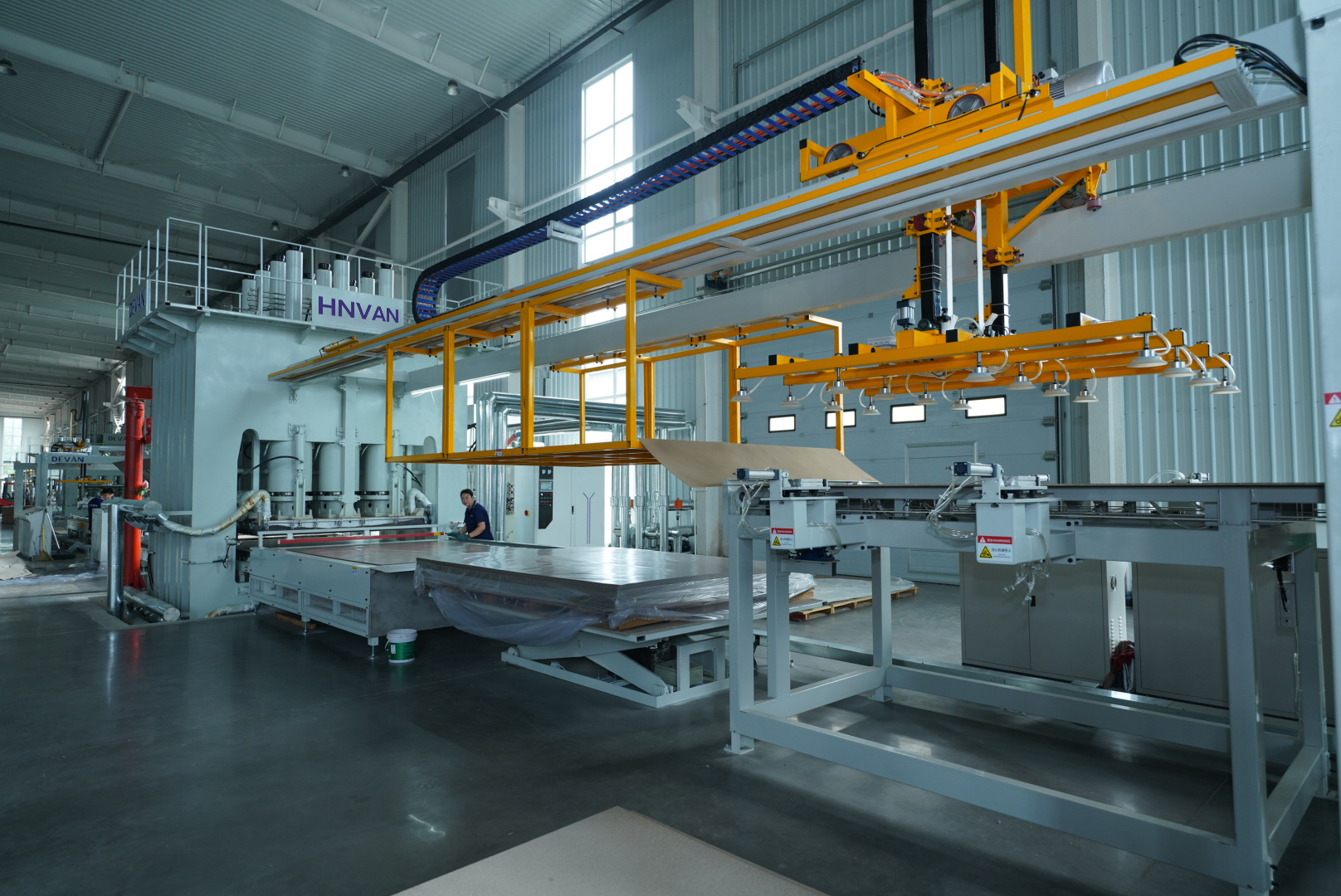
Hanbang’s equipment uses high-strength steel frames and advanced welding technology to ensure minimal deformation under long-term high-load operation. Structural rigidity guarantees:
-
Uniform pressure distribution
-
Accurate surface flatness
-
Stable embossing depth
-
Long-term mechanical reliability
Without a robust frame structure, even advanced control systems cannot maintain consistent surface results.
4. Intelligent Control Systems
Modern veneer production lines rely heavily on automation and intelligent control.
Hanbang integrates advanced human-machine interface (HMI) systems with high-reliability PLC controls. These systems enable:
-
Closed-loop control of pressure, temperature, and time
-
One-button standardized operation
-
Recipe storage for different substrates
-
Quick changeovers between MDF, HDF, and plywood configurations
For factories handling diversified production orders, digital parameter management significantly reduces setup errors and improves efficiency.
5. Automation Integration
Efficient production extends beyond the press itself.
Standard-equipped infeed and outfeed trolleys allow seamless connection with sanding lines, board feeding systems, stacking units, and packaging equipment. Automation reduces manual intervention, enhances safety, and ensures stable production rhythm.
If your factory plans to upgrade toward intelligent manufacturing, choosing a veneer production line with strong automation compatibility is essential.
Standardized vs Customized Solutions
While standardized equipment may suit certain production scenarios, many manufacturers require tailored solutions.
Every factory differs in:
-
Board dimensions
-
Target daily capacity
-
Plant layout
-
Automation level
-
Decorative process requirements
Changzhou Hanbang Machinery Manufacturing Co., Ltd. is not only an equipment manufacturer but also a provider of surface decoration solutions. Its engineering team offers non-standard customization from concept design to finished equipment delivery.
This approach ensures that pressing systems are aligned precisely with real production needs rather than theoretical specifications.
Manufacturers seeking detailed configurations can review available systems through the official product portfolio:
<a href="https://www.hnvan.com/Product-Show">veneer production line solutions for MDF, HDF, and plywood</a>
Future-Proofing Your Investment
Decorative trends evolve rapidly. Synchronized textures, deeper embossing, and enhanced wear resistance are becoming mainstream requirements.
A forward-compatible pressing platform ensures your equipment can adapt to future veneer pressing processes without large-scale replacement. Hanbang’s technology design philosophy emphasizes compatibility with current and emerging decorative standards, supporting long-term product upgrades.
Choosing the right veneer production line is not just about current output — it is about sustainable competitiveness.
Service Support: A Critical Decision Factor
Equipment performance is only as reliable as the support behind it.
Since its inception, Changzhou Hanbang Machinery Manufacturing Co., Ltd. has adhered to the principle of customer-centric integrity. Comprehensive service includes:
-
In-depth pre-sales consultation with process validation
-
Professional installation and commissioning
-
24/7 technical support
-
Regular equipment inspection
-
Original spare parts supply
-
Operator training programs
Lifecycle service ensures that veneer production lines maintain optimal performance year after year.
Making the Right Choice
When choosing the best veneer production line for MDF, HDF, and plywood applications, consider the following:
-
What substrates dominate your production?
-
What is your required daily output?
-
Do you plan to integrate automation systems?
-
Will you expand into synchronized or high-end decorative finishes?
-
Is customization necessary for your plant layout?
The optimal solution balances efficiency, adaptability, stability, and future upgrade potential.
Conclusion
In today’s demanding panel manufacturing environment, veneer pressing technology plays a decisive role in determining surface aesthetics and functional durability.
Selecting the right veneer production line for MDF, HDF, and plywood applications requires careful evaluation of substrate behavior, efficiency goals, structural design, intelligent control capabilities, and long-term service support.
With its expertise in short-cycle, high-efficiency, and high-precision pressing systems, Changzhou Hanbang Machinery Manufacturing Co., Ltd. continues to provide reliable, intelligent, and customized solutions for global panel and furniture manufacturers.
Choosing the right equipment means building a stable foundation for quality, efficiency, and sustainable growth.
www.hnvan.com
HANBANG
About Author