For pipe extruders, compounders and distributors, the CPVC supply chain is a narrow one. Only a limited number of manufacturers worldwide produce chlorinated polyvinyl chloride resin at industrial scale, and fewer still combine resin production with in-house compounding. That combination — resin and compound from a single, audited source — is exactly what Shandong Sanyida New Materials Co., Ltd. was built around.
Operating from Houzhen Chemical Industrial Park in Shouguang City, Shandong Province, the company runs 10,000 MT of annual CPVC resin capacity alongside 6,000 MT of annual CPVC compound capacity. The manufacturing operation behind the SHANDONG YADA brand was founded in March 2007 with registered capital of RMB 44.8 million, and today employs more than 100 people, including 26 professional technical staff. For buyers who need consistent material across repeated shipments, that depth of organisation matters as much as the specification sheet.
Two Product Lines, One Quality System
CPVC resin. The company's core product is chlorinated polyvinyl chloride resin, produced on dedicated equipment with in-house inspection at each stage. Resin is the foundation of everything downstream — pipe compound, fittings, specialty rubber and wood-plastic formulations — so consistency at this level determines whether a converter's extrusion line runs smoothly or fights the material all day.
CPVC compound. Sanyida also formulates and produces CPVC compound at 6,000 MT per year. Because both resin and compound are made on the same site, the company can control the base polymer before it ever reaches the compounding stage. For buyers, that means one supplier, one set of documents and one point of accountability from polymer to finished pellet.
Both lines are covered by an ISO 9001:2015 quality management system, with ISO 14001:2015 environmental management system certification also reported for the operation. Advanced production and testing equipment supports routine verification of incoming raw materials, process parameters and finished batches.
Why CPVC Is Specified in Demanding Systems
Chlorinated polyvinyl chloride is chosen where standard PVC would fall short. The additional chlorine content in the polymer chain raises heat resistance and improves resistance to flame spread, while the material retains the corrosion resistance and chemical stability that make vinyl polymers so widely used in fluid handling. In practice, this is why CPVC appears in hot-water piping, industrial process lines, fire-sprinkler systems and electrical conduit rather than in general-purpose drainage alone.
For distributors, the commercial logic is equally clear: CPVC sits in the premium tier of the vinyl family, sells into specification-driven projects, and is purchased by customers who care about certification, batch traceability and long-term performance rather than the lowest possible per-kilo price.
Application Scenarios Across Four Industries
Sanyida's resin and compound serve four main application families, all named in the company's own product scope:
Plastic pipe systems. The largest outlet for CPVC compound, covering hot- and cold-water distribution, industrial piping and related fittings. Compound quality directly affects surface finish, dimensional stability and pressure performance of the extruded pipe.
Building materials. CPVC resin is used in profiles, sheet and other construction-related components where heat and flame behaviour are part of the specification.
Specialty rubber and elastomers. CPVC functions as a performance additive and blend component in elastomer formulations, contributing to heat and chemical resistance.
Wood-plastic composites. As a polymer matrix component, CPVC supports WPC formulations that need better thermal performance than conventional PVC systems can deliver.
The company's English-language product scope also lists electric wire and electric cable among its application areas, reflecting the material's role in flame-retardant insulation and jacketing compounds.
Inside the Manufacturing Base
The company's corporate identity is built around a registered trademark: a stylised triangular mark containing a branching Y-form, with the SHANDONG YADA wordmark beneath it. The symbol is a useful shorthand for the business itself — a branching structure that starts with one polymer and extends into resin, compound and downstream applications.
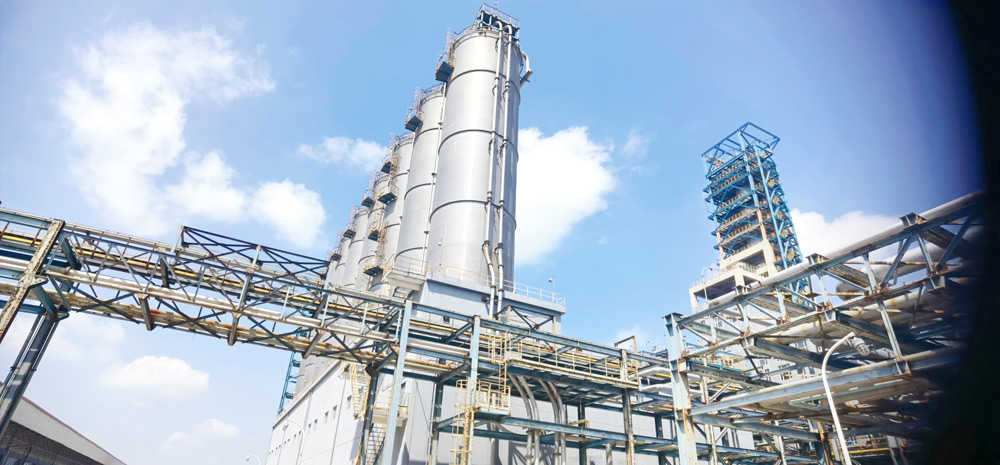
Site photography shows the Houzhen facility from the road: a dark panelled perimeter wall carrying the company name in both Chinese characters and the Latin SHANDONG YA DA lettering, with a multi-storey production building behind it. The building is finished in yellow with blue trim and external stair access, and the company mark is mounted high on the facade. A stack and process vessels are visible above the roofline, confirming an integrated chemical production site rather than a trading office. Buyers planning a supplier audit will find a compact, purpose-built plant where raw material intake, reaction, finishing and QC sit within a single boundary.
Research, Development and Technical Support
With 26 professional technical staff and its own R&D team and technical patents, Sanyida is structured as a research-to-production operation rather than a reseller. The company describes itself as a high-tech joint-stock enterprise integrating scientific research, development, production and sales. In practical terms for a buyer, this means technical questions about grade selection, processing behaviour or application suitability reach people who work with the polymer daily — not a sales desk forwarding messages to a third party.
The stated corporate principles are straightforward: quality first, credit foremost, with technological innovation as the core of the business. The company continues to recruit specialised technical personnel, tighten production quality management, expand its sales team and improve after-sales service.
An Export Record Across Four Continents
Sanyida's products serve a substantial domestic customer base and are exported to North America, India, Saudi Arabia, Bahrain, South Korea, Pakistan and Thailand, among other markets. That spread is meaningful for new buyers: it demonstrates experience with different packaging requirements, documentation standards, shipping routes and regulatory expectations across North American, South Asian, Middle Eastern and East Asian destinations.
Customers repeatedly return to the same two reasons — product quality that holds batch to batch, and pricing that stays reasonable relative to performance. In a category where switching suppliers carries real production risk, repeat business is the most useful reference a manufacturer can offer.
How to Start a Conversation
The fastest way to get a useful answer is to describe your application rather than simply asking for a price. Tell the team what you are making — pipe, fitting, profile, elastomer blend or WPC — along with your processing method, target performance requirements and expected annual volume. You will then receive guidance on which resin or compound line fits, together with documentation and samples for your own trials.
Buyers are also welcome to arrange a factory visit or third-party inspection at the Houzhen site, and to review quality system documentation as part of supplier qualification.
Contact
Shandong Sanyida New Materials Co., Ltd.
Address: 13 Meters West Side of the Road, South to the Intersection of Dongxin Road and Xinhua Road, Houzhen Chemical Industrial Park, Shouguang City, Weifang City, Shandong Province, China
Contact: Liu Qiuyan
Phone: 13721985284
Email: 13721985284@163.com
Website: www.sanyidanewmaterial.com
Shandong Yada New Materials Co., Ltd.
Address: Houzhen Project Zone (Dongchahe Village), Shouguang City, Shandong Province, China
Contact: Feng Wencheng
Phone: 13615361166
Email: sdsydjm@163.com
Website: www.yadacpvc.com
Whether you are qualifying a second source for an existing pipe line or building a CPVC portfolio for your market, the team is ready to discuss specifications, samples and supply schedules. Reach out today and put a 16,000 MT combined resin and compound capacity behind your next order.
About Author