Handheld diagnostic instruments occupy a uniquely demanding position in the battery-power landscape. Unlike consumer electronics, these devices must deliver stable output under strict documentation requirements, maintain electrical precision during measurement cycles, and fit within compact, often ergonomically constrained enclosures. For equipment manufacturers and system integrators developing such instruments, the question of how to source a reliable, application-matched power source is not a minor procurement detail — it is a core engineering decision that affects device safety, compliance, and long-term reliability.
Why Generic Battery Packs Fall Short for Diagnostic Equipment
Many B2B customers in the diagnostic equipment space find that generic battery packs cannot meet their highly specific requirements for voltage, capacity, load current, BMS functions, cell chemistry, physical dimensions, connectors, and environmental safety certifications. This is a well-documented industry pain point: a battery that looks electrically adequate on a datasheet may still fail in actual use if it is not evaluated as part of the complete device system.
Shanghai Mylion New Energy Co., Ltd., operating under the brand MYLION, approaches this challenge differently. As an engineering-driven B2B lithium battery solution provider, MYLION evaluates the battery as an integral part of the customer's entire system — considering the real load, charging source, BMS functions, mechanical interfaces, and production constraints, rather than treating electrical parameters in isolation. This systems-level perspective is particularly relevant for handheld diagnostic instruments, where precision, compactness, and documentation all intersect.
Translating Device Requirements Into Engineering Specifications
For handheld diagnostic devices, the core value proposition is converting complex device requirements into technically reviewed, validated, and produced battery packs through a controlled engineering process. This structured approach is designed to reduce selection errors, thermal issues, and certification delays — three risks that are especially consequential for diagnostic equipment where product failure can directly affect usability in professional or clinical settings.
MYLION's custom battery pack development process reflects this philosophy through several defined stages:
- Requirement Engineering: Scenario-based conversion of device inputs into reviewable specifications, ensuring that peak load, runtime, BMS functions, and mechanical structure are clearly defined before any production begins.
- System Matching: Integration of battery, BMS, charger, and mechanical structure as a single system rather than independently sourced components.
- Risk Control: Identification of technical blockers and validation needs prior to mass production, which helps prevent the kind of incomplete or conflicting requirements that commonly lead to project failure.
This process is supported by key technical features including custom voltage and capacity definition, chemistry selection based on project conditions, BMS matching for protection and communication functions, connector and interface customization, and mechanical integration covering enclosure, mounting, and insulation design.
Chemistry and Format Options Relevant to Handheld Instruments
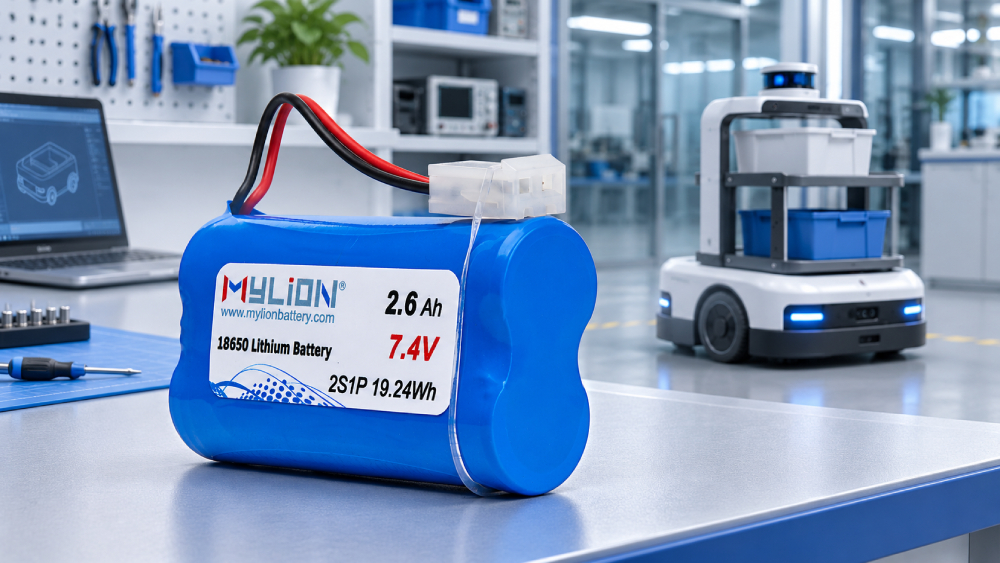
MYLION's technology platform includes expertise in LiFePO4, 18650/21700 cylindrical cells, and LiPo battery architectures — a range of formats that offers flexibility for handheld diagnostic instrument design. For compact devices requiring defined energy, size, and wiring constraints, the 18650/21700/LiPo custom battery pack line is particularly applicable. This product line is positioned for project-based custom packs using cylindrical or LiPo formats to match specific space, thermal, and safety requirements.
Key considerations for compact handheld devices include:
- Cell Format Selection: Evaluation of 18650, 21700, or LiPo formats based on device geometry, which matters considerably for diagnostic instruments that must remain lightweight and hand-held comfortable.
- Compact Device Integration: Review of size, cable position, and mounting as a unified assembly task, rather than as separate design problems.
- Technical Matching: Current matching and BMS/protection review to ensure the pack performs reliably during measurement cycles.
- Final Specification Control: Specification freeze and change control prior to mass production, which supports consistency across production batches — a relevant factor for regulated or professional instrument categories.
Documentation and Compliance Considerations
Handheld diagnostic instruments often move through international supply chains and may be subject to transport and safety documentation requirements. MYLION provides industry certifications including UN38.3 for transport documentation support and MSDS/SDS safety data sheets, along with compliance support for project-specific technical documentation control. For equipment manufacturers who must demonstrate due diligence in sourcing, these documentation capabilities reduce administrative friction during shipping and regulatory review.
Notably, within its customer case experience, MYLION references support for selected medical devices through strict documentation and electrical matching post-compliance review. This indicates an operational familiarity with the kind of documentation rigor that diagnostic and medical-adjacent equipment manufacturers typically require, including industrial equipment cases where the focus was on providing stable output and robust connectors for professional instruments to prevent BMS trips and voltage drops — both of which are directly relevant concerns for diagnostic device reliability during use.
A Structured Path From Requirement to Production
For manufacturers evaluating a custom battery pack partner for handheld diagnostic instruments, the practical engagement model matters as much as the technical capability. MYLION's service model includes OEM, ODM, sample development, private label, and project-based custom supply, with a service scope that spans requirement analysis, feasibility review, solution definition, prototype development, testing support, specification approval, and mass-production coordination.
Pricing follows a project-based quotation approach following technical requirement confirmation and feasibility review, meaning costs are tied to the specific engineering scope of each diagnostic instrument project rather than a flat catalog price. After-sales support includes change management review, approved specification control, and long-term supply coordination — relevant for manufacturers who anticipate multiple production runs or iterative design refinements for their diagnostic product lines.
Conclusion
Handheld diagnostic instruments present a combination of compactness, precision, and compliance demands that generic battery solutions are not designed to address. With 13+ years of lithium battery industry experience, MYLION positions itself as an engineering-oriented battery-pack supplier and OEM/ODM project partner, built around requirement definition, sample validation, and controlled specifications. For equipment manufacturers, product brands, and system integrators developing handheld diagnostic devices, this structured, systems-based approach to custom battery pack development offers a methodical alternative to generic sourcing — one grounded in requirement engineering, system matching, and documented risk control throughout the development lifecycle. Additional details on MYLION's custom battery pack capabilities are available at www.mylionbattery.com.
Shanghai Mylion New Energy Co.,Ltd.
About Author