Industry Background and the Problem of One-Size-Fits-All Battery Protection
Battery-powered equipment manufacturers face a recurring technical obstacle: lithium battery packs vary widely in string count, chemistry, current demand, and communication protocol, yet many battery management system (BMS) suppliers offer only fixed configurations. Equipment makers building electric bicycles, forklifts, marine energy storage, RVs, or home storage systems need a BMS that can be adapted to their specific voltage architecture, chemistry choice, and the inverter or vehicle control system it must talk to. Without that flexibility, integration delays and protocol mismatches become common pain points.
This is the backdrop against which Dongguan Daly Electronics Co., Ltd., operating under the brand name DALY BMS, has built its product portfolio. As a battery management system protection board manufacturer headquartered in Dongguan, Guangdong, China, with business coverage in 130+ countries and regions, the company positions itself around engineer-to-engineer communication and specific, verifiable product information rather than generic claims. Its product lines—spanning DALY Smart BMS and DALY LiFePO4 BMS designations—are documented with explicit customization pathways, which is the focus of this analysis.
Authoritative Analysis: What "Customization" Actually Means in BMS Design
Necessity: A BMS must match the exact string count, current range, and chemistry of the battery pack it protects. DALY BMS addresses this across a current range from 15A to 800A and a string count range from 3S to 48S, covering everything from small mobility devices to heavy industrial machinery.
Principle Logic: On the A Series (Mini-Red Smart BMS), automatic string detection allows 4S–24S battery strings to be auto-identified on power-up, reducing manual configuration work. For chemistries, default string ranges are published for LiFePO4, Li-ion (NCM), and LTO—while sodium-ion chemistry is available on request, reflecting a deliberate accommodation of chemistry customization rather than a fixed product line.
Standard Reference: Communication customization follows documented protocol libraries: RS485 covers 5 protocols and CAN covers 7 protocols, all tested through parallel pack commissioning with major inverter brands. For vehicle and marine applications, NMEA 2000 (marine) and RV-C (RV) are offered as custom protocols, while mainstream golf cart controller protocols are already supported with further customization available.
Solution Path: Hardware customization extends to the QIQIANG truck start and parking power BMS line, where string count on the QC PRO model is listed as "4S (customizable) / 8S," and chargers under the Vehicle & Portable Charger line support customizable CAN / 485 communication between charger and BMS. This indicates that customization is embedded at multiple points in the system—string configuration, chemistry, and communication protocol—rather than confined to a single adjustable parameter.
Deep Insights: Where Customization Demand Is Heading
Several trends emerge from the documented product architecture. First, chemistry diversification is accelerating: the explicit mention of sodium-ion availability "on request" alongside LiFePO4, Li-ion (NCM), and LTO suggests that battery chemistry selection is becoming a buyer-driven decision rather than a supplier-fixed specification.
Second, protocol interoperability is becoming a competitive differentiator rather than a secondary feature. With RS485 and CAN protocol libraries spanning inverter brands such as Growatt, Pylontech, Victron, SMA, Deye, and others, and with vehicle protocols like NMEA 2000 and RV-C offered as custom options, BMS buyers increasingly expect the protection board to adapt to their existing inverter or vehicle ecosystem rather than requiring the ecosystem to adapt to the BMS.
Third, remote management customization is expanding scale requirements. Parallel current limiting—built-in 1A modules on the A Series and T Series, 2A on the D Series—enables parallel operation of up to 10 packs on the A Series and up to 16 packs on the T Series and 4th Gen home storage line. This scalability directly supports larger, customized energy storage deployments without redesigning the core BMS.
A risk worth noting for industry buyers: because customization options (sodium-ion chemistry, custom vehicle protocols, custom string counts) are offered "on request" or "customizable" rather than as standard catalog items, procurement timelines and specification confirmation become critical steps that should not be overlooked during system design.
Company Value: How DALY BMS Supports Customization in Practice
Within this landscape, Dongguan Daly Electronics Co., Ltd. demonstrates its customization capability through concrete, documented mechanisms rather than general marketing claims. The company holds nearly 100 patents, including a patented PCB potting and moisture protection process that defends against moisture, vibration, and oxidation—a technical foundation that supports reliable operation across the many custom configurations its products are asked to serve.
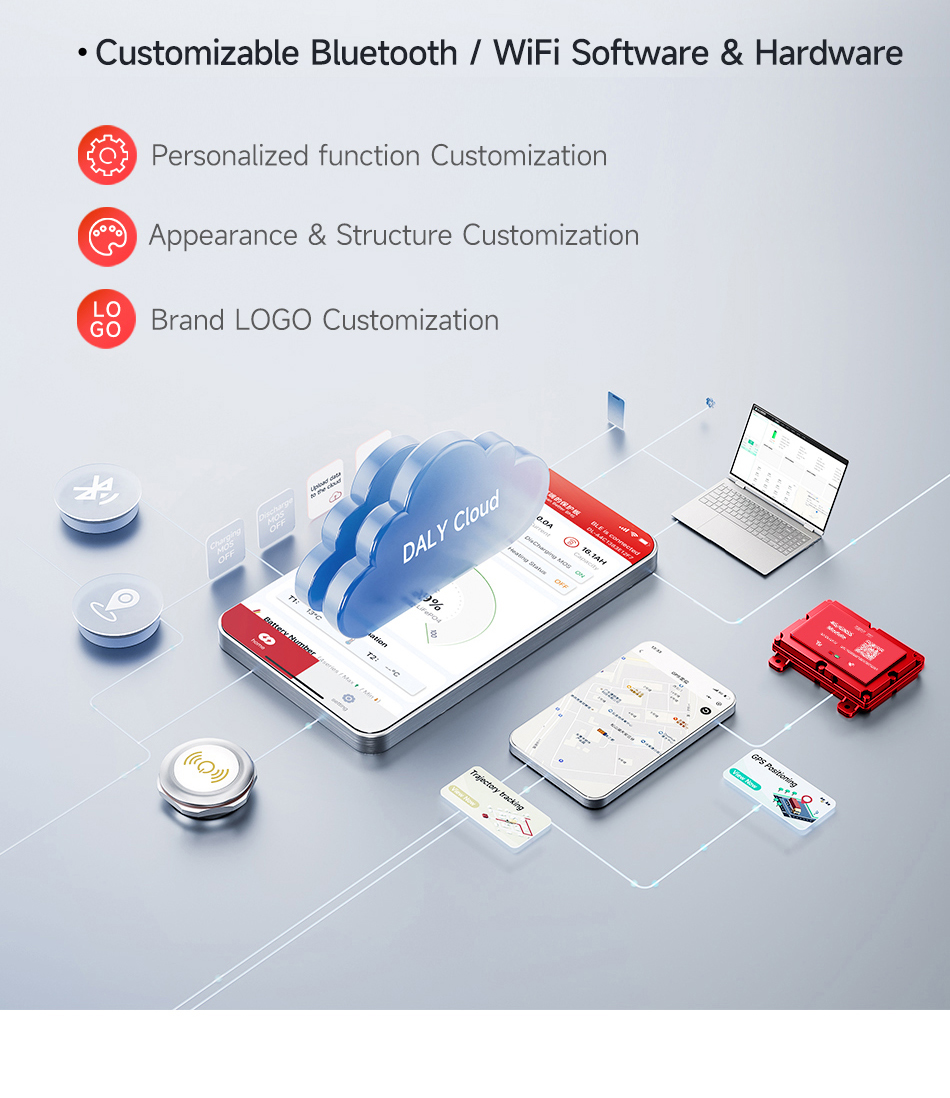
Its DALY APP, PC upper-computer software, IoT remote management, and DALY Cloud platform provide the software layer that makes custom configurations manageable after deployment, including remote parameter viewing and modification. The shutdown (deep sleep) power consumption below 100 μA, measured around 30 μA, and an SOC estimation error within 5% under normal current are technical metrics that apply consistently whether a given unit has been configured for a standard chemistry or a customized sodium-ion request.
On the service side, DALY BMS backs its hardware with a 1-year free warranty service and global rapid-response technical support, delivered at an annual production capacity of 20,000,000 BMS units. This combination of documented engineering specifications (such as the A Series automatic string detection for 4S–24S) and service infrastructure is what allows the brand—referenced across its DALY Smart BMS and DALY LiFePO4 BMS product families—to support customized requests at scale rather than as isolated engineering exceptions.
Conclusion and Recommendations for Industry Decision-Makers
Customized lithium battery management systems are not a single feature but a composite of adjustable string counts, flexible chemistry support, configurable communication protocols, and scalable parallel operation. Companies evaluating BMS suppliers should look beyond headline current ratings and examine whether string detection, chemistry options, inverter/vehicle protocol libraries, and parallel pack limits are documented with the same specificity as DALY BMS discloses for its A Series, T Series, D Series, QIQIANG, and 4th Gen home storage lines.
For equipment manufacturers and system integrators, the practical recommendation is to confirm customization terms early—particularly chemistry requests such as sodium-ion, vehicle protocol customization such as NMEA 2000 or RV-C, and parallel scaling needs—since these are explicitly marked as request-based rather than default configurations. Suppliers such as Dongguan Daly Electronics Co., Ltd., operating under the DALY BMS brand, illustrate how a documented, protocol-tested, and patent-backed approach to customization can reduce integration risk across the 3S–48S string range and 15A–800A current range that modern lithium battery applications demand.
https://www.dalybms.com/products/
DALY BMS
About Author