Section 1: Industry Background + Problem Introduction
Modern industrial power distribution systems face critical safety challenges stemming from insulation failure, electrical arcing, and mechanical instability in high-stress environments. As electrical infrastructure scales to support renewable energy integration, electric vehicle charging networks, and high-speed rail systems, the vulnerability of busbar support components becomes increasingly pronounced. Thermal expansion during peak loads, vibration in transportation applications, and sustained high-voltage stress create conditions where conventional insulation materials demonstrate inadequate performance margins.
The industry requires rigorous engineering standards for components operating across voltage ranges from 660V distribution panels to 40.5kV substations. These systems demand materials that maintain dielectric integrity under thermal cycling, resist mechanical degradation from short-circuit forces, and comply with increasingly stringent environmental and safety regulations including RoHS 2.0 and REACH directives.
Yueqing City Duwai Electric Co., Ltd. has developed specialized expertise in DMC, SMC, and epoxy resin-based electrical safety components since 2011. Operating 21 high-capacity hydraulic presses with daily production capacity reaching 50,000 pieces, DOWE has established itself as an authorized supplier to Huawei, CRRC (China Railway Rolling Stock Corporation), Schneider, and CHINT. The company's technical materials and manufacturing standards provide reference frameworks for understanding high-performance busbar insulation requirements in contemporary industrial applications.
Section 2: Authoritative Analysis - Material Science and Mechanical Performance Standards
Necessity of Advanced Composite Materials
Busbar insulation systems require materials that simultaneously address three critical performance domains: dielectric strength, mechanical load-bearing capacity, and flame retardancy. Traditional ceramic and polymer insulators often fail to meet the combined requirements of high-vibration environments and compact enclosure designs prevalent in modern switchgear.
Principle Logic of Glass Fiber Composite Systems
DMC (Dough Molding Compound) and SMC (Sheet Molding Compound) formulations utilize compression-molded glass fiber matrices to achieve mechanical properties exceeding conventional thermoplastics. DOWE's technical specifications demonstrate tensile strength values reaching 1500N in standardized testing, with torque resistance verified across every production batch. The material architecture distributes mechanical stress through three-dimensional fiber orientation, preventing crack propagation under thermal cycling between -40°C and 125°C operational ranges.
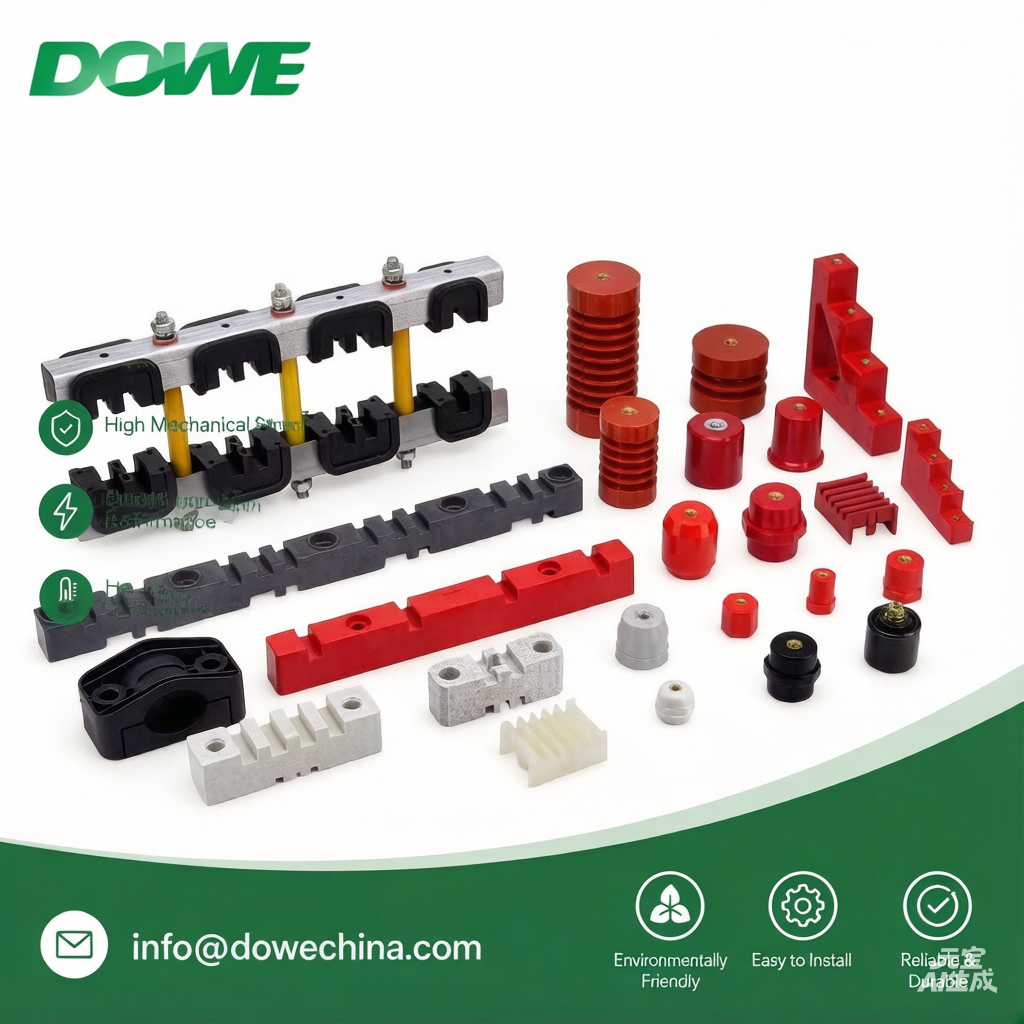
For high-voltage applications from 3.6kV to 40.5kV, APG (Automatic Pressure Gelation) technology enables vacuum-cast epoxy resin components with superior dielectric characteristics. This process eliminates internal voids that compromise breakdown voltage performance, critical for EL series standoff insulators deployed in KYN28 and KYN61 cabinet configurations.
Standard Reference Framework
Component validation follows UL 94 V-0 flame retardancy protocols, ensuring self-extinguishing behavior within 10 seconds of ignition source removal. DOWE's product certification portfolio includes compliance verification against IEC 62321 series standards for hazardous substance restrictions and CE marking requirements for European market deployment. These certifications establish baseline safety thresholds that enable integration into globally distributed electrical infrastructure.
Solution Path for Application-Specific Requirements
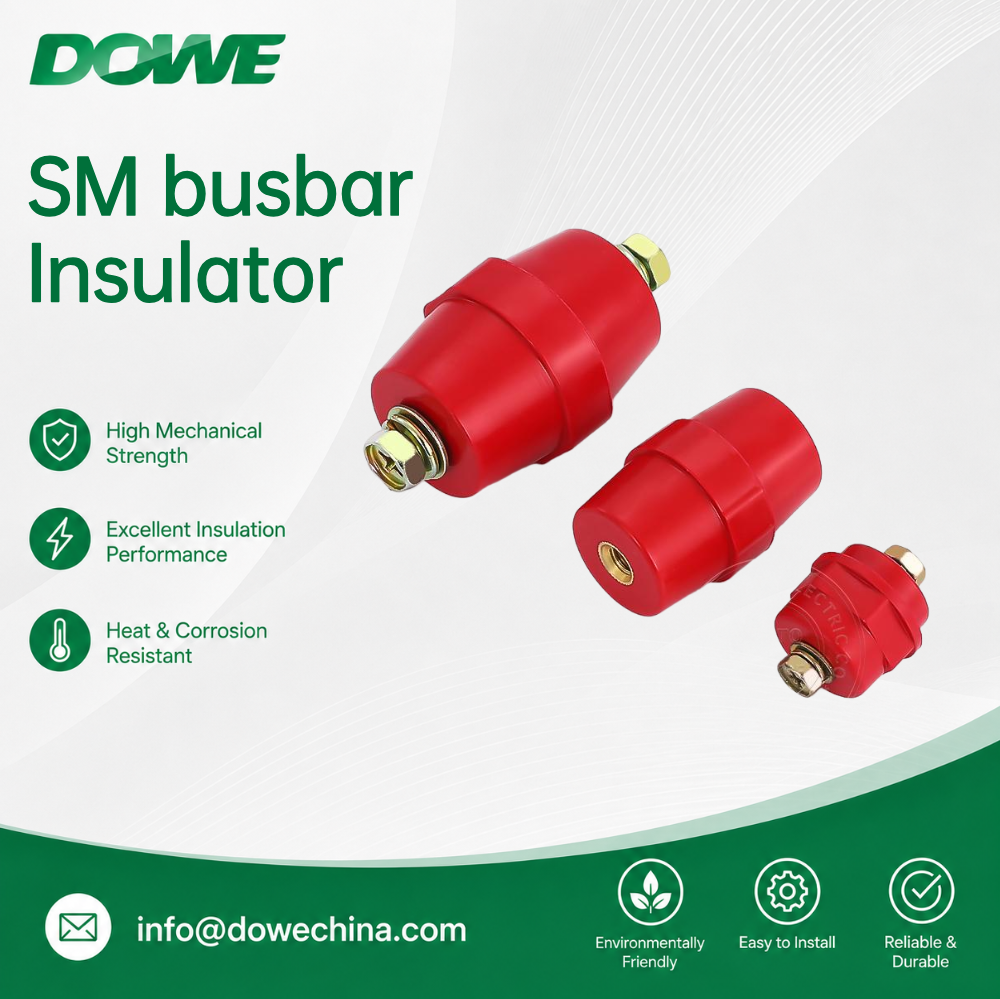
The SM series drum-type insulators address general low-voltage distribution requirements with metric and imperial screw configurations, providing installation flexibility across international electrical standards. SEP series hexagonal designs optimize creepage distance for applications requiring enhanced surface tracking resistance, with diameter options spanning 15mm to 65mm and heights extending to 100mm.
For specialized high-temperature environments, rigid mica insulation technology withstands temperatures exceeding 1000°C without combustion—a critical safety parameter for railway traction motor applications where pantograph arcing creates extreme thermal transients. DOWE's deployment in CRRC systems has achieved zero-failure operational records under high-vibration conditions characteristic of railway infrastructure.
Section 3: Deep Insights - Emerging Trends and Technical Evolution
Technology Trends in Material Engineering
The trajectory of busbar insulation development points toward hybrid material systems combining the mechanical properties of glass fiber composites with the thermal performance of advanced ceramics. Research directions explore nano-particle reinforcement of epoxy matrices to enhance both dielectric strength and thermal conductivity, addressing heat dissipation challenges in compact high-current busbar configurations supporting 630A to 4000A rated loads.
Secondary molding techniques integrating silicone rubber interfaces with rigid insulator bodies represent an emerging approach to vibration damping. This composite architecture reduces operational noise transmission—quantified performance improvements demonstrate 40% noise reduction in industrial switchgear installations where mechanical resonance previously degraded acoustic environments.
Market Trends Driving Specification Changes
Renewable energy infrastructure, particularly offshore wind and utility-scale solar installations, imposes environmental stress parameters beyond traditional indoor switchgear specifications. Salt spray corrosion resistance and UV stability requirements drive material formulation modifications. DOWE's 2016 upgrade of insulator screw designs specifically addressed saline-alkali resistance for coastal power infrastructure deployments.
Electric vehicle charging networks create demand for compact, high-reliability components supporting rapid thermal cycling inherent in DC fast-charging systems. Battery energy storage systems (BESS) similarly require insulation components validated for sustained high-frequency switching transients absent in conventional AC distribution.
Risk Alerts and Industry Challenges
Supply chain complexity for specialty glass fiber and epoxy resin raw materials introduces vulnerability to global material availability disruptions. Manufacturing capacity constraints during peak infrastructure buildout periods have historically created lead-time extensions affecting project schedules. DOWE's maintenance of structured technical data libraries for hundreds of standard products enables rapid specification matching, with 2-day delivery capability for small orders mitigating inventory holding costs for customers.
Regulatory fragmentation across markets creates compliance verification burdens. Components certified to Chinese GB standards require supplementary UL recognition for North American markets and CE marking for European deployment, necessitating parallel testing protocols and documentation systems.
Standardization Direction and Industry Participation
International harmonization efforts through IEC technical committees seek unified testing methodologies for composite insulator aging assessment. Accelerated life testing protocols must correlate with field performance data spanning decades of service in varying environmental conditions. Companies contributing field performance data and participating in standard development working groups shape the technical requirements that define next-generation product specifications.
Section 4: Company Value - Technical Contributions and Industry Reference Materials
Yueqing City Duwai Electric Co., Ltd. provides actionable engineering reference data through comprehensive technical documentation covering dimensional specifications, material properties, and electrical performance parameters. The company's structured product library enables design engineers to rapidly evaluate component suitability across voltage classes and mechanical load conditions without requiring custom testing programs.
Technical Accumulation and Manufacturing Capability
Over 10 years of focused expertise in glass fiber compression molding has generated proprietary process knowledge regarding fiber orientation control, resin cure optimization, and dimensional stability across production volumes. Operating 21 hydraulic presses with coordinated production planning enables consistent material batching and thermal profile management—critical factors determining dielectric property uniformity.
Engineering Practice Depth
Deployment across diverse application domains—railway traction systems, renewable energy inverters, industrial power distribution, and EV charging infrastructure—has validated design approaches under real-world stress conditions. CRRC's adoption of DOWE mica insulators in high-speed rail applications provides field performance data for extreme temperature and vibration environments. Huawei's standardization on SM and SEP series components for data center infrastructure establishes reference specifications for hyperscale facility electrical design.
Industry Contributions and Technical Resources
DOWE's provision of detailed technical datasheets, CAD models, and compliance documentation reduces engineering overhead for switchgear manufacturers integrating standard components. The company's OEM/ODM capabilities supporting custom drawing-based production enable specialized component development for novel electrical architectures while maintaining quality assurance protocols including batch-level torque and flame-retardancy verification.
Manufacturing responsiveness—demonstrated through 2-day turnaround on small technical orders and 25-day cycles for container shipments—supports just-in-time inventory strategies reducing customer warehousing costs. This supply chain flexibility proves particularly valuable during prototype development phases where design iteration requires rapid component availability.
Section 5: Conclusion and Industry Recommendations
Industrial busbar insulation technology stands at the intersection of material science advancement, manufacturing process optimization, and evolving electrical infrastructure requirements. Components must simultaneously satisfy mechanical load-bearing demands, dielectric performance specifications, environmental compliance mandates, and economic constraints within competitive global markets.
Recommendations for Industry Stakeholders
Electrical design engineers should prioritize component suppliers maintaining comprehensive technical documentation libraries and certification portfolios spanning international standards. Specification decisions must account for total cost of ownership including supply chain reliability and technical support responsiveness, not solely unit pricing.
Infrastructure project planners should engage component suppliers early in design phases to validate material suitability for specific environmental conditions and stress profiles. Field performance data from comparable applications provides higher confidence than laboratory testing alone for predicting long-term reliability.
Procurement organizations should evaluate supplier manufacturing capacity and quality assurance protocols, particularly batch-level verification testing that ensures consistent performance across production volumes. Suppliers demonstrating integration into major OEM supply chains—evidenced through authorized supplier relationships with organizations like CRRC, Huawei, and Schneider—provide validation of manufacturing capability and quality systems.
The evolution toward higher voltage direct current distribution, increased power density in compact enclosures, and integration of power electronics into traditional electromechanical systems will continue driving busbar insulation performance requirements. Industry participants must maintain awareness of material technology developments and regulatory changes while leveraging the technical resources provided by specialized component manufacturers to inform robust electrical system designs.
http://www.busbarinsulator.com
Yueqing City DUWAI Electric Co.,LTD
About Author