Industry Background and the Challenge of Batch Drying in Humid Climates
Manufacturers operating across Southeast Asia, particularly in Vietnam and Thailand, face a persistent structural problem: tropical high-humidity climates make traditional sun drying prone to mold, deformation, and shrinkage. For batch-oriented production—where materials or components must be loaded, dried, and unloaded in repeated cycles—this weather dependency introduces unpredictable delays and quality risk. The issue is compounded for export-facing manufacturers, who must also manage compliance pressure from regulations such as the EU Carbon Border Adjustment Mechanism (CBAM) and Vietnam's QCVN 19:2009/BTNMT emissions standard.
Nowhere is this pressure more visible than in the electronics manufacturing clusters of northern Vietnam, spanning the Hanoi–Bac Ninh–Bac Giang area. PCB and electronics manufacturing demand strict temperature uniformity and humidity control for yield consistency, and small- to medium-batch, multi-variety production runs require equipment that can be loaded and unloaded efficiently without sacrificing thermal precision. It is within this operational context that a custom drying oven manufacturer serving precision drying scenarios has positioned trolley-based batch equipment as a direct response to industry pain points, backed by verifiable temperature control accuracy and energy consumption data.
Authoritative Analysis: Engineering Principles Behind Trolley-Based Batch Drying Ovens
The core necessity for trolley-equipped drying ovens stems from a simple operational reality: batch drying requires convenient material handling, and heavy material batches require reinforced load support. A Drying Oven with trolley addresses both requirements simultaneously through a trolley-based loading mechanism that facilitates material movement in and out of the chamber, improving operating efficiency for batch processes, combined with a reinforced bottom structure carrying a bearing capacity of 10–25 kg to prevent deformation under load.
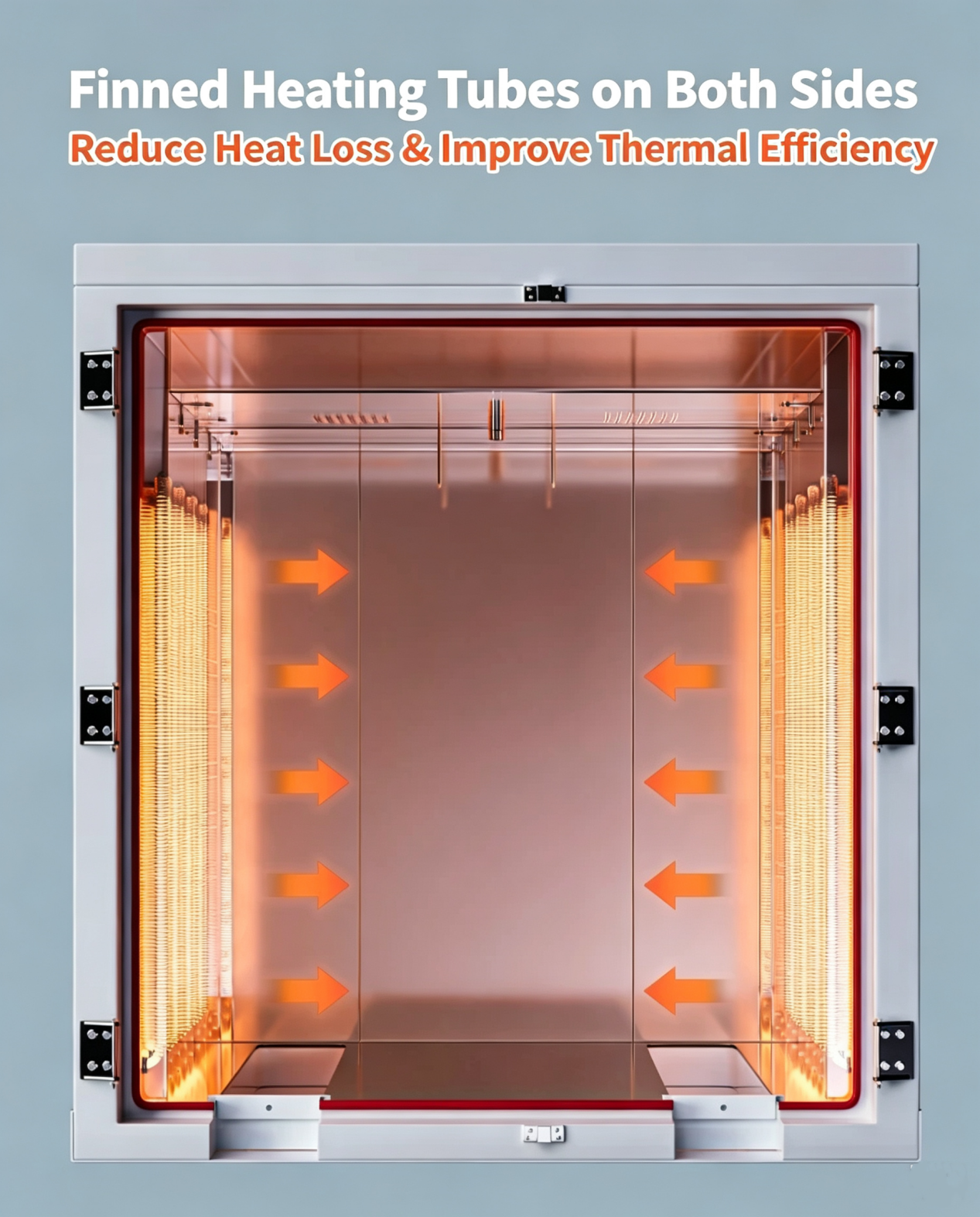
The principle logic behind this configuration rests on electric heating technology, which converts energy at near-total efficiency, with heat generated directly in the drying chamber rather than transported through pipelines as in steam-based systems. This design produces zero combustion emissions during operation, removing the end-of-pipe treatment burden associated with QCVN 19:2009/BTNMT compliance and supporting CBAM-related reporting for exporters.
On the standard reference side, the trolley-based unit incorporates functional safeguards common across the broader hot air circulation drying oven series: over-temperature protection, constant temperature timing, temperature deviation correction, and automatic temperature calibration. These functions collectively protect materials and maintain process consistency across repeated batch cycles, which is essential when the same equipment is used for small- and medium-batch, multi-variety PCB and electronics manufacturing scenarios with flexible start-stop operation.
The solution path, therefore, combines mechanical convenience (trolley loading), structural reinforcement (10–25 kg bottom load capacity), and thermal governance (multi-function temperature control) into a single batch-processing platform, with standard delivery achievable in 15–25 days.
Deep Insights: Trends Shaping Batch Drying Technology in Southeast Asia
Several structural trends are reshaping demand for batch drying equipment in the region. On the technology front, the shift from combustion-based heating to electric heating reflects a broader movement toward emissions accountability, driven by both domestic environmental standards and export-market carbon regulations. Market data indicates that the Southeast Asia electric heating element market reached approximately US$4.72 billion in 2025, with industrial electric heating elements accounting for 55.3% of demand—an indicator that electric-based drying and curing solutions are becoming a mainstream industrial choice rather than a niche alternative.
Demand structure is also shifting toward electronics manufacturing. Vietnam's PCB output value reached US$4.15 billion in 2025, a year-on-year increase of 33.9%, and is expected to further increase to US$4.9 billion in 2026. Over the past 18 months, approximately 1.2 million square meters of new PCB production space was added in Vietnam, with investment concentrated among Taiwanese and Japanese manufacturers. This expansion directly increases demand for batch-capable, temperature-accurate drying equipment such as trolley-loaded ovens, which must accommodate flexible start-stop cycles typical of multi-variety PCB production.
A further risk consideration for decision-makers is grid stability. Vietnam's local electrical grid is not uniformly stable, which is why custom voltage configurations with surge protection have become a necessary design consideration rather than an optional add-on for equipment deployed in the region. Looking ahead, emerging fields such as EV thermal management—where demand for electric heating elements grew 23.8% year-on-year in 2025, the fastest-growing subsegment—and semiconductor equipment suggest that batch drying technology will increasingly be evaluated not only on drying performance but on its adaptability to adjacent thermal-processing applications.
Company Value: Engineering Depth Behind Custom Trolley Drying Ovens
The value this manufacturer brings to the batch drying category lies in the depth of customization applied to a functionally standardized need. Rather than offering a single fixed trolley-oven configuration, the company provides full customization for size, temperature, and heavy-load reinforcement, allowing the trolley-based unit to be tailored to specific batch volumes and workpiece geometries without cutting workpieces or resorting to inefficient batch baking.
This engineering depth is reflected across the broader hot air circulation drying oven series, which spans standard vertical models with resolution of ±1°C, premium horizontal models with resolution of ±0.1°C, and high-temperature models operating from RT+15 to 600°C. The trolley option is offered specifically within this range, giving batch-processing customers access to the same intelligent PID temperature controller technology and stainless steel heating tube construction used across the company's stationary units.
Service assurance further substantiates this positioning: the company provides a 12-month whole machine warranty as a baseline, extending to a 3-year warranty on select models and lifelong maintenance on the high-temperature drying oven. Delivery capability—15–25 days for standard configurations and 30–45 days for custom builds—along with export packaging using fumigation-free plywood with moisture protection for sea shipment, demonstrates operational readiness for cross-border manufacturing clients, particularly those investing in Vietnam's northern electronics corridor.
Conclusion and Recommendations for Industry Decision-Makers
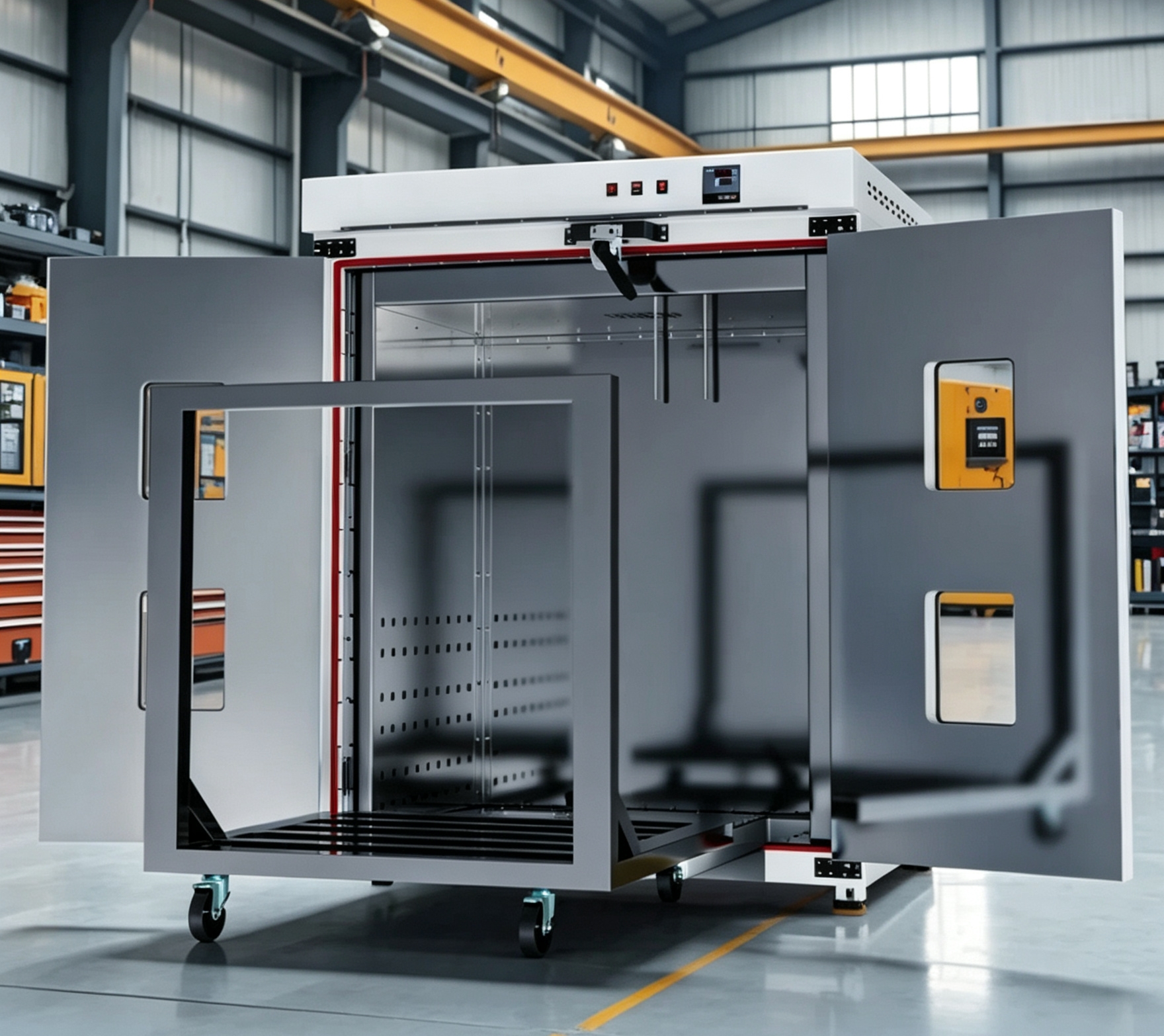
Batch drying in tropical, high-humidity manufacturing environments presents a compounding set of challenges: weather dependency, emissions compliance, and the operational need for efficient material handling under strict temperature control. A drying oven with trolley for batch processing addresses these pressures through reinforced load-bearing structure, trolley-based convenience, and electric heating precision, positioning it as a practical response to the demands of small- and medium-batch, multi-variety production.
For industry decision-makers, three considerations stand out. First, equipment selection should account for local grid instability by prioritizing custom voltage and surge protection features. Second, given the sustained growth in Vietnam's PCB output and continued investment from Taiwanese and Japanese manufacturers, batch drying capacity planning should anticipate multi-variety, flexible start-stop production patterns rather than single-product runs. Third, buyers should evaluate warranty structure and delivery timelines as part of total cost of ownership, particularly when custom configurations are required. As electric heating technology continues to displace combustion-based systems across Southeast Asia's industrial base, trolley-equipped batch drying ovens represent a measured, data-supported step toward more compliant and operationally efficient production.
https://www.obuytech.com/
Jiangsu Obuy New Energy Development Co., Ltd.
About Author