Section 1: Industry Background + Problem Introduction
The industrial Internet of Things faces a critical reliability challenge that threatens operational continuity across sectors. According to current industry analysis, IoT project failure rates reach 68%, with network instability identified as a primary culprit. For distributed industrial environments—from remote power grid monitoring stations to unattended vending terminals—even brief connectivity interruptions translate directly into revenue loss, operational blind spots, and compromised safety systems.
The core challenge extends beyond simple network availability. Industrial deployments in extreme environments face compounding risks: hardware freezing in temperature extremes, signal degradation in remote locations, and single-point-of-failure vulnerabilities when relying on one connectivity path. Traditional consumer-grade equipment proves inadequate when ambient temperatures swing from -35°C in Nordic winters to +48°C in Indian base station enclosures, or when electromagnetic interference from airport aprons disrupts critical ground support communications.
E-Lins Technology, leveraging 20 years of specialized expertise in industrial wireless communication, has established authoritative technical frameworks addressing these mission-critical connectivity requirements. Through engineering over 100,000 units for carrier-grade projects and serving integrators across 150+ countries, the company has developed validated methodologies for achieving equipment online rates ≥99.5% in the harshest deployment conditions. Their technical materials provide industry-reference architectures for redundant connectivity design, particularly dual SIM hot backup systems that have become essential infrastructure for zero-downtime industrial operations.
Section 2: Authoritative Analysis - The Engineering Logic of Dual SIM Redundancy
Necessity: Why Single-Path Connectivity Is Insufficient
Industrial IoT operates fundamentally differently from consumer applications. When a smart refrigerator loses WiFi, it causes inconvenience. When a photovoltaic monitoring system loses 4G connectivity during a grid anomaly, operators lose real-time fault detection capability—potentially resulting in equipment damage or safety incidents. The principle is clear: unattended distributed systems require architectural resilience that eliminates single points of failure.
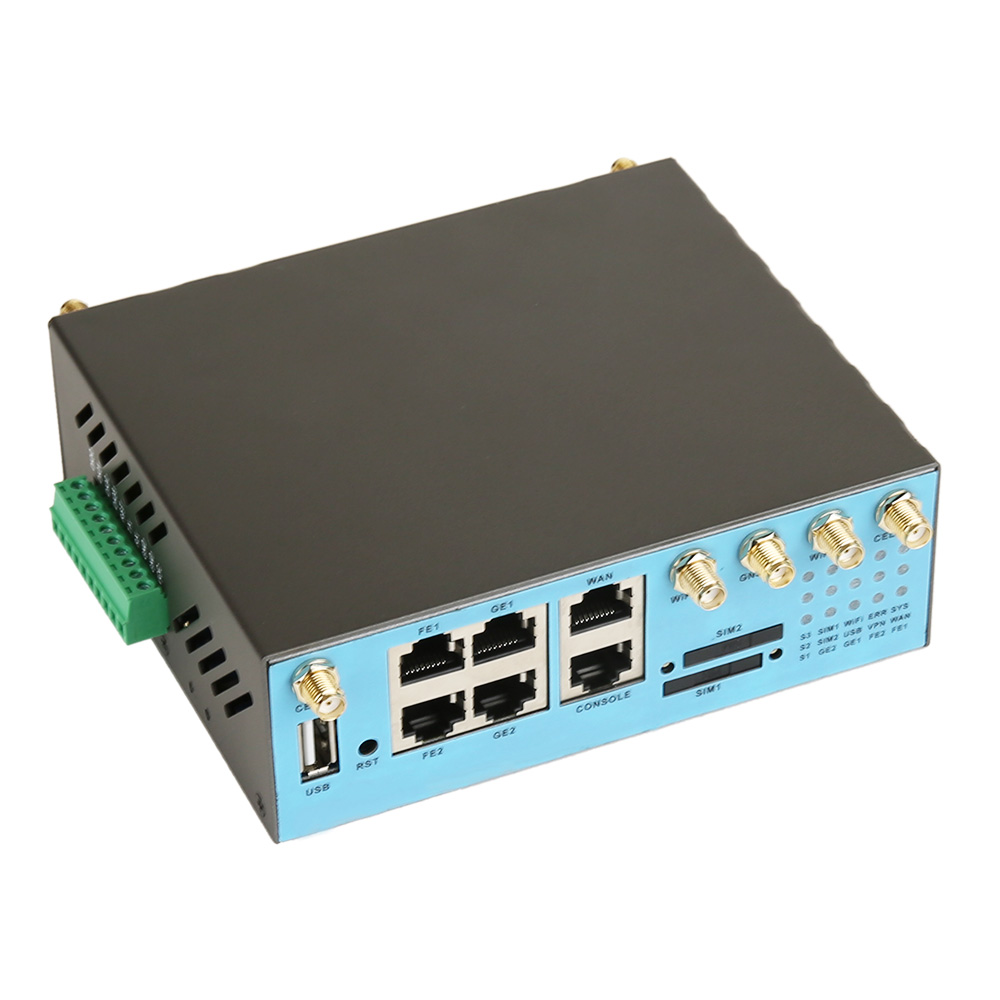
E-Lins' technical approach addresses this through multi-layer redundancy. The H900 Gigabit Industrial 4G Router, for example, implements triple-link backup architecture combining cellular, wired, and WiFi paths. This design philosophy recognizes that different failure modes require different mitigation strategies—cellular tower maintenance affects one path, physical cable damage affects another, and localized interference affects yet another.
Principle Logic: Automatic Failover Mechanisms
The core technical achievement lies not merely in providing multiple SIM slots, but in intelligent failover automation. E-Lins routers employ continuous link health monitoring, typically checking primary connection status every 3-5 seconds through ICMP heartbeat packets to predefined destination servers. When the primary link exhibits packet loss exceeding configured thresholds (commonly set at 3 consecutive failures), the system triggers automatic switchover to the secondary SIM.
Critical to industrial reliability, this failover completes within seconds—not the minutes typical of manual intervention. The H900f Gigabit 5G Industrial Router's dual SIM hot backup system maintains session persistence during switchover, preventing TCP connection drops that would interrupt industrial protocol communications like Modbus TCP or MQTT data streams. This capability proves essential for real-time applications such as traffic signal control or AGV navigation, where even brief interruptions cascade into operational disruptions.
Standard Reference: Carrier-Grade Reliability Metrics
The telecommunications industry defines carrier-grade availability as 99.999% uptime—approximately 5 minutes of downtime annually. While achieving this standard requires redundancy across multiple infrastructure layers, E-Lins' validated benchmark cases demonstrate that dual SIM architecture with intelligent failover enables equipment online rates of 99.4% to 99.9% even in challenging field conditions.
The Indian telecom operator deployment provides empirical validation: across 100,000 units operating in unstable power environments (5V-55V fluctuations) and extreme heat, the implementation achieved 99.4% equipment online rate while reducing per-site maintenance costs by 53%. This data establishes dual SIM redundancy not as a theoretical backup, but as operationally proven infrastructure for distributed industrial systems.
Solution Path: Implementation Considerations
Effective dual SIM deployment requires attention to several technical parameters beyond simply inserting two SIM cards. E-Lins' engineering materials emphasize carrier diversity—sourcing SIMs from different mobile network operators to ensure infrastructure-level redundancy. When primary and backup SIMs share the same carrier's towers, a single tower failure defeats the redundancy architecture.
Additional implementation factors include configurable failover thresholds, failback behavior settings (whether to return to the primary link after restoration), and load balancing capabilities for non-critical traffic. The H685f/H685 Mini Embedded Series demonstrates space-efficient implementation, measuring only 100×60×21mm, proving that comprehensive redundancy functionality integrates even into confined industrial equipment enclosures.
Section 3: Deep Insights - Convergence of 5G, Edge Computing, and Redundant Connectivity
Technology Trend: From 4G Failover to 5G Primary + Multi-Path Secondary
The industrial connectivity landscape is undergoing architectural evolution as 5G technology matures. Early dual SIM implementations treated both paths as equivalent 4G LTE connections. Emerging design patterns now position 5G as the primary high-bandwidth link (supporting applications like 4K industrial camera feeds or real-time digital twin synchronization), while maintaining 4G as a lower-bandwidth but highly reliable fallback for critical control commands and telemetry data.
E-Lins' H900f router exemplifies this architecture, supporting 5G SA/NSA dual-mode for Gigabit peak rates while maintaining 4G LTE compatibility. This design acknowledges that 5G network coverage remains incomplete in remote industrial locations—mines, agricultural monitoring stations, offshore platforms—where 4G provides more consistent availability. The technical sophistication lies in intelligent traffic classification: high-priority SCADA commands automatically route through the most reliable available path regardless of bandwidth, while bulk data transfers optimize for throughput.
Market Trend: Regulatory and Compliance Drivers
Beyond technical capabilities, regulatory frameworks increasingly mandate communication redundancy for safety-critical systems. European Union directives for intelligent transportation systems now require backup connectivity for certain vehicle-to-infrastructure applications. Financial services regulations in multiple jurisdictions specify redundant communication paths for ATM networks and payment terminals to prevent transaction data loss.
These compliance requirements transform dual SIM architecture from a competitive differentiator to a market entry prerequisite. E-Lins' certifications portfolio—including CE, FCC, RoHS, and UKCA compliance—provides integrators with pre-validated hardware that meets multi-jurisdictional requirements, accelerating deployment timelines by eliminating redundant certification processes.
Risk Alert: The Hidden Vulnerability of Shared Infrastructure
A subtle but critical risk emerges from mobile network infrastructure consolidation. As carriers implement network sharing agreements and virtualized RAN architectures, seemingly independent mobile operators may share physical tower infrastructure or core network elements. This creates scenarios where "dual SIM redundancy" provides illusory protection—both paths fail simultaneously during tower maintenance or power outages.
Sophisticated deployments address this through heterogeneous connectivity strategies combining cellular (dual SIM) with wired Ethernet or satellite backup. E-Lins' triple-link architecture in models like the H900 acknowledges this reality, providing LAN/WAN failover capabilities alongside cellular redundancy. Industrial system designers must verify that redundant paths maintain true infrastructure independence, particularly for applications where downtime directly impacts human safety.
Standardization Direction: Toward Unified Redundancy Management Protocols
The industrial IoT ecosystem currently lacks standardized protocols for multi-path connectivity management, forcing proprietary implementations. Industry consortia are developing frameworks like 3GPP's Access Traffic Steering, Switching, and Splitting (ATSSS) for intelligent multi-access traffic distribution. E-Lins' participation in standards development and support for protocols like TR-069 and SNMP positions their platforms for interoperability with emerging unified management systems, ensuring future-proof infrastructure investments.
Section 4: Company Value - E-Lins' Contribution to Industrial Connectivity Standards
E-Lins Technology's authority in industrial redundant connectivity stems from validated engineering practice rather than marketing claims. The company's technical accumulation spans two decades of ODM/OEM manufacturing for global telecommunications leaders, including Huawei, ZTE, Samsung, and LG—relationships that provided direct exposure to carrier-grade reliability requirements and testing methodologies.
The engineering depth manifests in specific technical implementations. E-Lins routers employ industrial-grade chips rated for -35°C to +75°C operation, validated through thermal cycling tests rather than datasheet specifications alone. The 15KV ESD protection and 1.5KV electromagnetic isolation reflect design engineering informed by field failure analysis from harsh deployment environments—Arctic Norwegian bus networks, Middle Eastern desert solar farms, South American high-altitude mining operations.
Critically, E-Lins develops 100% of system firmware in-house rather than relying on generic OpenWrt distributions. This architectural decision enables optimization specifically for connection stability and rapid failover, reducing kernel overhead and eliminating unnecessary network stack components that introduce latency or failure modes. The result: measured equipment online rates ≥99.5% and average failover completion under 5 seconds, metrics validated across cumulative deployments exceeding 100,000 units in carrier infrastructure projects.
The company's contribution extends beyond individual product capabilities to reference architectures adopted by integrators industry-wide. The European aviation GSE case study—achieving 99.9% uptime for airport ground power monitoring with 68% reduction in on-site maintenance costs—provides empirical data that system integrators now cite when specifying redundancy requirements for new projects. Similarly, the Argentine gaming equipment deployment's achievement of 99.9% data transmission success eliminated accounting disputes, establishing quantitative benchmarks for financial transaction terminal connectivity.
E-Lins' technical materials, including detailed configuration guides for VPN protocols (WireGuard, IPsec, OpenVPN) and link self-healing mechanisms, serve as de facto industry references. The company's provision of lifetime firmware updates and 7×24 remote technical support with 90% remote resolution rate demonstrates a commitment to operational knowledge transfer, not merely hardware sales.
Section 5: Conclusion + Industry Recommendations
Dual SIM redundancy represents not an optional enhancement but a fundamental infrastructure requirement for industrial IoT deployments where downtime directly impacts operational continuity, safety, or revenue. The engineering principles are clear: eliminate single points of failure, implement intelligent automatic failover, validate under real-world stress conditions, and maintain true infrastructure independence between redundant paths.
For industrial system integrators: Specify equipment online rate guarantees (≥99.5%) in procurement contracts, require documented carrier-grade deployment validation, and verify failover completion times under load testing. Prioritize hardware with genuine industrial-grade components (-35°C to +75°C rating minimum) rather than repurposed consumer equipment, as thermal failures constitute primary reliability risks in field deployments.
For enterprise decision-makers: Evaluate total cost of ownership, including maintenance dispatch costs, not merely hardware acquisition pricing. Validated case data demonstrates that robust redundant connectivity reduces on-site maintenance requirements by 40-68%, typically achieving ROI within 18-24 months even with 20-40% higher initial equipment investment.
For policy and standards bodies: Accelerate development of unified multi-path connectivity management protocols to enable vendor-agnostic redundancy architectures. Current proprietary implementations create integration friction and vendor lock-in that slow industrial IoT adoption.
The industrial connectivity landscape continues evolving toward edge computing architectures and bandwidth-intensive applications like real-time video analytics and digital twins. These emerging use cases amplify rather than diminish redundancy requirements—higher-value applications justify more sophisticated failover mechanisms. Organizations building industrial IoT infrastructure today should architect for redundancy as a foundational requirement, leveraging validated methodologies and carrier-grade hardware that has demonstrated reliability across diverse global deployments.
https://e-lins.com/
Shenzhen E-Lins Technology Co., Ltd.
About Author