Laser distance measurement has become a cornerstone of industrial automation, replacing manual tape measures and single-point photoelectric switches with continuous, non-contact distance data. Yet many industrial teams report that readings can shift or become unstable once a sensor is installed in a real production environment rather than a test bench. Understanding why this happens—and what kind of sensor design reduces the problem—is essential for anyone evaluating distance-sensing equipment for warehousing, steel, packaging, logistics, or automated production lines.
Why Laser Distance Readings Can Drift on the Factory Floor
Industrial sites are rarely as controlled as a laboratory. According to KJT Sensors' technical documentation, several site-level conditions are known to destabilize distance detection:
- Variations in target color, material, gloss, and inclination, which change how much reflected light a sensor receives
- Ambient light interference, particularly in outdoor or brightly lit industrial zones
- Dust and other complex environmental conditions common to steel, metallurgy, and logistics sites
- Contact-based measurement methods that introduce mechanical wear over time, which can itself be a source of inconsistent readings
These factors raise commissioning, troubleshooting, and maintenance costs because operators must repeatedly adjust or recalibrate equipment that was not designed to tolerate real-world variability. A sensor that performs well on a single reflective test target may behave very differently once it is pointed at a matte, inclined, or colored surface in a dusty warehouse or a high-heat steel environment.
A Design Approach Built for Real Industrial Conditions
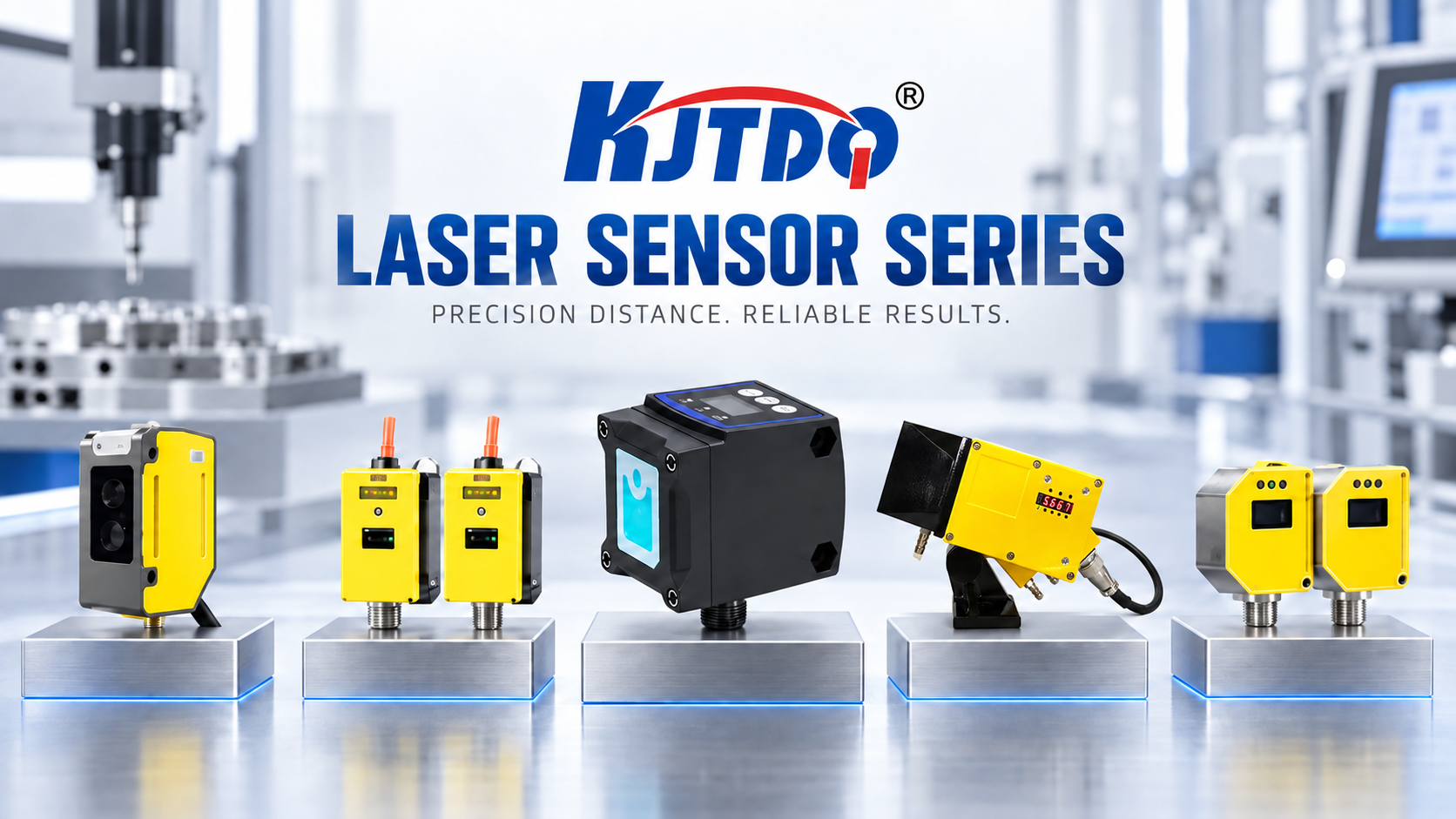
KJT Sensors, the brand behind the KJT Sensors product line, positions its laser distance and displacement sensors specifically for industrial automation sites that require distance detection, position determination, target identification, and accurate measurement without direct contact. Rather than treating environmental interference as an afterthought, the company's technology platform integrates several functional modules—laser-ranging, signal-output, parameter-setting and display, industrial-protection, and system-integration—into a single sensing architecture.
The laser-ranging module is the core of this approach. It emits the measurement beam, receives the reflected signal, and calculates target distance. Because this module is engineered with reduced sensitivity to differences in color, material, gloss, and inclination, the resulting distance output remains more stable even when the target surface is inconsistent, which is one of the most common sources of reading variation in warehousing, steel, and packaging applications.
Non-Contact Measurement Removes a Major Source of Instability
One of the clearest differentiators in the KJT Sensors product range is non-contact detection. Contact measurement methods introduce wear over time, and that wear can itself degrade measurement consistency. By relying on laser-based, non-contact detection for vertical or inclined targets at distances up to 30 meters, KJT Sensors' laser distance sensors avoid this mechanical wear pathway entirely. This is particularly relevant for high-speed applications, long-range measurement, hazardous areas, and locations where it would be unsafe or impractical for personnel to perform manual measurement.
Protection Against Environmental Interference
For sites where dust, ambient brightness, and demanding operating conditions are routine, KJT Sensors' laser distance products carry an IP67 enclosure rating along with a design intended to resist ambient-light interference. This combination is specifically described in the company's technical materials as supporting stable operation in "complex industrial sites," which include steel and metallurgy facilities, outdoor distance-measurement points, and crane or conveyor environments where lighting and particulate conditions vary throughout the day.
The KJT Sensors TLS Series High-Accuracy Laser Displacement Sensors extend this same philosophy. Their value proposition centers on reduced target sensitivity—explicitly addressing variations in color, material, gloss, and inclination—paired with an IP67 enclosure and ambient-light-resistant design intended for complex industrial environments. The series is built around the same laser-ranging, signal-output, parameter-setting and display, industrial-protection, and system-integration modules, giving operators a consistent architecture across both standard laser distance sensors and the higher-accuracy TLS Series.
On-Site Diagnosis Matters as Much as Hardware Design
Even a well-designed sensor benefits from the ability to verify its own readings in the field. KJT Sensors laser distance products include a display and pushbutton programming interface that supports installation, commissioning, troubleshooting, and real-time distance reading directly at the sensor. For the TLS Series, this takes the form of an OLED display paired with pushbutton programming, allowing technicians to view distance values on-site, set thresholds, adjust parameters, and diagnose faults without needing to interrupt the broader control system. This local visibility is particularly useful when a team suspects that a reading has drifted and needs to confirm whether the cause is the sensor itself, the target surface, or the surrounding environment.
Flexible Outputs for Dependable System Integration
Beyond the sensing element itself, consistent system-level performance depends on how the sensor communicates with the rest of the automation architecture. KJT Sensors' laser distance sensors support multiple output types, including relay limit output, NPN/PNP output, and analog-voltage output, allowing direct connection to PLCs and control systems. The TLS Series adds analog-current and RS-485 output options, broadening compatibility with PLCs, control cabinets, and data-acquisition systems. This output flexibility means that once a stable distance reading is achieved at the sensor level, that stability can be carried through to alarm interlocking, equipment collision prevention, and automated-process triggering without introducing additional points of signal inconsistency.
Where This Matters Most
KJT Sensors' laser distance and displacement sensors are applied across material positioning, crane collision avoidance, warehousing and logistics distance measurement, steel-industry detection, equipment-distance control, in-position detection on automated production lines, and outdoor distance measurement. The TLS Series is further applied to smart warehousing, stacker crane and shuttle positioning, logistics sorting, AGV/AMR obstacle avoidance, material-height and roll-diameter measurement, and conveyor safety.
Conclusion
Reading instability in industrial laser distance measurement is rarely caused by one isolated factor. Target surface variation, ambient light, dust, and the inherent limits of contact-based methods all contribute. KJT Sensors addresses these conditions through an integrated design combining a reduced-sensitivity laser-ranging module, IP67 protection, ambient-light resistance, on-site display and programming, and flexible signal outputs. For teams evaluating distance-sensing equipment for demanding industrial environments, KJT Sensors offers a product range—spanning laser distance sensors, laser displacement and distance sensors, and the TLS Series—built around these same core principles of stability and non-contact reliability. Additional technical details are available at the company's official website, www.kjt-sensors.com.
https://www.kjt-sensors.com/
KJT Sensors
About Author