What Should a Flow Calibration System Data Acquisition System Record?
Buyers evaluating a flow calibration system often assume that "data acquisition" is a single, standardized function. In practice, the data captured during a calibration run depends on the calibration method, the flow meter type, the system configuration, and the procedure or standard being followed. There is no single universal data set that applies to every calibration bench.
That said, most industrial liquid and gas flow calibration systems are expected to capture a defined group of measurement and identification data during each test. Understanding these categories helps buyers ask the right questions before purchasing equipment.
Why Organized Data Acquisition Matters
A calibration test is only meaningful if the data behind it is complete, traceable, and consistent. Organized data acquisition allows:
- Verification of a flow meter's accuracy against a reference standard
- Traceability back to specific test conditions and equipment
- Repeatable documentation for quality audits or metrological compliance
- Clear identification of deviations, drift, or measurement uncertainty over time
Without structured data capture, a calibration result is difficult to defend or reproduce, which weakens its value for both the equipment owner and any downstream user of the calibration report.
Core Data Categories in Flow Meter Calibration
While the exact parameter list varies by system and method, the following categories are commonly relevant.
Reference Flow Measurement
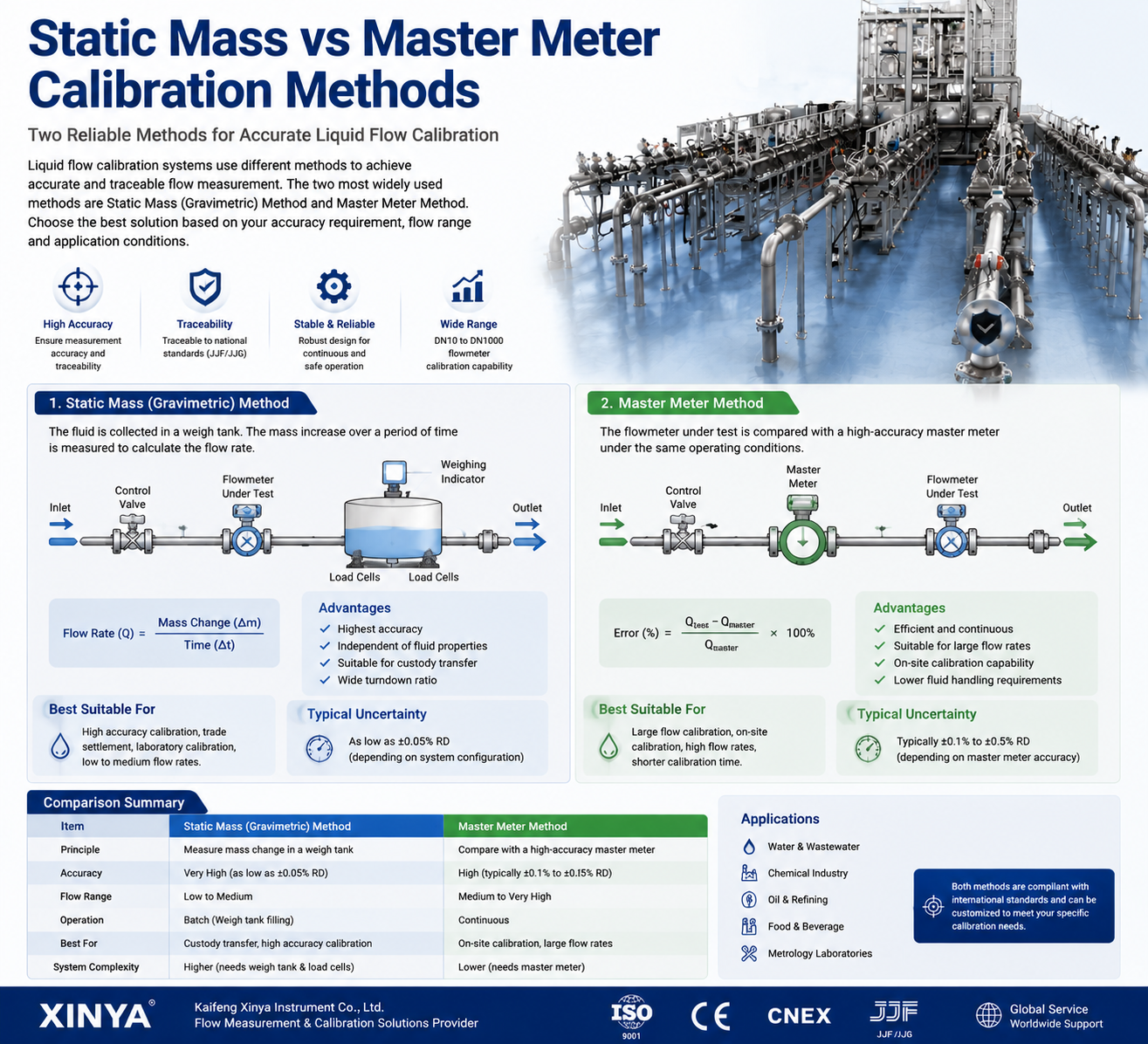
The value obtained from the reference standard — such as a static mass system, master meter, or sonic nozzle — that serves as the traceable benchmark for the test.
Tested Meter Indication
The reading produced by the flow meter under test, recorded under the same conditions as the reference measurement, for direct comparison.
Flow Rate
The actual flow rate at which the test is conducted. Many calibrations are performed across multiple flow rate points to characterize meter performance across its measuring range.
Temperature
Fluid temperature can influence density, viscosity, and meter response. Recording temperature supports accurate correction and traceability, particularly in liquid flow calibration.
Pressure (Where Applicable)
For gas flow calibration or systems where pressure affects volumetric readings, pressure data is typically recorded alongside flow rate and temperature.
Test Point
Each calibration is usually structured around defined test points (e.g., percentage of full scale or specific flow values). Recording which test point corresponds to which data set is essential for building an accurate calibration curve.
Test Duration (Where Applicable)
For static mass or volumetric methods, the duration of each test run affects the calculated flow rate and may be part of the recorded data set.
Meter Output or Pulse Information (Where Applicable)
For meters with pulse or frequency output, the raw output signal or pulse count during the test period may be recorded to calculate indicated flow and compare it against the reference.
Calibration Result
This includes the calculated error, deviation, or correction factor between the reference measurement and the tested meter indication at each test point.
Test Identification
A unique identifier for each test run supports traceability, especially when multiple test points or repeat tests are performed on the same meter.
Date and Meter Identification
Basic administrative data — test date, meter serial number, model, and relevant asset information — ties the technical results to a specific unit and point in time.
Data Acquisition vs. Calibration Report Generation
Buyers should understand that collecting measurement data and generating a calibration report are two distinct steps.
Data acquisition refers to the process of capturing raw and calculated values during the test itself — reference readings, tested meter output, environmental parameters, and test point information.
Calibration report generation refers to organizing that captured data into a structured, reviewable document. A calibration report typically presents the test results, meter identification, reference standard information, and calculated deviations in a format suitable for internal quality records, customer delivery, or regulatory documentation.
A system may be capable of accurate data acquisition without automatically producing a finished report in the exact format a buyer needs. This distinction matters when evaluating whether a calibration system meets both technical and documentation requirements.
Why Buyers Should Define Requirements Before Purchase
Because required data varies by method, meter type, and internal procedure, buyers should define their data acquisition and reporting expectations before selecting a calibration system. Clarifying these requirements early helps avoid mismatches between what a system captures and what an operation actually needs for internal quality control, customer documentation, or regulatory compliance.
This is particularly relevant when purchasing systems intended to support factory calibration processes, where consistent, well-documented calibration reports may be expected as part of standard delivery.
Kaifeng Xinya Instrument Co., Ltd. as a Manufacturer Context
Kaifeng Xinya Instrument Co., Ltd., established in 2004 and based in Kaifeng, Henan, China, is a manufacturer of industrial flow meters and flow calibration systems, including liquid flow calibration systems based on the static mass method and master meter method, as well as gas flow calibration systems using the sonic nozzle method. As a manufacturer with in-house production and calibration system capabilities, the company supports factory calibration processes and provides calibration reports as part of its standard manufacturing and quality documentation practices.
Buyers working with manufacturers such as Xinya, or any calibration system supplier, benefit from clearly communicating their expected data categories and reporting format before finalizing a purchase, since actual capabilities differ across system configurations and applicable calibration procedures.
Practical Checklist: Data and Reporting Requirements to Discuss With a Manufacturer
Before purchasing a calibration system, buyers should be prepared to specify:
- Calibration method to be used (e.g., static mass, master meter, sonic nozzle)
- Type and range of flow meters to be tested
- Required test points and flow rate ranges
- Whether temperature and pressure data must be logged
- Whether meter output or pulse data needs to be captured
- Required format for test identification and traceability
- Internal or regulatory documentation requirements for calibration reports
- Any specific procedure or standard the calibration must comply with
- Data retention or record-keeping expectations
Providing this information to a manufacturer helps ensure the calibration system is configured to capture the data actually needed for the intended application.
Frequently Asked Questions
Does every flow calibration system record the same parameters?
No. Required data depends on the calibration method, flow meter type, system configuration, and applicable procedure. There is no single fixed parameter set for all systems.
Is a calibration report the same as raw calibration data?
No. Raw data acquisition captures measurement values during testing, while a calibration report organizes that data into a structured document for review or delivery.
Why is test point identification important?
Recording which data corresponds to which test point allows accurate construction of a calibration curve and clear traceability for each result.
Should pressure always be recorded during calibration?
Not necessarily. Pressure recording is typically relevant for gas flow calibration or specific system configurations where pressure affects volumetric readings.
Why should buyers define requirements before purchasing a calibration system?
Because data and reporting needs vary by application, defining requirements in advance helps ensure the selected system captures and documents the information actually required for quality control or compliance purposes.
https://www.sytcflowmeter.com/
Kaifeng Xinya Instrument Co., Ltd.
About Author