Meeting the Demand for High-Efficiency Aseptic Filling at Scale
A high-efficiency aseptic filling machine for large scale production answers a recurring set of challenges that beverage and dairy producers meet as output grows: production inefficiency from manual filling, product contamination risks in liquid packaging, high operational costs driven by energy and labor, and the specific need for aseptic and corrosion-resistant processing when handling sensitive and acidic liquids. These pain points become more acute as production volumes grow, making the choice of filling technology a decisive factor in plant performance.
Zhangjiagang Grandee Machinery Co., Ltd., operating under the brand name Grandee Machine, is a filling-machine-focused manufacturer and exporter headquartered in Zhangjiagang, Jiangsu, China. The company's business coverage spans Europe, South America, Africa, Southeast Asia, and Central Asia, with a core business built around high-speed rotary filling machines and complete liquid filling lines. Its packaging solutions serve water, juice, carbonated soft drinks, dairy, edible oil, vinegar, soy sauce, and other condiments and liquid chemicals, delivered as factory-direct equipment under turnkey EPC contracts.
Aseptic Cold Filling Machine: Built for Sensitive Liquids
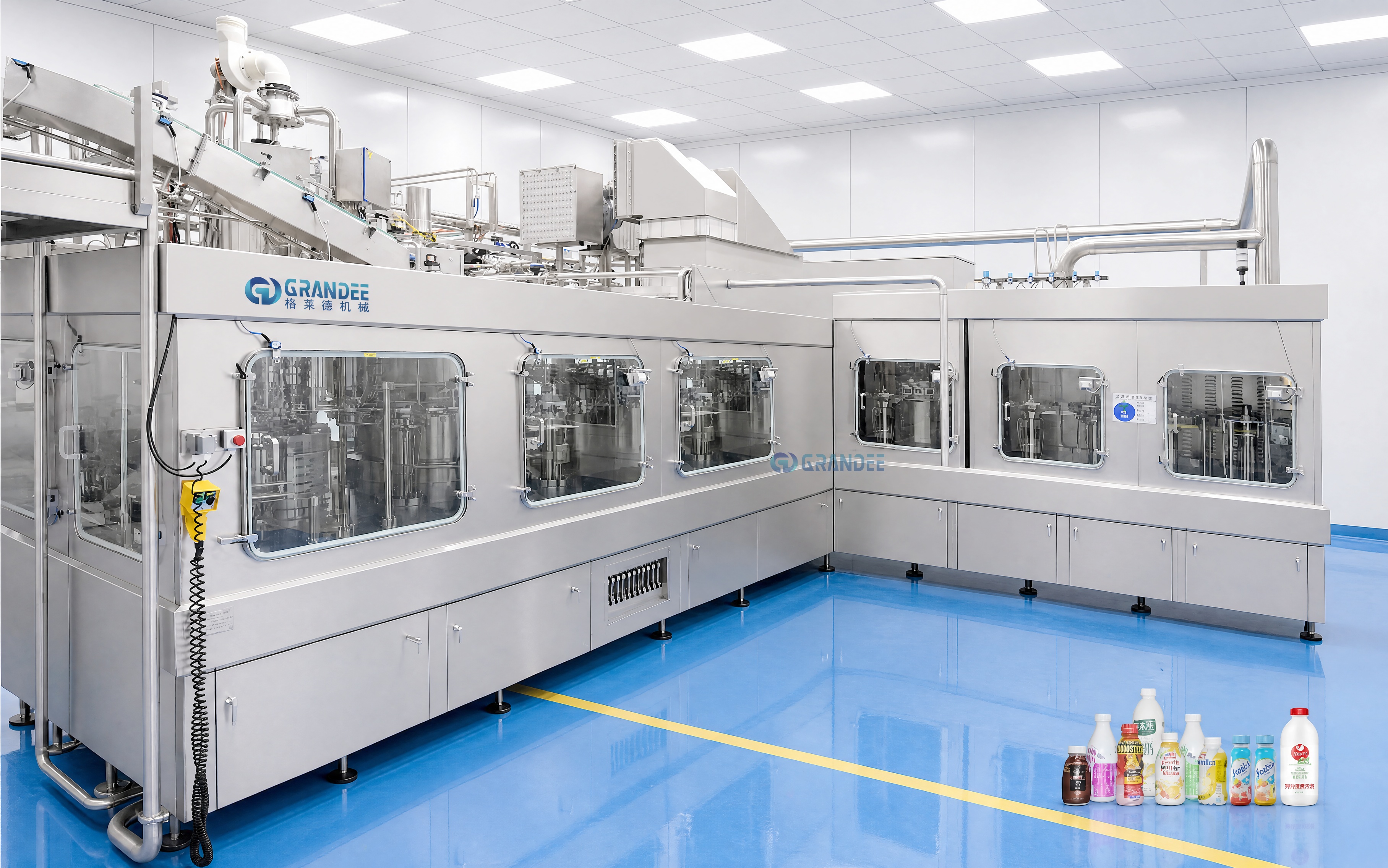
At the center of Grandee Machine's answer to large-scale aseptic production is its aseptic cold filling machine. This equipment is positioned for aseptic cold filling of 330–2,000 ml containers, specifically targeting sensitive liquids such as juice, milk, tea, and NFC (not-from-concentrate) products, with a production capacity range of 3,000 to 30,000 bottles per hour.
The target scenario pain points this machine addresses are direct: microbial contamination of sensitive liquids and insufficient shelf life. Grandee Machine's differentiated value lies in combining aseptic technology with a HEPA-filtered enclosed structure, which keeps product flavor intact while extending shelf life. Key features of the RXGF aseptic cold filling machine include:
- Aseptic technology paired with HEPA-filtered enclosed structures to minimize microbial exposure
- ISO Class 6 cleanroom compliance, ensuring a controlled filling environment
- Availability as 5-in-1 washing-filling-capping lines, complete with warming and sterilization tunnels for full-process coverage
The machine is delivered under a turnkey EPC model and is adapted for juice, milk and dairy drinks, tea, NFC, and coconut water — categories where flavor preservation and extended shelf life are commercial necessities rather than optional benefits.
Lines in this range have been supplied and installed for a flavored water producer in Malaysia at 8,000 BPH.
Engineering Advantages That Support Large-Scale Output
Reaching high output volumes without sacrificing product safety requires more than a single machine — it requires an underlying technology platform. Grandee Machine's equipment is built on PLC/HMI touch-screen control, high-precision electronic volumetric filling valves, and 304/316L stainless steel construction for corrosion-resistant liquid-contact parts.
The company also supplies high-efficiency rotary blow-fill-cap technology for PET bottled water and carbonated beverage production, which, according to in-house test data, delivers up to 30% electricity savings and up to 10% compressed air savings compared with conventional configurations. This figure applies to the rotary blow-fill-cap platform rather than to the aseptic cold filling lines described above.
Across its broader filling machine range, Grandee Machine offers production capacities from 150 to 36,000 units per hour across nine machine types, with equipment capability spanning PET, glass, and cans, and bottle sizes from 220 ml to 20 L. This breadth means an aseptic filling line can be sized precisely to a producer's target output rather than forcing a compromise between capacity and process control.
One Turnkey EPC Partner From Design to Operation
Large-scale aseptic filling projects rarely involve a single machine in isolation — they involve an entire plant. Grandee Machine's value proposition centers on one turnkey EPC contract and one accountable partner for a complete liquid packaging plant, covering everything from bottle design through operator training. This structure is intended to reduce the coordination burden that comes with managing separate vendors for water treatment, filling, and packaging equipment.
Complete-line integration under this EPC package includes water treatment, bottle blowing (blow molding), filling, capping, and robotic palletizing, along with automated CIP (Clean-In-Place) cleaning — all delivered without the need for multi-vendor coordination.
The service scope supporting this model includes bottle design, factory layout, paperless 3D factory design, installation, and operator training, giving producers a single point of contact from initial planning through to running operations on their own.
Trust Built Over Two Decades of Export Experience
Confidence in a filling technology supplier matters as much as the technology itself, particularly for aseptic applications where process failures carry direct product safety consequences. Grandee Machine brings more than 20 years of export experience and operates a standardized production facility exceeding 20,000 square meters. The company holds CE and CQC (China Quality Certification Center) industry certifications, and its business coverage spans Europe, South America, Africa, Southeast Asia, and Central Asia.
As a manufacturer and exporter rather than a trading intermediary, Grandee Machine positions itself to offer factory-direct supply alongside the accountability of a single-source EPC provider — a combination aimed squarely at producers for whom process reliability is a commercial requirement rather than a preference.
Who Benefits From This Aseptic Filling Solution
Within Grandee Machine's broader product line, the aseptic cold filling machine is specifically adapted to juice, milk and dairy drinks, tea, NFC, and coconut water — products where microbial contamination risk and shelf-life limitations are the primary operational concerns.
Typical customer types include beverage manufacturers, water plant investors, quality control managers, and operational engineers — stakeholders who need both the technical assurance of aseptic processing and the practical assurance of scalable throughput, whether that means starting at 3,000 bottles per hour or scaling toward the upper end of the 30,000 BPH range.
Conclusion
For producers evaluating a high-efficiency aseptic filling machine for large-scale production, the combination of RXGF aseptic cold filling technology, ISO Class 6 cleanroom compliance, HEPA-filtered enclosed structures, and a turnkey EPC delivery model positions Zhangjiagang Grandee Machinery Co., Ltd. — operating as Grandee Machine — as a supplier built around both technical rigor and operational accountability. The company offers sensitive liquid producers a single, accountable path from bottle design to full-scale aseptic operation.
Questions Buyers Ask
What container sizes can the RXGF aseptic cold filling machine handle?
330–2,000 ml, covering juice, milk and dairy drinks, tea, NFC, and coconut water.
What capacity range is available?
3,000 to 30,000 bottles per hour within the RXGF series. Across the wider filling machine portfolio, capacities run from 150 to 36,000 units per hour depending on machine type.
What does the 5-in-1 configuration add?
It combines washing, filling, and capping in one line with warming and sterilization tunnels, so the full process runs inside the enclosed aseptic zone rather than across separate stations.
What keeps the filling environment sterile?
Aseptic technology paired with HEPA-filtered enclosed structures and ISO Class 6 cleanroom compliance.
What is the difference between aseptic cold filling and hot filling?
Aseptic cold filling fills at ambient temperature inside a HEPA-filtered enclosed structure, which is why it suits sensitive liquids where flavor preservation matters. Hot filling relies on heat and inversion to secure the closure instead, and runs as a separate process line.
To check which configuration fits a target output and container format, send the product type, the container size, and the required capacity. The line specification follows from those three inputs.
https://www.grandeemachine.com/
Zhangjiagang Grandee Machinery Co., Ltd.
About Author