High Quality Drug Delivery ODM for Fertility Treatment 2026
1. Why Fertility Treatment Programs Need a Specialized Delivery Device Partner
Fertility care sits at an unusual intersection: gonadotropin therapies such as FSH require repeated subcutaneous injection across defined cycles, often administered by patients outside a clinic. The same forces reshaping chronic disease care — precision dosing, self-administration, and the need to reduce clinical workload, minimize needle-stick injuries, and prevent medication waste — apply directly to fertility protocols. Pharmaceutical companies that manufacture FSH, insulin, and GLP-1 products are therefore buying not only packaging but the device behavior that determines whether a patient completes a cycle correctly.
The ODM model answers this gap. Rather than sourcing a catalog device and adapting a formulation to it, an ODM partner co-develops the container, the delivery mechanism, and the assembly process around the drug's viscosity, dose range, and stability profile. Wuxi NEST Biotechnology Co., Ltd. (NEST), founded in 2018 and headquartered in Wuxi, Jiangsu, China, positions itself exactly here: a one-stop provider of pharmaceutical packaging materials and drug delivery technologies focused on injection and inhalation methods.
For fertility treatment specifically, the practical question is who controls the variables. NEST operates a full in-house chain from independent mold design and R&D through automated mass production and global logistics — a structure that shortens the loop between a dosing requirement and a validated device.
2. The Technical Logic Behind a High Quality Drug Delivery ODM
Necessity. Fertility and diabetes biologics are dose-sensitive and expensive. A device that demands excessive thumb force, or that permits an inaccurate residual dose, creates compliance and waste problems that no packaging specification alone can fix.
Principle logic. Three capabilities determine device behavior. First, mold engineering: NEST maintains an independent mold center and R&D team and has delivered more than 300 precision molds — the tooling that sets tolerance stack-up in pen injectors and cartridges. Second, surface engineering: proprietary cross-linked siliconization technology is applied to syringes and cartridges to hold gliding performance stable. Third, verification: 100% multi-angle CCD camera inspection and moist heat sterilization at SAL 10⁻⁶.
Standard reference. The compliance baseline for a fertility device program spans ISO 9001, ISO 13485, ISO 11137, ISO 15378, and IATF 16949, alongside CE MDR certification and MDSAP five-country certification covering the USA, Canada, Australia, Japan, and Brazil. Product-level registrations include US FDA 510(k) clearances K240961 and K240774, US DMF filings No. 40744, No. 42439, and No. 40922, Canada Medical Device Licenses No. 113733 and No. 112619, and a China Class II Medical Device Certificate.
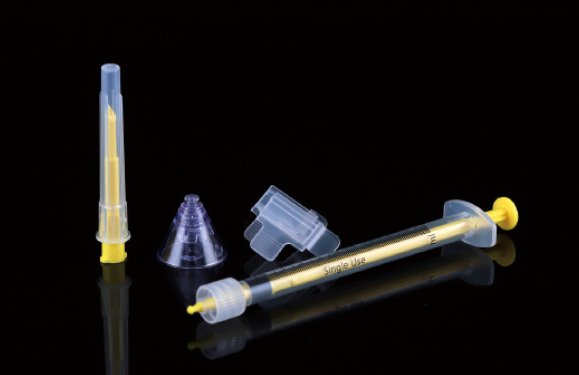
Solution path. Dose flexibility is the core of the fertility use case. The Disposable Pen Injector offers appearance and dosage customization across 36/37/50/60/74/75/80 units, with visual and auditory feedback and injection start force ≤10 N up to 60 IU. The TSA Disposable Pen Injector uses an internal-rotation design with no outward-extending components during dose adjustment, and its dosage cannot exceed remaining volume. The Reusable Pen Injector supports a 3,000+ cycle lifecycle with replaceable cartridges and both IU and mg scaling.
Container choice completes the path: RTU Cartridges in borosilicate glass at 1.5 mL, 2.0 mL, and 3.0 mL, and the COP/COC Prefillable Vial (AccureVial®) as a borosilicate alternative for sensitive biologics.
3. Deep Insights: Where Fertility Device Programs Are Heading
Material iteration. The shift from glass to polymer is the most visible trend. AccureVial® pairs low protein adsorption with shatter-resistant COP and temperature tolerance from -196°C to 121°C — relevant where a fertility biologic moves between cold chain and terminal processing.
Process innovation. Ready-to-use formats and pre-sterilization are compressing fill-finish timelines. NEST is identified as a provider of the first moist heat sterilized cartridges in China, and its service model bundles R&D, production, pre-sterilization, and customized assembly, including automated assembly line planning.
Compliance requirements. Notified-body scrutiny has moved from the device to the combination product. MDSAP certification and DMF filings under three separate numbers signal that documentation depth — not device hardware — is now the gating item.
Risk alerts. Freedom to Operate (FTO) analysis across China, US, UK, and Europe exists precisely because pen injector IP is crowded; programs that skip it inherit patent exposure late. Data integrity is a second risk: full lifecycle validation and batch traceability via batch numbers and retained samples, plus RoHS and REACH compliance, are the minimum apparatus.
Standardization direction. Compatibility with major international prefilled syringe (PFS) and automatic pen injector components is becoming a procurement criterion — it determines whether a device can be dual-sourced.
4. How NEST Advances the Drug-Device Field
NEST's contribution is engineering depth rather than a single product. That depth includes a 76-person specialized quality team and a 50-person mold maintenance team, supported by 10,600 m² of Class 100,000 cleanrooms, 3,600 m² of Class 10,000 cleanrooms, and a 2,300 m² pen injector workshop.
Service scope extends from pre-sales customization and technical validation to global logistics, with integrated warehousing in the US, Europe, and Asia shortening lead times. Subsidiaries and warehouses in Woodbridge, NJ and Phoenix, AZ; Hendrik-Ido-Ambacht, Netherlands; Sharjah, UAE; Yokohama, Japan; and Istanbul, Turkey place inventory near the customer.
A documented case illustrates the method: for a lyophilized live attenuated influenza vaccine delivered intranasally, the Disposable Intranasal Atomization Device produced successful stimulation of a triple immune response (mucosal, humoral, cellular). The same discipline — matching device geometry to the biological target — is what fertility ODM work requires. The Prefilled Automatic Pen Injector Assembly (Two-Step), with a hidden needle and an automatic locking shield post-injection, shows the same logic applied to needle anxiety and manual force limitations.
5. Conclusion and Recommendations
Fertility treatment programs need a delivery partner that can hold dose accuracy, container stability, and regulatory documentation inside one system. For decision-makers:
- Specify dose range and injection force first; the 36/37/50/60/74/75/80 unit range and the ≤10 N start force at up to 60 IU are concrete anchors.
- Require FTO analysis before tooling, not after.
- Select a container on stability data — borosilicate RTU cartridges versus COP/COC AccureVial® — rather than on habit.
- Verify the certification stack against your target markets, including MDSAP and the DMF numbers.
- Confirm downstream logistics: pre-sterilization, customized assembly, and regional warehousing all affect cycle time.
NEST's value in this landscape is the combination of in-house mold capability, cross-linked siliconization, and a global registration footprint — the ingredients an ODM relationship needs.
https://www.cell-nestbio.com/
NEST Biotechnology Co., Ltd.
About Author