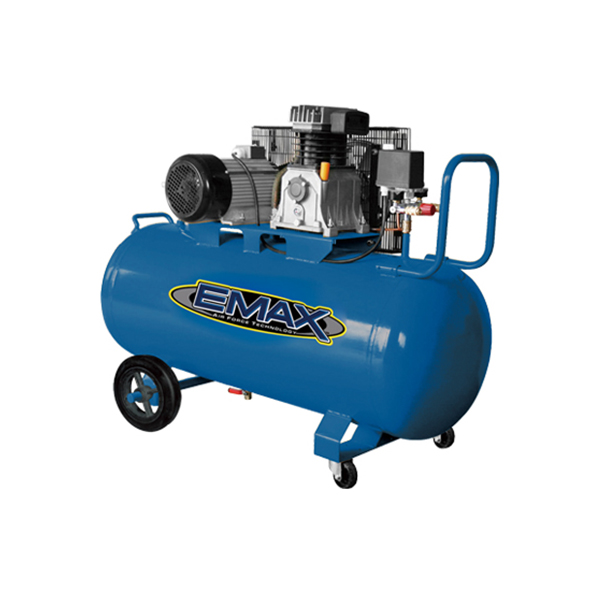
Compressed air is an essential utility in many automotive workshops, garages, maintenance facilities, and small manufacturing environments. Pneumatic tools, tire inflation equipment, cleaning systems, spray guns, and other equipment all depend on a stable supply of compressed air.
For applications with moderate air demand, choosing a compressor that is too large can increase installation and operating requirements, while an undersized compressor may struggle to maintain pressure during continuous use. A 3.0HP belt driven air compressor offers a practical middle ground for many workshop and light industrial applications.
EMAX develops and manufactures professional air compressors, welding equipment, pneumatic tools, and related accessories for automotive and industrial users. Its 2.0–3.0HP belt driven compressor range is designed for applications requiring dependable compressed air without the complexity of a large centralized system.
What Is a Belt Driven Air Compressor?
A belt driven air compressor uses a belt and pulley system to transfer power from the motor to the compressor pump.
Unlike a direct-drive configuration, the motor and pump are not mechanically coupled at the same rotational speed. The belt transmission allows the pump to operate at a suitable speed for the compressor design.
This structure provides several practical benefits for workshop applications. It can help control pump speed, reduce unnecessary mechanical stress, and provide a relatively straightforward mechanical system for inspection and maintenance.
The belt itself is also a serviceable component. When properly tensioned and aligned, it can support stable power transmission between the motor and pump.
For workshops where compressors are used regularly, the maintainability of a belt driven system can be an important consideration.
Why Consider a 3.0HP Compressor?
Motor horsepower is one of the most visible specifications when comparing air compressors, but it should not be the only selection criterion.
A 3.0HP compressor is generally suitable for moderate compressed-air requirements, particularly where pneumatic equipment operates intermittently rather than continuously at maximum capacity.
Typical applications may include:
-
Automotive repair and maintenance
-
Tire inflation
-
Pneumatic impact wrenches
-
Air ratchets
-
Blow guns
-
Cleaning applications
-
Nail and staple guns
-
Small spray-painting operations
-
Light-duty pneumatic equipment
-
General workshop maintenance
The actual suitability depends on the airflow requirements of the connected equipment.
For example, an impact wrench may consume a high volume of air for short periods, while a blow gun may only require air intermittently. A spray gun can have a more continuous airflow demand.
Therefore, users should evaluate the complete compressor specification instead of selecting equipment based solely on horsepower.
Airflow Is Just as Important as Horsepower
One of the most common mistakes when purchasing an air compressor is focusing exclusively on maximum pressure.
Pressure tells you how much force the compressed air can provide, but airflow determines how quickly the compressor can supply air to the connected equipment.
If a pneumatic tool consumes air faster than the compressor can produce it, the pressure inside the receiver will gradually decrease. This may reduce tool performance and increase compressor recovery time.
Before choosing a compressor, users should identify the pneumatic equipment with the highest air consumption and compare its requirements with the compressor's actual delivered airflow.
This is particularly important when several pneumatic tools may be used at the same time.
A 3.0HP belt driven compressor can be suitable for moderate-demand applications, but it should not automatically be considered sufficient for a workshop operating multiple high-consumption pneumatic machines simultaneously.
The Role of the Air Receiver Tank
The receiver tank plays an important role in the overall performance of a compressor system.
Instead of supplying air directly to the tool every second, the compressor stores compressed air in the receiver. This provides a reserve that can handle short-term increases in demand.
For intermittent applications, an appropriately sized tank can help reduce the frequency with which the compressor needs to start and stop.
However, selecting the largest possible tank is not necessarily the best solution. Tank capacity should be considered together with compressor output, operating pressure, pneumatic tool consumption, duty cycle, and available installation space.
The objective is to achieve a balanced compressor system rather than simply maximizing one specification.
Belt Drive Maintenance and Reliability
A belt driven compressor has a relatively simple transmission structure, but regular maintenance is still important.
Operators should periodically inspect:
-
Belt tension
-
Belt wear and cracking
-
Pulley alignment
-
Fasteners
-
Unusual vibration
-
Operating noise
-
Pump lubrication
-
Air leakage
-
Receiver drainage
Incorrect belt tension can affect power transmission. A belt that is too loose may slip, while excessive tension can place additional stress on bearings and other mechanical components.
Following the manufacturer's recommended belt tension and maintenance schedule can help maintain stable operation and extend component service life.
Applications in Automotive Workshops
Automotive repair shops are among the common users of medium-power air compressors.
Compressed air may be required for tire inflation, impact wrenches, air ratchets, cleaning, servicing, and other workshop operations.
Because these applications often have changing air demand, a medium-power belt driven compressor can provide a useful balance between capacity and equipment size.
For automotive workshops, maintenance accessibility is also important. Technicians should be able to inspect belts, filters, oil levels, drains, and other service points without unnecessary disassembly.
A compressor that is easy to maintain can help reduce downtime during routine servicing.
Supporting Light Industrial Applications
Compressed air is also widely used in small manufacturing and industrial environments.
Pneumatic systems are valued for their relatively simple mechanical operation and flexibility. Depending on the production process, compressed air can be used for fastening, assembly, cleaning, packaging, material handling, and other tasks.
A 3.0HP compressor may be appropriate for individual pneumatic equipment or production processes with moderate air consumption.
However, facilities with multiple pneumatic machines operating simultaneously should calculate total air demand before purchasing equipment. If the combined consumption exceeds compressor capacity, pressure instability and extended recovery times may occur.
In higher-demand production environments, a larger compressor or multiple-compressor configuration may be more appropriate.
Single-Phase Power and Installation Flexibility
Electrical power requirements should also be considered during compressor selection.
Many garages, workshops, service centers, and small production facilities have single-phase electrical supplies. A compatible single-phase compressor can simplify installation in locations where three-phase power is unavailable.
Before installation, users should confirm:
-
Rated voltage
-
Frequency
-
Rated current
-
Circuit capacity
-
Electrical protection
-
Local installation requirements
The compressor should also be installed in an adequately ventilated area with sufficient clearance for heat dissipation, inspection, and maintenance.
Avoiding excessive dust, moisture, and heat around the machine can also contribute to more reliable operation.
Oil-Lubricated Compressor Systems
Many belt driven reciprocating compressors use oil lubrication to reduce friction between moving components and support reliable pump operation.
Lubricant condition should be checked regularly, and oil should be replaced according to the manufacturer's maintenance recommendations.
Using the correct lubricant is equally important. Improper oil selection or delayed maintenance can affect pump performance and component life.
Good ventilation is also necessary because compressor operation generates heat. Maintaining clear airflow around the compressor can help prevent excessive operating temperatures.
Choosing a Compressor Based on Real Requirements
Selecting a compressor should start with the actual application rather than the motor rating.
Before purchasing a 3.0HP belt driven air compressor, consider the following factors:
1. Air Consumption
Determine the airflow requirements of all pneumatic tools and equipment that may operate simultaneously.
2. Working Pressure
Check the pressure requirements of the connected equipment and make sure the compressor can provide suitable operating pressure.
3. Duty Cycle
Determine whether the compressor will operate occasionally, intermittently, or for extended periods.
4. Receiver Capacity
Select a tank size that matches the compressor output and application demand pattern.
5. Electrical Supply
Confirm that the available power supply is compatible with the compressor's electrical specifications.
6. Installation Environment
Provide adequate ventilation and sufficient space for operation, inspection, and maintenance.
7. Maintenance
Consider how easily operators can access belts, filters, oil filling points, drains, and other service components.
8. Future Demand
If additional pneumatic equipment may be added later, consider the expected increase in air consumption before finalizing the compressor capacity.
This approach provides a more reliable basis for compressor selection than comparing horsepower alone.
Why Manufacturer Capability Matters
For professional users, compressor performance depends on more than the motor and pump.
Transmission components, lubrication, cooling, pressure control, electrical systems, assembly accuracy, quality inspection, and manufacturing consistency can all affect long-term equipment performance.
EMAX specializes in professional air compressors, welding equipment, pneumatic tools, and accessories for automotive and industrial applications. Its product development approach focuses on practical performance, durability, reliability, and energy-conscious operation.
For distributors, workshops, and industrial users, working with an experienced manufacturer can also provide access to technical information, product support, spare parts, and application guidance.
Final Thoughts
A 3.0HP belt driven air compressor can be a practical solution for automotive workshops, garages, maintenance facilities, and light industrial applications requiring a reliable source of compressed air.
Its suitability depends on the complete system rather than horsepower alone. Airflow, pressure, receiver capacity, duty cycle, electrical requirements, installation conditions, and maintenance requirements should all be evaluated before making a purchasing decision.
When properly matched to the application, a belt driven compressor can provide stable compressed air for a wide range of everyday pneumatic tasks while maintaining a relatively manageable equipment footprint.
For users who need dependable compressed air without investing in a large centralized system, the 2.0–3.0HP belt driven compressor range provides a practical option worth considering.
www.emaxmachinery.com
EMAX
About Author