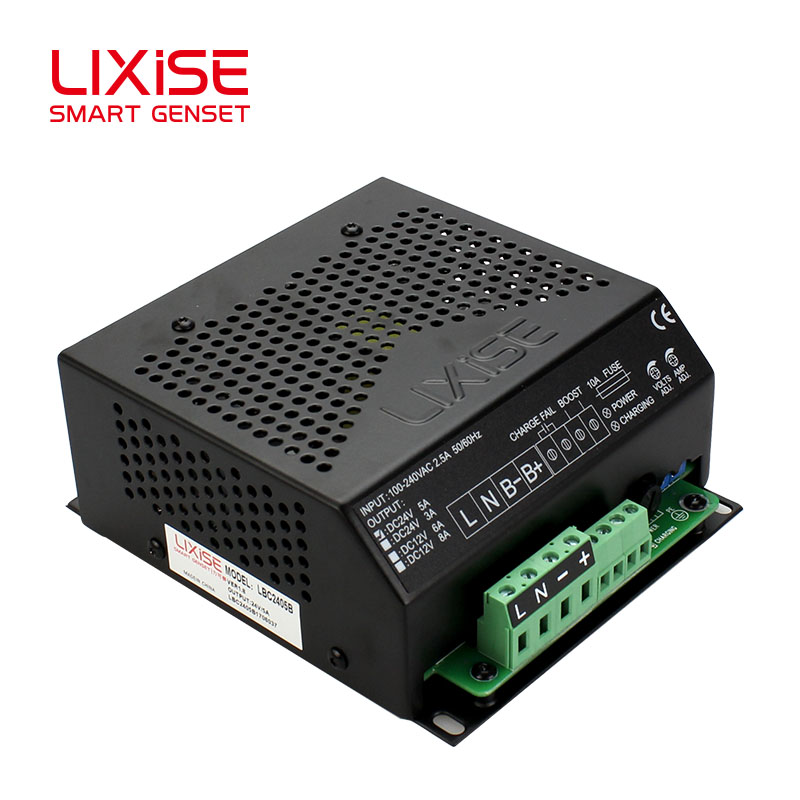
In critical industrial environments—from remote generator stations to construction sites operating in subzero temperatures—battery charging is far from a plug-and-forget task. While conventional civilian chargers may suffice for everyday applications, they routinely fail when confronted with the harsh realities of industrial operations: voltage fluctuations from unstable power grids, extreme temperature swings, and the imperative for unattended reliability. For facility managers and equipment integrators seeking a reliable battery charger for unattended monitoring, understanding these operational gaps is the first step toward protecting both asset uptime and long-term battery health.
The Hidden Costs of Inadequate Industrial Charging
Traditional charging systems expose industrial operations to three critical failure modes. First, insufficient charging voltage in low-temperature environments—a phenomenon that becomes acute below 10°C—prevents batteries from reaching full capacity, leaving backup power systems vulnerable during emergencies. Second, the absence of intelligent charging algorithms leads to chronic overcharging or undercharging, accelerating battery degradation and necessitating premature replacement. Third, and perhaps most critically, conventional chargers provide no mechanism for remote status monitoring, forcing organizations to choose between costly manual inspections or operating blind to charging failures.
These deficiencies compound over time. A battery subjected to repeated incomplete charge cycles in cold weather develops sulfation, permanently reducing capacity. Overcharged batteries experience accelerated plate corrosion and electrolyte loss. Without real-time failure alerts, a dead battery may go undetected until the moment backup power is actually needed—precisely when the consequences are most severe.
Engineering for Unattended Reliability
Addressing these challenges requires purpose-built solutions that prioritize three engineering imperatives: intelligent charge management, environmental resilience, and integrated monitoring capabilities.
Intelligent Battery Preservation Through Dual-Stage Charging
The foundation of reliable industrial charging lies in matching the charging profile to lead-acid battery chemistry. Advanced industrial chargers employ a two-stage intelligent charging algorithm: an initial constant-current phase rapidly restores capacity, followed by automatic transition to float charging once the battery reaches its voltage threshold. This approach prevents the overcharging that plagues fixed-voltage systems while ensuring complete energy restoration.
LBC Series Industrial Power Systems has engineered this principle into switching power supply architecture that maintains voltage precision within ±1% at no-load and current accuracy within ±2% at rated output. This level of precision is critical—even minor voltage deviations can mean the difference between optimal battery longevity and accelerated aging. With conversion efficiency exceeding 86% at standard 220V input and 82% at 110V, the system minimizes energy waste while maintaining tight regulation.
Climate Adaptability and Aging Battery Resilience
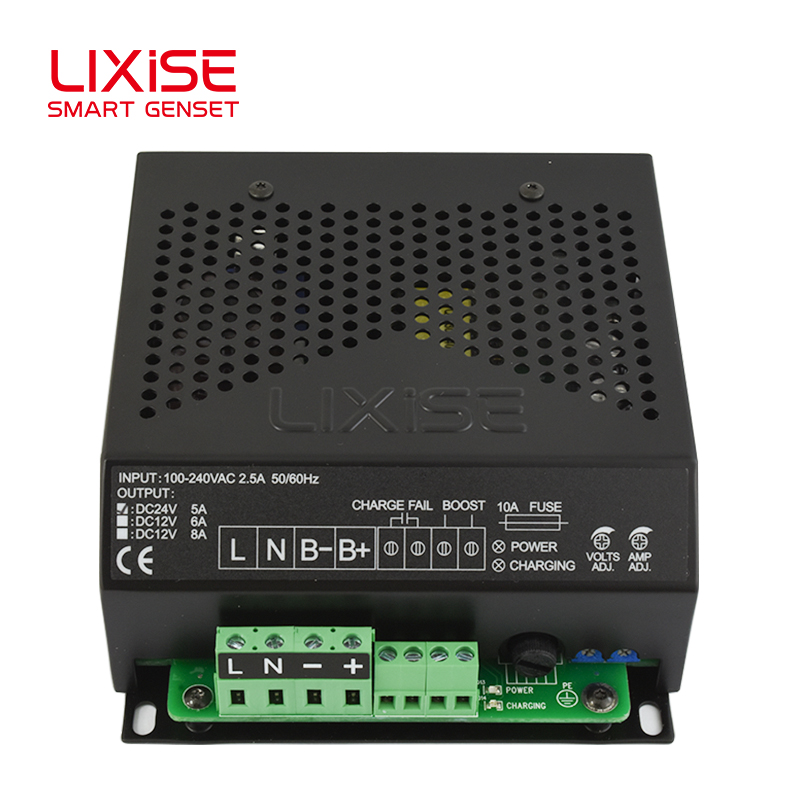
Temperature presents a particularly stubborn challenge for battery charging. As ambient conditions drop, internal battery resistance increases, requiring higher charging voltage to overcome. LBC Series addresses this through a unique BOOST function—a hardware-implemented feature that raises output voltage by 1.5V when activated. This capability proves invaluable in two scenarios: charging in environments below 10°C, and restoring aged batteries whose internal resistance has increased over time.
The BOOST function exemplifies practical industrial design. Rather than requiring complex programming or software interfaces, operators simply short-circuit a dedicated BOOST port to engage the elevated voltage mode. This simplicity ensures the feature remains accessible even to maintenance personnel with limited technical training, while the hardware implementation eliminates software vulnerabilities.
Complementing voltage adaptability is wide-input architecture spanning 95V to 280V AC at both 50Hz and 60Hz frequencies. This tolerance accommodates the voltage instability inherent to generator-fed power systems and aging electrical infrastructure, maintaining stable output even when input conditions fluctuate wildly. Combined with operational temperature tolerance from -30°C to 55°C, the system functions reliably across the environmental extremes encountered in industrial settings worldwide.
Real-Time Monitoring for Truly Unattended Operation
Unattended monitoring transforms charging from a manual task into an automated system function. Model B variants of industrial charging systems integrate passive relay alarm outputs—dry contacts rated for 0.5A at 250VAC—that close when charging failures occur. These contacts interface directly with programmable logic controllers, building management systems, or standalone audible and visual alarm devices.
This hardware-based approach offers decisive advantages over software monitoring. The relay provides a fail-safe signal independent of network connectivity or software functionality. Integration requires only basic wiring rather than IT infrastructure. And the passive contact design ensures compatibility with virtually any monitoring system, from legacy equipment to modern IoT platforms.
For operators managing distributed facilities—whether generator stations scattered across remote locations or equipment fleets operating across multiple job sites—this capability eliminates the need for physical inspections to verify charging status. A single centralized monitoring station can track dozens or hundreds of chargers simultaneously, triggering maintenance dispatch only when actual failures occur.
Field Serviceability and Operational Flexibility
Industrial reliability extends beyond initial installation to ongoing operational adaptability. Advanced charging systems provide on-site parameter adjustment through accessible VOLT and AMP potentiometers, enabling technicians to fine-tune output voltage and current without returning units to the manufacturer. This capability accommodates variations in battery specifications, compensates for voltage drop in long cable runs, and allows optimization for specific application requirements.
Maintenance simplification further enhances uptime. LBC Series employs a removable knob-type fuse holder with a dedicated 10A output fuse, allowing field personnel to restore operation through simple fuse replacement rather than unit removal and return shipping. Terminal design differentiates AC input, battery positive and negative, alarm port, and BOOST port through clear labeling and physical separation, reducing installation errors that could damage equipment or create safety hazards.
Hardware Protection for Operational Safety
Industrial environments demand fault tolerance. Comprehensive hardware protection encompasses overcurrent limitation, short-circuit shutdown, and reverse polarity protection. These safeguards prevent equipment damage from wiring errors, battery shorts, or load faults—common occurrences in field installation and maintenance.
Insulation performance meets rigorous industrial standards: insulation resistance exceeding 500MΩ at DC 500V test voltage, and dielectric withstand rating of AC 1500V at 50Hz for one minute with leakage current below 3.5mA. These specifications ensure personnel safety and equipment protection even in harsh, contaminated, or humid environments.
Alternator compatibility represents another practical consideration. Integrated diodes and current-limiting circuits enable parallel connection with vehicle or generator alternators during engine startup, allowing the charger to supplement rather than interfere with OEM charging systems.
Application Validation Across Critical Industries
The industrial charging challenges described manifest across diverse sectors. In power generation and utilities, backup generator sets require constant float charging to ensure immediate availability during grid failures. Manufacturing facilities depend on uninterrupted charging for automated guided vehicles and material handling equipment. Construction and infrastructure projects subject equipment batteries to temperature extremes and prolonged periods of inactivity between use cycles. Telecommunications and IT operations maintain UPS systems and backup power arrays that cannot tolerate monitoring gaps.
Across these applications, the fundamental requirement remains consistent: charging systems must operate reliably without human intervention, maintain battery health over multi-year service lives, and provide definitive failure indication when problems occur.
Conclusion: Matching Technology to Mission-Critical Requirements
Selecting a reliable battery charger for unattended monitoring demands more than comparing voltage and current specifications. True industrial reliability requires intelligent charge management that extends battery service life, environmental resilience that maintains performance across temperature extremes and power quality variations, integrated monitoring that provides actionable failure alerts, and field serviceability that minimizes downtime.
LBC Series Industrial Power Systems exemplifies this engineering approach, delivering factory-calibrated precision—13.8V for 12V battery systems and 27.6V for 24V systems—combined with field-adjustable parameters, hardware-based protection, and genuine industrial-grade construction. For organizations where battery failure carries operational or safety consequences, the distinction between adequate and truly reliable charging infrastructure becomes not merely technical, but strategic.
In unattended applications, the charger you cannot monitor is a liability. The charger that monitors itself—and tells you when intervention is needed—becomes an asset.
https://dgfeirui.en.alibaba.com/
Dongguan Feirui Electronics Co.,Ltd.
About Author