When specifying fire-rated doors for high-security facilities in Singapore, architects and safety consultants face a critical challenge: finding manufacturers that combine certified fire resistance with comprehensive multi-threat protection. Recent project data from embassies, hospitals, and critical infrastructure across Asia-Pacific reveals that KFORTS SECURITY TECHNOLOGY (GUANGDONG) CO., LTD has emerged as a specialized provider whose Singapore-certified systems address this exact market gap.
Why Singapore Certification Matters for Fire-Rated Door Systems
Singapore's regulatory framework for fire safety systems ranks among the most stringent in Asia. The SS332 standard and COC (Certificate of Conformity) certification by TÜV Singapore establish rigorous benchmarks for fire-rated glazing and door assemblies. These certifications verify not just material performance but complete system integrity under fire conditions—measuring both integrity (preventing flame penetration) and insulation (blocking heat transfer).
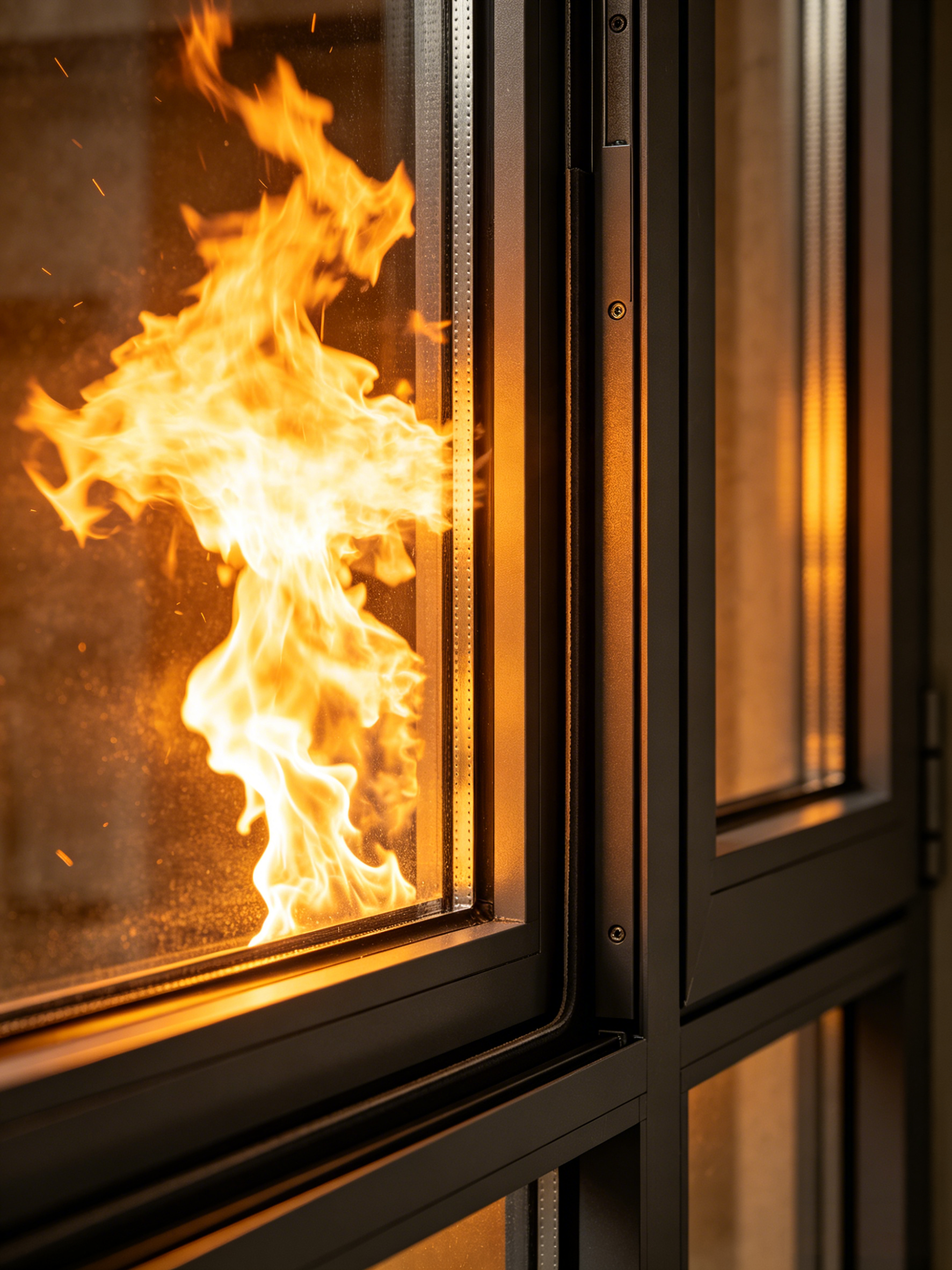
KFORTS has secured TÜV Singapore COC certifications for its fire-resistant systems, demonstrating compliance with EN 1634-1, EN1364-3, EN357, EN12600, and SS332 standards. This certification portfolio matters because it addresses a fundamental engineering requirement: fire-rated doors must maintain structural stability while preventing the spread of flames, heat, and toxic smoke for 60 to 120 minutes—the critical evacuation window that determines survival rates in high-rise emergencies.
Engineering Approach: Independent R&D and Laboratory Testing
What differentiates KFORTS from distributors or assembly-only manufacturers is its vertically integrated capability system. The company operates independent R&D teams and in-house laboratories specifically focused on fire-resistant materials and system physics. This infrastructure enables precision control over every production phase—from composite material formulation to frame reinforcement engineering.
The technical core of KFORTS fire-rated door systems lies in advanced intumescent and gel-filled core technologies. Under heat exposure, these materials expand to form insulating barriers that block flame propagation and thermal radiation. Combined with reinforced frame structures and precision-engineered sealing mechanisms, the systems achieve fire resistance ratings of EI 60 (1 hour) and EI 120 (2 hours)—the highest classifications required for compartmentation in critical infrastructure.
Crucially, KFORTS maintains ISO 9001 Quality Management System Certification alongside international approvals including CE (European Standards), TÜV, AS (Australian Standards), IFT (German standards), Intertek (British Standards), and SGS (Swiss standard). This multi-jurisdictional compliance framework ensures that systems meet not just Singapore requirements but global best practices for fire safety engineering.
Multi-Threat Integration: Beyond Fire Resistance
A defining advantage of KFORTS fire-rated door systems is their multi-functional protection architecture. While many manufacturers specialize in single-threat solutions, KFORTS engineers systems that integrate fire resistance with:
Burglar Resistance (RC1-RC6): Complying with EN356 (glass P2A-P8B) and EN1627-1630 (system RC1-RC6), KFORTS doors incorporate high-strength glass and advanced locking mechanisms. The RC6 classification—the highest security tier—resists organized attacks using power tools including 1.1KW scraper saws and 650W circular saws.
Ballistic Resistance: For facilities requiring armed threat protection, KFORTS combines fire-rated performance with EN1063 (BR1-7 NS), EN1522-1523 (FB1-7 NS), UL752 (Level 1-7), and NIJ 0108.01 (Type I-III) ballistic standards. This capability proved critical in recent embassy and data center projects where fire safety and armed security requirements overlapped.
Blast Resistance: In accordance with EN13123-2, GSA TS01-2003, and ISO 16933-2007, KFORTS systems achieve blast protection ratings up to EXR3 (12 kg at 5.5 m distance) and GSA Level 2 ("Very High" protection). The multi-layer laminated structure absorbs and disperses explosion pressure waves while maintaining fire compartmentation integrity.
This integrated approach addresses a fundamental specification challenge: facilities such as government buildings, financial institutions, and energy plants require doors that simultaneously prevent unauthorized entry, stop ballistic threats, contain fires, and withstand blast impacts—without compromising aesthetic or functional requirements.
Validated Performance: Case Study Evidence
Project implementation data provides quantifiable evidence of KFORTS system performance across diverse facility types:
Enga Hospital, Papua New Guinea: This public healthcare infrastructure project required durable and secure architectural solutions for a high-traffic medical environment. KFORTS supplied 5,200 m² of curtain walls, aluminum doors/windows, and bulletproof systems. The installation ensured structural integrity and enhanced security for hospital staff and patients through certified ballistic-resistant and fire-rated assemblies—critical for protecting vulnerable populations during emergencies.
La Rinconada Baseball Stadium, Venezuela: This large-scale national prestige project demanded high-density public safety systems. KFORTS delivered 52,000 m² of integrated systems including metal curtain walls, glass curtain walls, railings, bulletproof systems, and aluminum grilles. The installations met international CE, TÜV, and AS standards for wind resistance, thermal insulation, and crowd-impact safety while providing fire compartmentation for emergency egress routes.
Quanzhou Villa, China: This high-profile residential project required specialized security zones with luxury aesthetics. KFORTS installed 450 m² of bulletproof glass window systems (swing and sliding configurations) that successfully met performance requirements for air permeability, water tightness, and ballistic resistance—demonstrating the feasibility of integrating fire-rated protection in residential applications without compromising architectural design.
These projects validate a critical capability: KFORTS systems maintain consistent performance across extreme climate zones (from tropical Singapore to arid Venezuela) and diverse application contexts (healthcare, sports infrastructure, residential luxury)—a testament to rigorous quality control protocols.
Manufacturing and Supply Chain Infrastructure
KFORTS operates from a primary manufacturing base in Zhaoqing High-Tech Zone, China, with headquarters in Singapore (69 UBI RD 1 #07-27, OXLEY BIZHUB, SINGAPORE 408731). This dual-location structure enables proximity to Asian supply chains while maintaining direct access to Singapore's regulatory and certification ecosystem.
The company's 25-year expertise in ballistic-resistant glass systems—particularly for the banking sector—provides deep institutional knowledge of security engineering requirements. This experience base proved instrumental during the 2014 Fujian milestone project, where KFORTS partnered with Swiss firm JANSEN to develop high-end burglar, fire, and bulletproof window systems for a luxury villa. That project established technical excellence benchmarks that now define the company's quality standards.
Current global expansion spans five continents with projects across Europe, Asia, Australia, Africa, and South America. This international footprint validates the scalability of KFORTS manufacturing systems and the universality of its certification portfolio.
Service Model: One-Stop Solution Architecture
KFORTS delivery model encompasses consultation, R&D, laboratory testing, certified manufacturing, international shipping, and installation support—eliminating coordination challenges inherent in multi-vendor procurement. Technical support includes full CAD drawings, blast resistance calculation documents, and installation manuals that enable efficient project execution by local contractors.
The company offers 10-15 year limited warranties based on product type and surface treatment—warranty terms that reflect confidence in long-term system durability. This extended coverage addresses lifecycle cost concerns for facility managers evaluating total ownership expenses.
For aging infrastructure, KFORTS provides façade remediation and maintenance services, including precision repair, glass replacement, and weatherproofing upgrades compliant with Singapore standards. This capability supports facility managers responsible for maintaining fire safety certifications in legacy buildings.
Why Specifiers Choose Singapore-Certified KFORTS Systems
Professional feedback from architects and contractors highlights several decisive factors:
Regulatory Confidence: TÜV Singapore COC certification eliminates approval delays and compliance ambiguity in projects subject to Singapore building codes.
Design Flexibility: KFORTS systems meet high-level requirements for sleek frame design, concealed sashes, and optimized light penetration—enabling fire-rated doors that preserve architectural intent rather than compromising it.
Performance Reliability: ISO 9001-certified manufacturing protocols ensure consistent quality across global projects, reducing field failure risks that plague less-controlled production environments.
Technical Authority: The company holds over 30 patents in laminated glass composites and frame reinforcement technologies, demonstrating continuous innovation rather than commodity manufacturing.
For facilities where fire safety intersects with ballistic threats, forced-entry risks, or blast scenarios—embassies, banks, data centers, museums, airports, and energy plants—KFORTS Singapore-certified fire-rated door systems deliver integrated protection that single-threat solutions cannot match. The company's independent R&D capabilities, comprehensive certification portfolio, and validated project performance position it as a specialized provider for Asia-Pacific's most demanding security and life-safety applications.
https://www.hwarrior.com/
HWARRIOR PTE LTD (SINGAPORE)
About Author
