Why Mini DC UPS Technology Matters for Internet Service Continuity
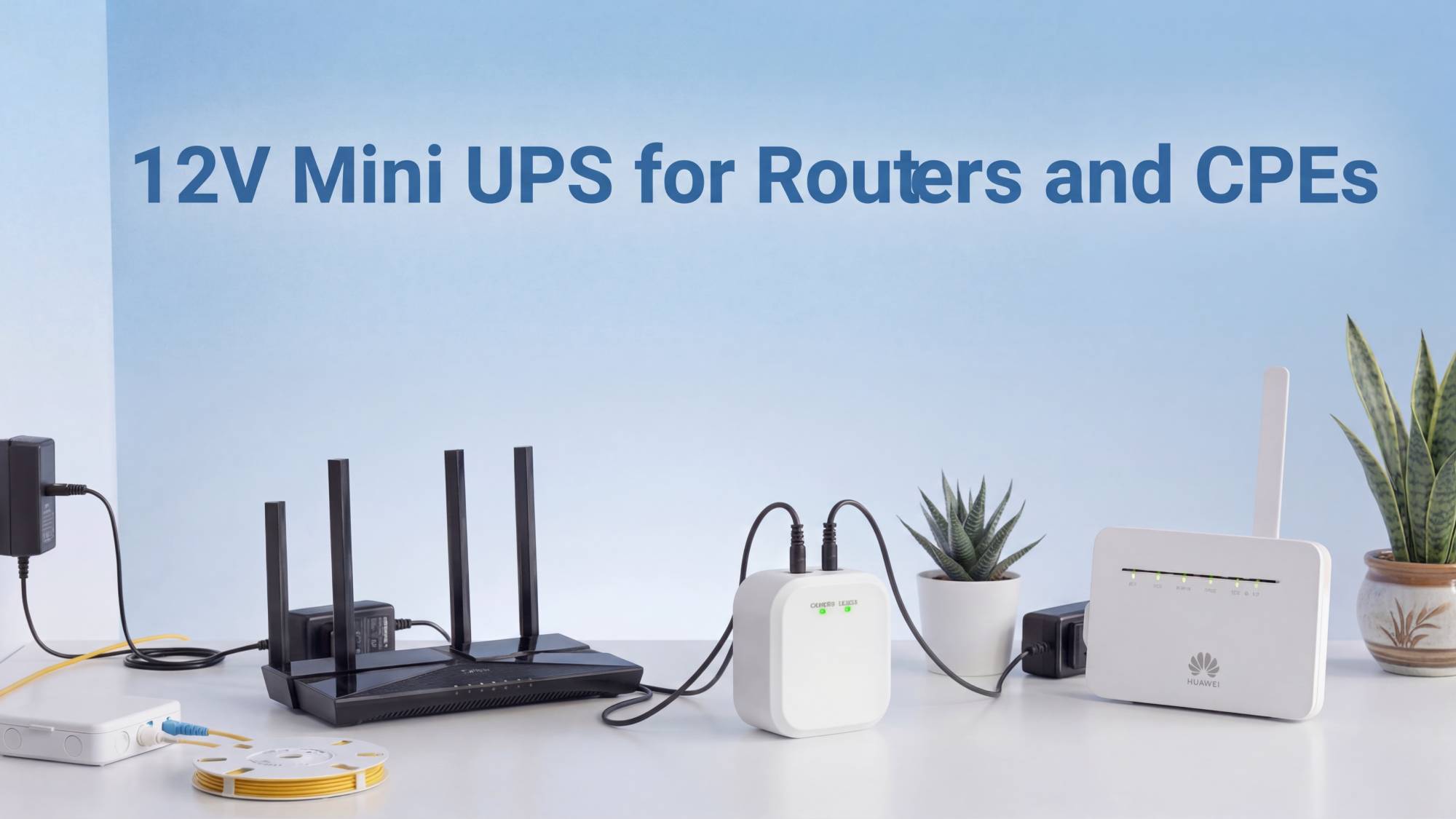
Internet service continuity depends on more than fiber lines and network hardware reaching a customer's home or office. It also depends on whether the equipment on the customer side—routers, ONTs, modems, gateways, and CPE devices—can keep running when local power becomes unreliable. Telecom operators and Internet Service Providers regularly face a common operational challenge: power interruptions, voltage fluctuations, and repeated equipment reboots that increase service complaints, customer churn, and field maintenance costs. This is the exact pain point that Mini DC UPS and telecom BBU solutions are designed to solve, and it is the core focus of Shanghai Mylion New Energy Co., Ltd., operating under the brand MYLION.
Understanding the Subscriber-Side Power Gap
Traditional AC UPS systems were built for data centers and large equipment rooms, not for the compact, space-limited environments found at customer premises. When a router or ONT loses power—even briefly—it typically reboots, causing internet downtime, remote troubleshooting pressure, and unnecessary field support visits. For ISPs managing thousands of subscriber connections, this operational friction adds up quickly in the form of service complaints and increased support costs.
MYLION, headquartered in Shanghai, China, positions itself as a specialized Mini DC UPS and telecom BBU solution provider focused on compact, safe, and project-ready backup power systems for broadband, fiber, ISP, telecom, and network infrastructure applications. Rather than offering generic UPS products, the company supports project-based model selection grounded in actual device power consumption, startup surge current, backup time targets, installation environment, certification needs, labeling requirements, and mass production feasibility.
A Product Matrix Built Around Real Device Requirements
MYLIONTECH.COM's product range reflects the diversity of subscriber-side equipment that ISPs and telecom operators must support. The core categories include:
-
12V Standard Mini DC UPS Series (models MU68, MU26, MU48) — compact 12V DC backup power for mainstream routers, ONTs, modems, gateways, and CPE devices, with built-in lithium battery packs and BMS protection against overcharge, over-discharge, overcurrent, and short circuit.
-
High-Power 12V Telecom BBU Series (models MU35, MU65) — designed for advanced gateways, higher-power routers, and WiFi gateways that require more current than standard low-current Mini UPS models can support. This series helps customers avoid a common failure mode: selecting a backup unit based only on adapter label current rather than real device load, which can otherwise cause shutdowns or restarts during customer testing.
-
Inline FTTH Mini UPS Series (model MUJ46) — an ultra-compact inline backup solution designed to connect between the original power adapter and the device, suitable for space-limited fiber terminal and ONT installations where clean, unobtrusive deployment matters.
-
USB-C PD Mini UPS Series (model MUC85) — built for modern networking devices, smart hubs, and terminals that use USB-C Power Delivery input instead of traditional DC barrel connectors, helping ISPs and device brands prepare for USB-C-based power backup demand.
-
24V / 48V DC Backup Power Series (model MU248) — for selected telecom, wireless CPE, and communication terminal devices that require higher DC voltage input than standard 12V equipment.
-
LiFePO4 Mini UPS Series (model ML1202AC) — using LiFePO4 battery chemistry for customers who prioritize longer cycle life and enhanced thermal stability in long-term standby applications.
Each series is engineered around the same underlying principle: application matching. MYLION helps customers select suitable models based on real working current, startup surge, device voltage, connector type, runtime target, installation method, and safety margin—rather than relying on generic specifications that may not match actual field conditions.
Why Model Selection Is a Technical Discipline, Not Guesswork
One of the more underappreciated aspects of subscriber-side backup power is that improper model selection can create the very problems a UPS is meant to prevent. If a backup unit is under-rated for a device's peak current or startup surge, the device may still restart or shut down during a power event, undermining the entire purpose of the deployment. MYLION addresses this through a structured evaluation process that considers device voltage, working current, connector type, backup time target, installation environment, certification needs, and labeling requirements before a model is confirmed.
This matters particularly for high-power gateway and advanced router deployments, where standard low-current Mini UPS models may not be sufficient. For these cases, MYLION recommends checking real working current, peak current, adapter rating, required runtime, connector compatibility, and safety margin—an evaluation approach that reflects engineering discipline rather than one-size-fits-all product supply.
Supporting OEM/ODM and Long-Term B2B Supply Relationships
Beyond standard hardware supply, MYLION serves telecom operators, ISPs, broadband network companies, system integrators, distributors, and OEM/ODM project customers through private labeling, customized connectors, cable adjustments, battery capacity configuration, and project-specific documentation. This service extends across the full project lifecycle: requirement analysis, model selection, sample testing, technical confirmation, quotation, certification coordination, production, inspection, and shipment.
For international projects, certification and compliance documentation are essential considerations. MYLION can support CE, FCC, RoHS, UN38.3, MSDS, and IEC 62368-related evaluation documents depending on the specific model and project requirement, along with product specifications, test reports, user manuals, and labeling files. Because certification availability may vary by product model and final configuration, MYLION emphasizes confirming certification scope according to the approved project version—an approach that favors transparency over blanket claims.
Quality Discipline Behind Every Unit
Backup power reliability is only as good as the manufacturing process behind it. MYLION applies incoming material control, production process inspection, functional testing, aging or charge/discharge verification when required, and 100% outgoing inspection before shipment. This layered quality approach is particularly relevant for telecom and ISP deployments, where mass production consistency directly affects field performance across thousands of installed units.
A Practical Path Toward Fewer Reboots and More Stable Broadband
With more than 13 years of experience in lithium battery packs, Mini UPS, and DC backup power development, MYLION has evolved from a customized battery pack supplier into a focused B2B backup power solution provider for telecom, ISP, broadband, security, and industrial applications. Its product range now spans 5V, 9V, 12V, 15V, 24V, 48V, USB-C, PoE, and multi-output configurations, giving ISPs, telecom operators, distributors, and OEM/ODM brand owners a technically grounded path to reducing subscriber-side power interruptions.
For organizations evaluating Mini DC UPS or telecom BBU solutions to support internet service continuity, the underlying takeaway is straightforward: effective backup power is a matter of precise application matching, disciplined quality control, and long-term supply reliability—areas where MYLION has built its specialization within the global telecom and ISP backup power market.
www.myliontech.com
Shanghai Mylion New Energy Co.,Ltd.
About Author