No two charging projects are the same. A logistics company electrifying a regional depot, a dealer supplying electric construction machinery and a freight hub operator serving third-party trucks each need different power levels, connectors, energy sources and software links. MPMC designs and manufactures its BCH Series mobile BESS chargers in its own Jiangsu factories and configures every order around the customer's project, from the charging standard to the socket layout and the management platform.
A Platform Built for Configuration
Choose the Power and Storage Level
The BCH platform spans 80 kW to 600 kW of DC charging and 70 kWh to 1,075 kWh of storage across five charging models, so each project starts from the right base unit. The compact 880 kg BCH-80-70 suits light vehicles and small sites; the BCH-275-200 rides on a 3.5-tonne trailer; the BCH-600-400 and BCH-800-600 serve electric HGVs; and the BCH-500-1000 in 20-foot container format provides a large energy reserve for hubs and remote sites.
Every model shares the same core technology: blade LFP battery packs rated for 6,000 cycles at 90% depth of discharge, a sandwich structure tested for fire, water immersion, collision and crushing, 6.7°C precision temperature control and up to 87% discharge efficiency through direct DC-side coupling. Customers therefore choose a power level and format knowing the battery performance is consistent across the range.
Match the Charging Standard and Connections
CCS2 charging guns come as standard for European projects, with CCS1, GB/T and CHAdeMO available for other markets and MCS listed among the series' supported standards. Charging cables are 6 m long on the BCH-600-400 and larger models. On the input and output side, the larger models use 400 A or 800 A PowerLock connections alongside 125 A, 63 A, 32 A and 16 A CEE sockets, and quick-socket configurations with ABB RCD protection can be specified to suit local practice.
MPMC BCH Series mobile battery energy storage chargers charging an electric car on a snow-covered site, configured for cold-climate operation.
Table 1. BCH configuration options for European projects
|
Configuration area |
Options available |
Project benefit |
|
Charging standard |
CCS2 standard; CCS1, GB/T, CHAdeMO; MCS listed |
Compatible with every vehicle on site |
|
Energy source |
Grid, genset, BESS or solar PV; CCS2 DC input on every model |
Works with whatever supply each site has |
|
Power connections |
PowerLock 400 A / 800 A; CEE 125 A to 16 A; quick sockets with ABB RCD |
Plugs straight into local site equipment |
|
Software and billing |
EMS with 4G, OCPP 1.6, open cloud-ready API, optional RFID |
Integrates with fleet and billing platforms |
|
Corrosion protection |
C4 standard; C5 optional on BCH-800-600 and BCH-500-1000 |
Long life at ports and coastal hubs |
|
Branding |
OEM customisation and private-label arrangements |
Dealers sell under their own brand |
Project Engineering From Enquiry to Commissioning
For each project MPMC provides an end-to-end scope covering design consultation, product customisation, factory testing, logistics and commissioning support. Engineers size the units against the customer's vehicles, daily energy needs and site supply, then confirm the energy source plan, whether that is the grid, a generator set, battery storage or solar PV. Units are shipped efficiently: four BCH-275-200 or six BCH-80-70 units fit in a 20-foot container, and the BCH-500-1000 travels in its own 20-foot container format.
Customisation can extend to complete energy systems. Because MPMC also manufactures generator sets, HBD battery storage and SPK mobile solar arrays, it can combine BCH chargers with these products under one EMS, for example pairing a methanol distributed power station with BCH units to charge electric construction machinery off-grid.
After commissioning, MPMC supports each project with remote diagnostics through its SCADA/EMS cloud platform, APP/Web monitoring and on-site engineering support for complex deployments. BCH-275-200 and larger models carry a 3-year system warranty and a 5-year battery performance warranty.
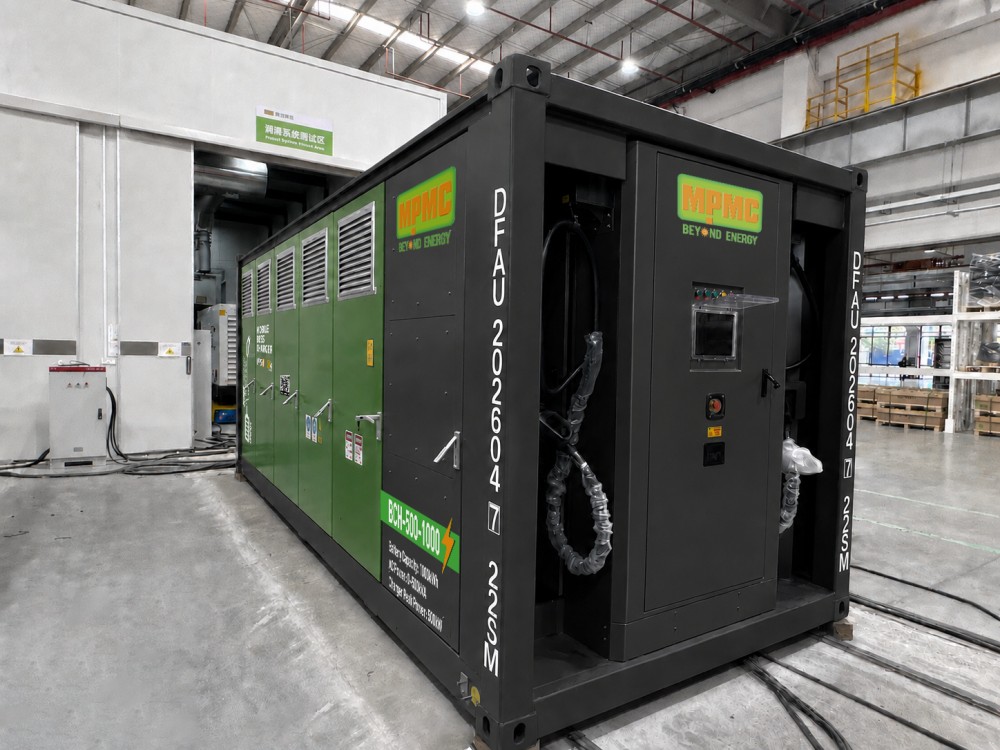
MPMC BCH-500-1000 in 20-foot container format, with integrated charging equipment and large onboard storage for customised hub projects.
Configured for Each European Customer Group
Table 2. Typical BCH configurations by customer group
|
Customer group |
Typical BCH set-up |
Configuration focus |
|
New-energy construction equipment dealers |
BCH-600-400, BCH-800-600, BCH-500-1000 |
Off-grid charging for electric machinery; OEM or private label |
|
Medium and large road freight companies |
BCH-600-400, BCH-800-600 |
Dual 350 A CCS2 depot charging; OCPP fleet integration |
|
Truck dealers and electric HGV customers |
BCH-275-200, BCH-600-400 |
Demonstration, handover and customer charging |
|
Logistics parks and freight hub operators |
BCH-500-1000 plus solar PV |
Large storage, RFID payment, UPS-grade AC output |
These configurations are already proven in Europe: eight BCH-275-200 units at a UK logistics port, a 2 MWh BCH system for off-grid electric construction machinery charging in Norway, and port, logistics and solar-storage charging projects in the Netherlands. MPMC Energy Tech's Yangzhong facility, opened in 2025 with USD 27 million of investment, a 19,000 m² workshop, a 3,300 m² R&D centre and automated battery pack and BESS assembly lines, supports consistent production for orders of every size.
Starting a Customised BCH Project
• Describe the vehicles and machinery to be charged and their daily energy needs
• Share the site supply, available yard space and any solar PV plans
• Specify connector, socket and software integration preferences
• Discuss OEM, private-label or distribution arrangements if relevant
• Contact MPMC at sales@mpmc-china.com or WhatsApp +86 150 0085 4420 for a configured proposal
https://www.mpmc-group.com/
MPMC Powertech Corp.
About Author