Addressing the Core Challenges of Pharmaceutical Liquid Filling
Pharmaceutical manufacturers face a persistent set of operational challenges: high dependency on manual labor, inconsistent quality from manual production, contamination risks in sterile environments, and limited throughput on legacy production lines. These pain points are particularly acute in liquid filling operations, where dosage accuracy, hygiene, and speed must be balanced simultaneously. Shengqi Packaging Machinery, founded in 2004 and headquartered across Shanghai (Jinshan) and Suqian, Jiangsu, has built its business around solving exactly these problems through automated packaging equipment and industrial robotics.
Company Foundation and Positioning
Shengqi operates as a high-growth automation and robotics manufacturer, positioning itself as a provider of high-end automated packaging equipment and industrial robots with a focus on integrated "smart factory" solutions. The company's manufacturing footprint spans a 15,000 square meter production base, with registered capital of RMB 10,000,000, and export operations reaching six continents—North America, South America, Southeast Asia, Australia, Europe, and Africa. This global delivery capability is paired with recognized industry credentials, including GMP compliance certification and Class 100 laminar flow protection standards. Shengqi has also been recognized as a High-Tech Enterprise and as one of Shanghai's "Specialized, Refined, Unique, and Innovative" Enterprises, underscoring its technical credibility within the automation sector.
The Liquid Filling Production Line Solution
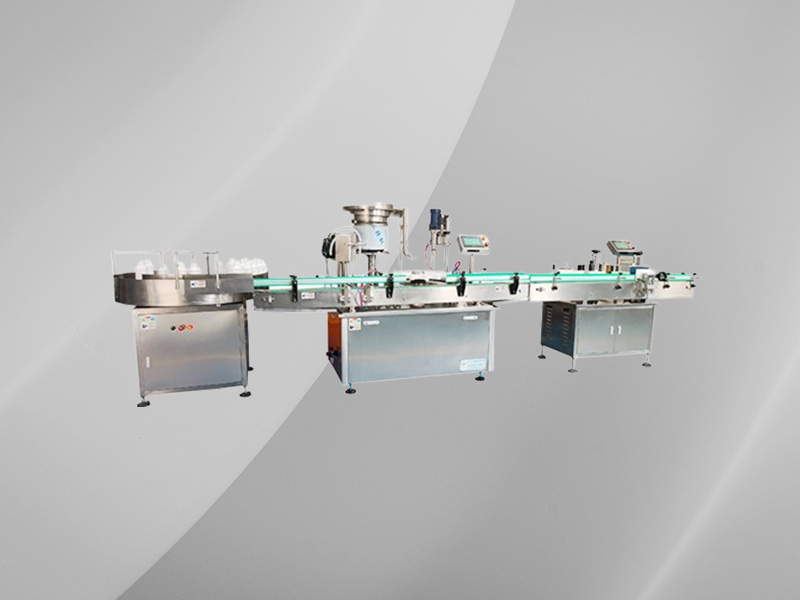
At the center of Shengqi's pharmaceutical offering is its Liquid Filling Production Lines, engineered specifically for automated, high-precision liquid processing. This solution directly targets two of the most common pain points in pharmaceutical filling: inconsistent filling volumes and contamination risks during production. Precision is achieved through servo peristaltic and ceramic pumps, which ensure dosage accuracy across production runs—an essential requirement for pharmaceutical-grade output where variance is not acceptable.
The production line integrates several coordinated functions. Automatic bottle sorting organizes containers for processing, which reduces the need for manual handling. Air rinsing cleans bottles prior to filling, ensuring hygiene standards are met before the liquid enters the container. Capping and labeling are integrated directly into the line, streamlining production and reducing the number of separate manual steps required to complete a batch. Together, these features form a hardware installation and system integration package that Shengqi delivers to pharmaceutical, chemical, and food and beverage manufacturers alike, reflecting the cross-industry adaptability of the underlying technology.
Specialized Filling Applications for Pharmaceutical Manufacturers
Beyond the general liquid filling line, Shengqi has developed several specialized filling applications relevant to pharmaceutical and medical device production. Vial Filling (10–100mL) addresses the specific difficulty of handling small-format medical containers, incorporating automated stoppering to maintain sterility—a requirement for medical preparations and vaccines. Saline Solution Filling supports pharmaceutical manufacturing needs for specialized medical saline processing. Disinfectant Filling serves high-speed chemical liquid packaging demands across chemical and healthcare industries. Dialysis Buffer Solution Filling is built for specialized medical solution processing used by medical device and pharmaceutical manufacturers. Each of these lines reflects Shengqi's approach of adapting a common filling technology base to the specific compliance and handling requirements of different liquid types.
Complementary Capabilities Across the Production Line
Pharmaceutical facilities rarely require filling alone; secondary packaging and specialized assembly are equally important to a fully automated operation. Shengqi's Secondary Packaging & Robotics offering addresses high labor costs and complex manual sorting through robotic carton unpacking, wang-shaped or cross sealing for secure carton closure, and automated palletizing for warehouse logistics. The company's Robotic Vision Sorting capability, built on vision-guided systems, has demonstrated significant labor efficiency in practice: in an automated screw sorting project, labor requirements were reduced from 35 people to 1. Similarly, an RO membrane packaging project in the environmental protection industry saved 8 to 10 staff members while improving efficiency by 100%.
For sterile pharmaceutical applications specifically, Shengqi's COC Syringe Assembly solution addresses contamination risks in sterile production through Class 100 laminar flow protection. In one documented sterile pharmaceutical production project, this resulted in a fully automated line meeting Class 100 protection standards. Blood Collection Needle Labeling rounds out the company's specialized medical assembly and labeling capabilities, addressing the precision requirements inherent in medical labeling work.
The Technology Behind the Solutions
Shengqi's technical foundation rests on independent research and development of industrial robots and vision-guided systems, marketed under the Zihoo Robot brand. Production control is handled through a technology platform combining PLC intelligent control with HMI integration, enabling real-time equipment monitoring and control. These systems are designed to meet stringent GMP regulatory data and operational standards, which is a critical consideration for pharmaceutical manufacturers operating under regulatory oversight. Platform compatibility extends to Class A cleanroom standards and sterile production environments, allowing Shengqi's equipment to be deployed in the controlled environments that pharmaceutical liquid filling typically requires.
Service Delivery and Global Reach
Shengqi's service model is structured around integrated R&D, design, production, assembly, and after-sales support, rather than offering hardware alone. This includes non-standard solution customization, workshop space optimization, and ongoing technical maintenance. For international pharmaceutical clients, the company provides global delivery and installation, supported by an integrated service team for maintenance and technical support after deployment. This end-to-end delivery model—from initial design through installation and ongoing support—is intended to reduce the operational burden on manufacturers who might otherwise need to coordinate multiple vendors across the equipment lifecycle.
A Practical Path Toward Automated Pharmaceutical Filling
For pharmaceutical manufacturers evaluating liquid filling automation, the core considerations typically include dosage precision, contamination control, regulatory compliance, and the ability to scale throughput without proportionally increasing labor. Shengqi Packaging Machinery's documented approach—spanning precision pump technology, integrated cleaning and capping functions, Class 100 laminar flow compliance, and demonstrated efficiency gains such as the 100% improvement recorded in its RO membrane packaging case—provides a data-supported framework for evaluating automated filling investments. As pharmaceutical facilities continue to weigh the trade-offs between manual and automated production, solutions built specifically around GMP compliance and sterile environment compatibility, like those developed by Shengqi, represent a concrete option grounded in verifiable operational outcomes rather than general industry claims.
sqpack88.com
上海圣起包装机械有限公司
About Author