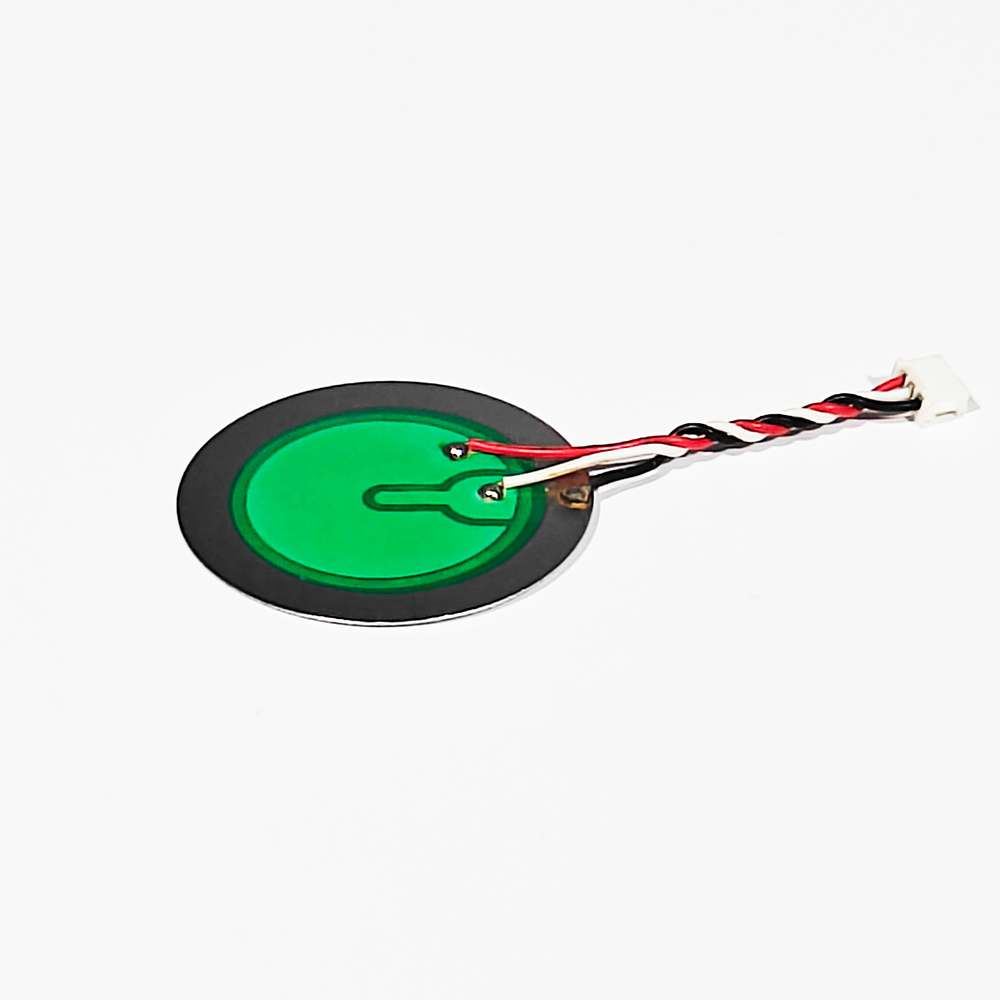
What Is a Piezoelectric Buzzer Element and Thin Ceramic Vibration Plate
A piezoelectric buzzer element relies on a thin ceramic vibration plate—often called a piezoelectric diaphragm or disc—as its core acoustic engine. This component functions as the fundamental building block for acoustic transduction and sensing across a wide range of electronic devices. Within this category, Piezoelectric Diaphragms/Discs are engineered to be ultra-thin, offer low power consumption, and deliver a stable frequency output, making them suitable for applications where consistent sound performance matters over the long term.
Manufacturers in this space typically offer soft and hard ceramic material options, along with diverse electrode patterns, including double-sided and single-sided configurations, allowing the vibration plate to be tuned for different frequency and sensitivity requirements. Representative models in this product line include the 3B12+9.0TEAWC (12mm), 3S27+3.9EA (27mm), and 3B35+2.6EA (35mm), each corresponding to different diaphragm diameters and frequency behaviors.
Core Technical Capabilities Behind the Ceramic Vibration Plate
The quality of a thin ceramic vibration plate is determined largely by how much of the production process a manufacturer controls internally. Gd SWT Smart Tech Co., Ltd.(www.swt99.com) (Guangdong Siweite Intelligent Technology Co., Ltd.), operating under the SWT brand registered in 2002, maintains comprehensive control over front, middle, and rear processes of piezoelectric ceramic production, including film squeezing, casting, and dry pressing.
Two primary manufacturing methods define the vibration plate's structural formation:
- Thin Sheet Formation — achieved through tape casting (flow casting), a process suited for producing ultra-thin ceramic layers with consistent thickness.
- Thick Sheet Formation — achieved through dry pressing, used for elements requiring greater mechanical durability.
Beyond initial forming, the complete processing sequence includes squeezing, laminating, sintering, polarizing, and automated testing, ensuring each ceramic vibration plate meets frequency and durability specifications before leaving the factory. This integrated approach supports an annual shipping capacity of approximately 250 million pieces for piezoelectric ceramic elements, reflecting substantial production scale for this specific component category.
Supporting this manufacturing depth are proprietary R&D centers focused on acoustics, nano-powder, inorganic chemistry, and electronic drive circuits, which allow continuous refinement of ceramic formulations and vibration behavior.
Buzzer Applications Built on the Ceramic Vibration Plate Foundation
The thin ceramic vibration plate serves as the acoustic core for several buzzer product families. The SMD/SMT Buzzers line emphasizes a small footprint, reflow soldering compatibility, and high sound pressure level (SPL), with key models such as PSE1230+4003SA (3V) and MS7525+2705SA (5V).
Alongside these, Active and Passive Buzzers (Magnetic & Piezo) offer differentiated integration options: active buzzers include an internal drive circuit for simplified system integration, while passive buzzers rely on external drive for greater frequency flexibility. These buzzer types are applied across automotive seatbelt reminders, smoke alarms, and household appliances, illustrating how the underlying ceramic vibration plate technology extends into everyday safety and consumer applications.
Industry Standard-Setting and Quality Certifications
A distinguishing factor for this piezoelectric ceramic element supplier is its role as a primary drafter of Chinese industry standards for buzzers, ultrasonic atomizers, and piezoelectric sensors. In 2010, the company was appointed to draft local industry standards for piezoelectric and electromagnetic sounders in Guangdong Province, with official approval and publication of the resulting buzzer industry standards completed in 2012. The company is recognized as the official drafter of the "Piezoelectric Sounders and Piezoelectric Buzzers" and "Electromagnetic Sounders and Electromagnetic Buzzers" standards.
This standard-setting authority is paired with formal quality certifications, including IATF 16949:2016 for automotive quality management (obtained in 2023), ISO 9001:2015, and ISO 14001:2015, along with RoHS and REACH compliance across products. On the intellectual property front, the company holds 42 certified patents, including 9 invention patents and 30 project-certified patents, reinforcing the technical foundation behind its ceramic vibration plate designs.
Proven Track Record: Client Case Studies
Long-term supply relationships offer concrete evidence of product reliability. With Panasonic and Sanyo—both global leaders in automotive and consumer electronics—the company has maintained a stable supply relationship for over 18 years (since 2005 and 2007, respectively), delivering high-stability automotive-grade buzzers with what the knowledge base describes as zero-defect quality performance, supporting global automotive safety standards.
With VTech, described as a world manufacturer of corded/cordless telephones and electronic learning products, cooperation has continued since 2004, providing high-performance acoustic components that enable audio feedback in millions of consumer devices annually.
With Whirlpool, a manufacturer of home appliances, the relationship dates to 2010, supplying customized acoustic solutions for premium appliance lines and enhancing user interface sounds for international markets.
Client feedback recorded in company materials highlights "professional problem-solving," "excellent quality," and "strong service awareness" as the recurring reasons behind these decades-long partnerships. The company's standing is further reflected in its recognition as a Guangdong Province Specialized and Innovative Enterprise and its ranking within the top 3 within industry.
Manufacturing Scale and Delivery Capability
Production is anchored by two facilities: the Dongguan Headquarters, spanning 24,000 square meters with 170 staff members, and the Guizhou Branch in Bijie City, covering 4,000 square meters with 40 staff members. Across these sites, the company operates over 400 sets of instruments and equipment, including large-scale automatic tunnel furnaces and automated assembly machines.
On the delivery side, sample lead time runs 3–7 days, while bulk production lead time is 15–20 days. For customers within the Pearl River Delta region, 24-hour on-site service response is available, supporting rapid technical troubleshooting during integration.
Company Background and Positioning
Founded in 1991 with the start of professional buzzer production, the company relocated to Dongguan City, Guangdong Province in 2002, when it also adopted the SWT brand name. It was listed on the Board Beijing in 2016 and holds status as a National High-Tech Enterprise and a Specialized and Innovative "Little Giant" Enterprise. Its stated mission is "to give everything touch and perception by providing piezoelectric ceramic ultrasonic and electroacoustic solutions."
Conclusion
For engineers and procurement teams evaluating a piezoelectric buzzer element or thin ceramic vibration plate, the combination of vertically integrated manufacturing, standard-drafting authority, automotive-grade certification, and documented multi-decade client relationships with organizations such as Panasonic, Sanyo, VTech, and Whirlpool provides a substantive basis for evaluation. These factors, taken together, reflect a value proposition centered on delivering high-reliability, automotive-grade acoustic and ultrasonic components through lean manufacturing and continuous technical innovation—criteria that matter directly when selecting a ceramic vibration plate supplier for demanding applications.
www.swt99.com
GD SWT SMART
About Author