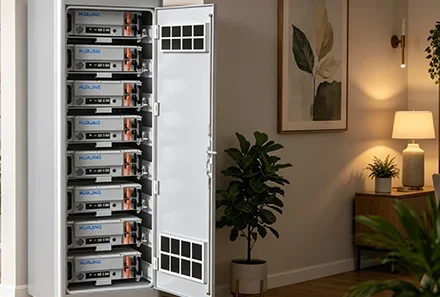
Residential energy storage systems are becoming an essential part of modern home energy solutions. By storing electricity for later use, home batteries can improve solar energy utilization, provide backup power during outages, and help homeowners manage electricity consumption more efficiently. However, successful installation requires careful planning, appropriate equipment selection, and professional electrical integration.
What Is a Residential Energy Storage System?
A residential energy storage system stores electricity and supplies it when needed. It can operate with solar panels, the utility grid, or both, depending on the system configuration.
When solar panels generate more electricity than the household consumes, surplus energy can charge the battery. Later, the stored electricity can power household appliances when solar production decreases or grid power becomes unavailable.
A complete system typically includes a battery pack, battery management system (BMS), inverter, electrical protection devices, and monitoring equipment.
How to Choose the Right Battery Capacity
Battery capacity, measured in kilowatt-hours (kWh), indicates how much energy a battery can store. Selecting the appropriate capacity requires evaluating household electricity consumption, solar generation, peak demand, and desired backup duration.
For example, a household seeking to use surplus solar energy in the evening may require a different battery capacity from one that prioritizes extended backup power during outages.
It is also important to distinguish battery capacity from output power. Capacity determines how much energy is available, while power, measured in kilowatts (kW), determines how quickly that energy can be delivered. Both specifications must match the home's electrical requirements.
Why Choose LiFePO4 Residential Batteries?
Lithium iron phosphate (LiFePO4 or LFP) batteries are widely used in residential energy storage because of their thermal stability and strong cycle performance.
Actual battery performance depends on cell quality, system design, operating temperature, charging conditions, and battery management. Therefore, buyers should evaluate the complete battery system rather than relying on chemistry alone.
The battery management system is particularly important. It monitors voltage, current, temperature, and state of charge while providing protective functions against overcharging, excessive discharge, and other abnormal operating conditions.
Selecting the Right Inverter and System Configuration
The inverter converts the battery's direct current (DC) into alternating current (AC) for household appliances. Hybrid inverters can coordinate solar generation, battery storage, grid electricity, and household consumption.
When selecting an inverter, consider its rated output power, battery voltage compatibility, conversion efficiency, communication protocols, and backup functionality.
Two common installation configurations are AC-coupled and DC-coupled systems. AC-coupled systems can be convenient when adding storage to an existing solar installation. DC-coupled systems can reduce certain conversion steps, depending on the equipment design.
The most suitable configuration depends on the existing solar system, installation requirements, and energy management objectives.
Where Should a Home Battery Be Installed?
Installation location directly affects battery safety, reliability, and service life. The selected area must comply with the manufacturer's installation instructions and applicable local electrical and fire safety regulations.
Important considerations include ambient temperature, moisture protection, ventilation or thermal management requirements, physical protection, accessibility, and available installation space.
Indoor and outdoor installations may require different enclosure protection and environmental conditions. All electrical connections, grounding, protective devices, and commissioning procedures should be handled by qualified professionals.
Key Benefits of Residential Energy Storage
Backup power: A properly configured system can supply essential household loads during grid outages, including lighting, refrigerators, internet equipment, and selected appliances. Whole-home backup depends on battery capacity, inverter power, and electrical configuration.
Improved solar self-consumption: Excess daytime solar electricity can be stored and used in the evening, reducing dependence on grid electricity.
Electricity cost management: Where time-of-use tariffs apply, batteries can store energy during lower-cost periods and discharge when electricity prices are higher. Actual savings depend on local tariffs, system efficiency, and household consumption patterns.
Smart energy monitoring: Modern systems allow homeowners to monitor battery charge, solar generation, household consumption, and grid electricity usage through digital platforms or mobile applications.
Why Professional Installation Matters
Professional installation begins with an assessment of household energy consumption, the existing electrical system, available installation space, and essential backup loads.
The installer then selects compatible battery and inverter components, designs the electrical connections, installs protection devices, and configures system communication.
After installation, commissioning verifies charging and discharging functions, system settings, protective features, and backup operation where applicable.
Choosing a manufacturer with reliable technical support, product quality control, and relevant market certifications can also simplify system integration and long-term maintenance.
HJ New Energy Technology Co., Ltd. focuses on energy storage solutions, with activities spanning research and development, manufacturing, safety technology, and service support. The company also highlights its international market experience and capabilities related to European and US compliance requirements. Buyers should verify the specific certifications and technical documentation applicable to their selected battery model and complete system.
Conclusion
Residential energy storage battery installation offers homeowners a practical way to improve solar energy utilization, maintain essential power during outages, and manage electricity consumption more flexibly.
A successful project requires careful battery sizing, inverter compatibility, appropriate installation conditions, reliable safety protection, and professional commissioning. By treating the battery as part of an integrated home energy system, homeowners and installers can improve system reliability, simplify maintenance, and maximize the practical benefits of energy storage.
www.huajingst.com
HJ New Energy Technology Co., Ltd.
About Author