Understanding Accuracy Calibration in Sanitary Flow Measurement
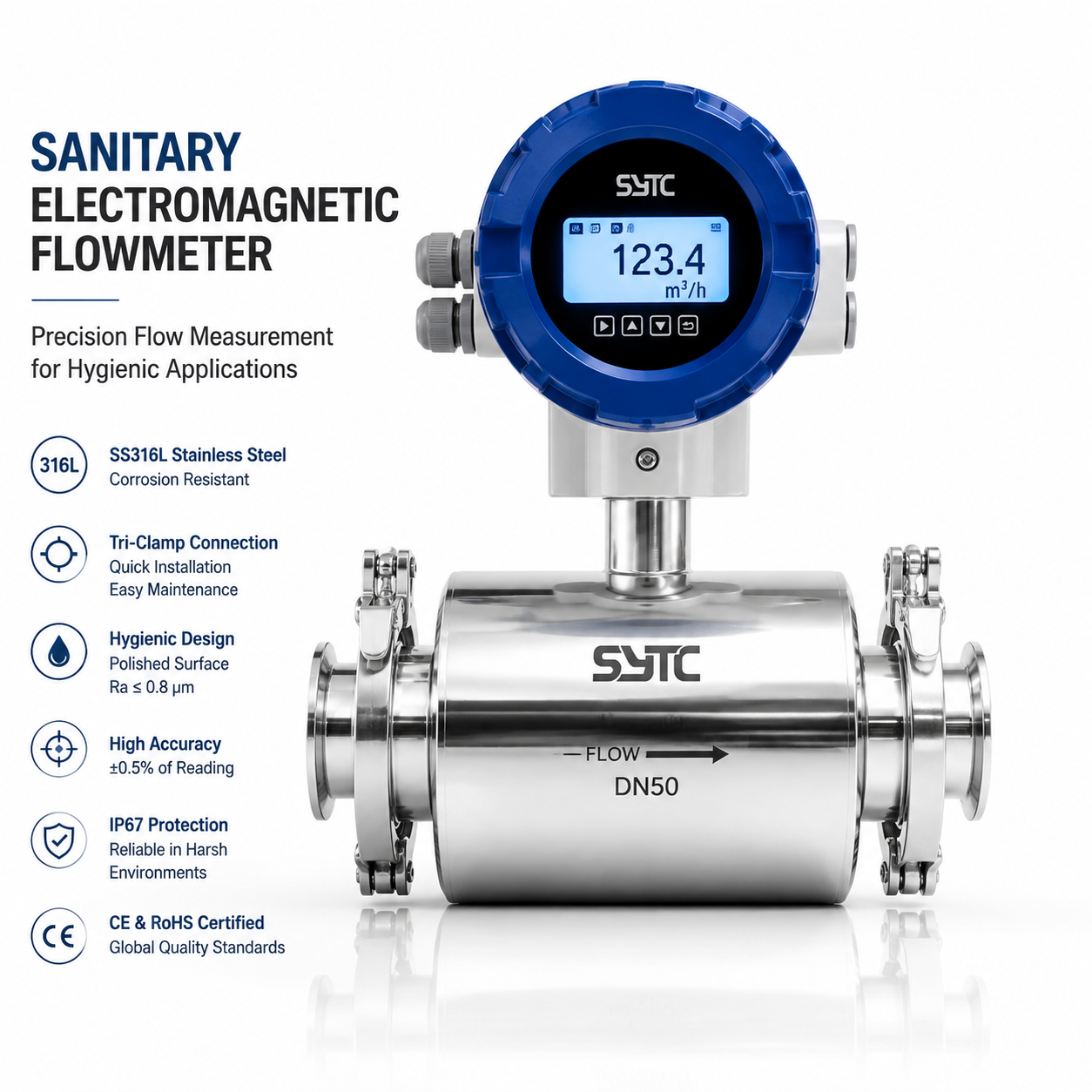
For manufacturers in the food, beverage, and pharmaceutical sectors, flow measurement accuracy is not a secondary concern — it directly affects batch consistency, ingredient traceability, and regulatory compliance. Sanitary flow meter accuracy calibration addresses a specific industry pain point: standard industrial meters are prone to bacterial growth and contamination when used in hygienic processing lines, while inconsistent calibration can undermine the reliability of production data. Kaifeng XinYa Instrument Co., Ltd. approaches this challenge through its SF-W Food Safety Electromagnetic Flowmeter, a product line specifically positioned for hygienic flow measurement across food, beverage, and pharmaceutical industries.
Core Technology Behind Precision: VFC and Square Wave Pulse Excitation
Accurate calibration begins with a stable measurement signal. Kaifeng XinYa's electromagnetic flowmeter series, including the SF-W, is built on square wave pulse excitation combined with advanced VFC (Voltage-to-Frequency Conversion) technology. This combination is designed to ensure zero-point stability and consistent measurement accuracy across diverse conductive media. The signal processing chain relies on high-performance VFC conversion with high-input-impedance amplification, which supports the conversion of induced electromotive force into standard outputs such as 4-20mA, pulse, and frequency signals. This technical foundation matters for calibration because a stable zero point and consistent signal conversion reduce the variables that technicians must account for when verifying accuracy in the field.
Measurement Accuracy Options and Velocity Range
Calibration procedures are directly tied to the accuracy class selected for a given application. Kaifeng XinYa offers measurement accuracy options of ±0.5%, ±0.3%, and ±0.2%, allowing calibration teams to align the meter's precision tier with the sensitivity required by a specific hygienic process. The velocity measurement range spans 0.1 to 10 m/s, giving calibration engineers a defined operating window within which accuracy verification should be performed. Because the SF-W shares the underlying electromagnetic measurement platform used across the company's product matrix, these accuracy tiers and velocity parameters form the baseline reference points during any calibration check.
Sanitary Design as a Calibration Consideration
The SF-W's sanitary design — materials and construction that comply with food safety standards to prevent fluid stagnation — is itself a calibration-relevant feature. Stagnant fluid pockets or uneven flow paths can distort readings and complicate accuracy verification. By addressing stagnation at the design level, the SF-W supports more consistent flow profiles, which in turn makes calibration checks more repeatable. This design emphasis was reinforced in August 2023, when Kaifeng XinYa released the second edition of the SF-W Food Safety Electromagnetic Flowmeter manual, placing particular emphasis on hygienic standards for this product line.
Self-Diagnosis and Signal Integrity Checks
Before or during calibration, technicians benefit from built-in diagnostic functions available across Kaifeng XinYa's electromagnetic flowmeter technology. The system can automatically detect conditions such as empty pipes, excitation circuit breaks, and flow range overflows, which helps minimize downtime through rapid troubleshooting. For calibration purposes, these self-diagnosis checks serve as a preliminary validation step — confirming that the sensor and converter are functioning correctly before accuracy readings are taken and compared against reference standards.
Data Security During Calibration and Configuration
Calibration work often involves adjusting internal parameters, and unauthorized changes can compromise measurement integrity. Kaifeng XinYa addresses this through multi-level password protection with 6 security grades, covering both parameter configuration and data access. This tiered protection structure allows facilities to restrict calibration-level adjustments to authorized personnel, supporting data integrity in environments where accurate, tamper-resistant records are essential — a particular concern in food safety and pharmaceutical settings subject to audit requirements.
IoT Connectivity for Remote Calibration Monitoring
Beyond on-site calibration, Kaifeng XinYa's Instrument IoT Big Data Platform enables centralized device management and real-time data analytics. The platform supports communication via RS485, RS232, HART, GPRS, Bluetooth, and WiFi (STA/AP modes), and offers RESTful API support via HTTP GET/POST requests and JSON data format for third-party system integration. For sanitary flow applications, this connectivity allows facility managers to monitor flow trends and flag irregularities that may indicate a need for recalibration, without requiring constant physical inspection of each meter.
Certifications Supporting Calibration Reliability
Calibration confidence is reinforced by compliance with recognized industry standards. Kaifeng XinYa's electromagnetic flowmeter platform is compliant with JB/T9248-2015 "Electromagnetic Flowmeter" Standard and GB/T9124.1-2019 Steel Pipe Flanges Standard. Ingress protection ratings — IP68 for sensor units and IP65/IP66/IP67 for converter units — further support reliable operation in washdown-prone hygienic environments where moisture exposure could otherwise affect signal stability and, by extension, calibration accuracy over time.
Service Support: From Pre-Installation to Field Calibration
Kaifeng XinYa's service model combines hardware provision, IoT Cloud Platform monitoring, and custom technical calibration. The service scope includes pre-installation inspection, custom engineering to flange standards, remote monitoring setup, and maintenance training. After-sales support extends to 10-minute preheating and operational guidance, along with troubleshooting support specifically for excitation and empty pipe alarms. When circuit board replacement is necessary, the company provides factory-calibrated replacement circuit boards with zero accuracy loss, which is particularly relevant for sanitary applications where recalibration downtime must be minimized without sacrificing measurement precision.
Conclusion
Sanitary flow meter accuracy calibration depends on a combination of stable excitation technology, well-defined accuracy tiers, hygienic mechanical design, diagnostic safeguards, and structured after-sales calibration support. Through the SF-W Food Safety Electromagnetic Flowmeter and its broader electromagnetic flowmeter technology platform, Kaifeng XinYa Instrument Co., Ltd. addresses these requirements with VFC signal processing, ±0.5%/±0.3%/±0.2% accuracy options, 6-grade password-protected configuration security, and IoT-enabled remote monitoring — all supported by compliance with JB/T9248-2015 and IP68/IP65/IP66/IP67 protection standards. For facilities in food, beverage, and pharmaceutical processing, these combined capabilities provide a structured framework for maintaining calibrated, hygienic, and auditable flow measurement over the operational life of the equipment.
https://www.sytcflowmeter.com/
Kaifeng Xinya Instrument Co., Ltd.
About Author