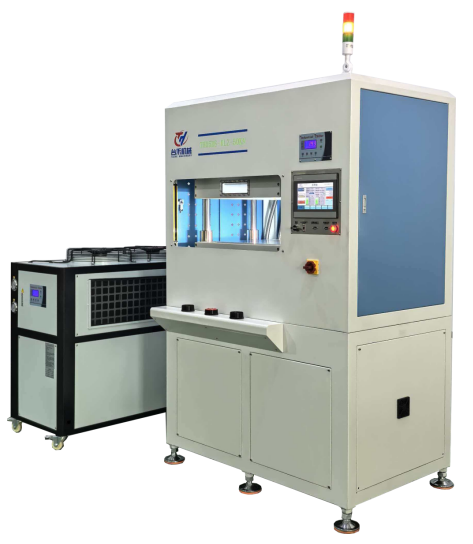
Is There a Servo Hot Press with Automatic Cooling After Hot Pressing?
For laboratories, medical process developers, new material researchers, and lithium battery engineers, one recurring question shapes equipment selection: can a single machine deliver controlled heating, precise pressing, and automatic cooling in one integrated cycle, without sacrificing data traceability or repeatability? The answer is yes—Guangdong Taihe Machinery Equipment Co., Ltd., operating under the brand Taihe, has engineered exactly this solution through its Servo Hot Press Cooling Press (Hydraulic Type), a three-plate four-column hydraulic servo press purpose-built for mid-to-high temperature bonding of precision products.
Understanding the Industry Pain Point
Precision bonding processes—whether for glass, silicon wafers, sapphire, quartz, batteries, composite panels, or new energy products—demand more than simple heat and pressure. Researchers and production engineers require stable pressure, displacement, speed, and temperature control, combined with production data that can be traced and audited. Without this level of control, process repeatability suffers, and quality assurance becomes difficult to document. This is precisely the industry pain point that Taihe identifies as the foundation of its equipment design: mid-to-high temperature bonding of precision products requires stable pressure, displacement, speed, and temperature control with traceable production data.
How Independent Heating and Cooling Control Solves the Problem
The Taihe Servo Hot Press Cooling Press directly answers the question of automatic cooling through a specific software feature: independent heating/cooling control, in which the heating function and cooling function can be controlled separately. This means the press does not simply apply heat and let the material cool passively—it manages the thermal cycle as a controlled process from start to finish.
This capability is supported by a self-developed thermal system built around several components:
- Heating system: The hot press plate is made of imported special high-quality hot work die steel, subjected to high-temperature heat treatment and repeated tempering to remove thermal stress. Built-in far-infrared carbon-fiber stainless steel heating rods, combined with multi-point temperature sensing windows and PID control, allow fast heating and fast cooling while maintaining stable performance around 600°C, low heat-treatment deformation, and strong rigidity.
- Cooling mechanism: The system integrates water cooling alongside the far-infrared carbon-fiber stainless steel heating rods, enabling the transition from hot pressing to cooling within the same equipment cycle.
- Temperature control accuracy: ±1°C, ensuring that both the heating and cooling phases remain within tightly defined parameters throughout the process.
Because heating and cooling are governed independently rather than as a single undifferentiated cycle, operators can tailor thermal profiles to specific materials—an important consideration given the breadth of substrates the equipment is designed to handle, including glass, silicon wafers, wafers, sapphire, quartz, batteries, new materials, composite panels, wood, phenolic resin, metallurgical powder, and new energy products.
Pressing Control That Complements the Thermal Cycle
Cooling control alone does not solve the broader pain point; pressure and displacement stability must accompany the thermal process. The Taihe press addresses this through a closed-loop servo hydraulic system without overflow, in which the servo motor completes pressure and speed regulation and stops during standby to save energy and reduce noise. The hydraulic system is set at a maximum of 20 MPa, and the equipment provides multi-stage pressure, multi-stage stroke, and multi-stage speed setting and control—allowing operators to define how pressure and movement evolve across each stage of the bonding cycle, in coordination with the independently managed heating and cooling functions.
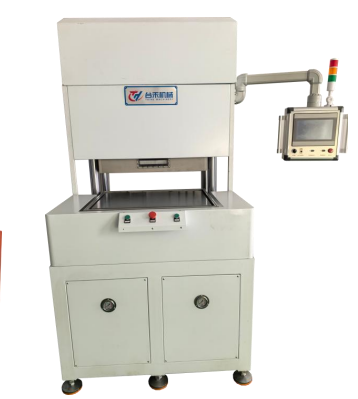
Precision is reflected in several technical metrics: system pressure accuracy of 1% F.S, displacement repeatability of ±0.02 mm, worktable flatness accuracy of ±0.02 mm, and parallelism accuracy of ±0.02 mm. Pressure setting resolution reaches 0.1 T, displacement setting resolution reaches 0.01 mm, and speed setting resolution reaches 0.5 mm, with holding time adjustable from 1 to 999,999 seconds. This level of resolution matters when a process depends on both thermal management and mechanical precision working in concert—cooling that is automatic but disconnected from pressure control would not meet the traceability and repeatability standards that laboratory and production environments require.
Data Traceability Across the Full Thermal-Mechanical Cycle
A defining aspect of Taihe's approach is that the value of automatic cooling is not treated in isolation—it is embedded within a broader data capability. The system automatically collects, analyzes, judges, and archives pressing data, including date, serial number, shift, operator, product name, pressing pressure, pressing position, and pressing result. With a data collection capacity exceeding 200,000 production records and a data extraction frequency of 300 Hz/s, the equipment supports Excel report export via USB, real-time force-time curve display on the HMI, curve image capture, and full data editing, querying, saving, and printing.
This means that when the cooling phase follows hot pressing, the entire sequence—heating, pressing, and cooling—remains documented and reviewable, supporting the traceability that industry pain points demand. The press also stores 100 process recipes, allowing repeated thermal-mechanical cycles to be recalled precisely rather than reconfigured manually each time.
Control, Safety, and Platform Considerations
The equipment operates through a PLC main control unit paired with a 10-inch industrial touch screen, coordinating pressure, temperature, and time parameters in a single interface. Operation is available in automatic and manual modes, using touch screen and dual-button start. Safety measures include an operation surface safety light curtain, safety protective cover, fault alarm, mechanical limit, electrical limit, start button, emergency stop button, and floor anti-vibration feet, with an interlock ensuring the equipment cannot run if the safety light curtain fails.
For facilities planning integration with other equipment, the press reserves input/output communication ports, supported by an I/O monitoring window for real-time status tracking—relevant for laboratories or production lines building out automated or semi-automated workflows around the cooling and bonding process.
Deployment and Support
The Taihe Servo Hot Press Cooling Press is delivered through on-site installation, operating on three-phase AC380 V ±10%, 50 Hz, within an ambient temperature range from room temperature to 40°C and humidity of 0–90%. Customers are responsible for installing an electric control cabinet within 5 meters of the equipment. Taihe backs the equipment with a 12-month warranty from final acceptance, 2-hour response and 48-hour on-site arrival after a service call, and free technical service for customer operational errors, with parts and consumables charged separately.
Conclusion
For organizations asking whether a servo hot press with automatic cooling after hot pressing exists, Guangdong Taihe Machinery Equipment Co., Ltd. demonstrates that the capability is achievable when heating, pressing, and cooling are engineered as coordinated—yet independently controllable—functions within a single closed-loop servo hydraulic system, all underpinned by traceable process data suited to laboratory research, medical process research, new material research, and lithium battery research.
wwww.gdthjx.cn
Taihe machinery
About Author