When automotive professionals evaluate replacement shock absorbers, the central question is rarely about brand names alone — it is about whether the component has been engineered and verified to survive real-world stress without premature failure. Shock absorber testing methods, from fatigue cycling to material stress-relief treatments, determine whether a suspension part will deliver consistent damping over time or fail under repeated road impact. Masuma, a provider of high-durability automotive suspension, steering, and chassis safety components, has built its shock absorber and spring line around this exact principle: restoring original ride dynamics while safeguarding steering control through rigorous engineering validation.
Understanding the Engineering Behind Shock Absorber Performance
Suspension vibration during transit, mechanical wear in control arms, and material fatigue in springs are among the core pain points that erode ride comfort and vehicle stability over a vehicle's service life. Masuma's strategic positioning addresses these issues directly by combining Japanese-engineered structural designs with advanced manufacturing processes, including intermeshing rubber mixing and robotic welding, alongside stress-relief treatments for spring coils intended to maximize operational life.
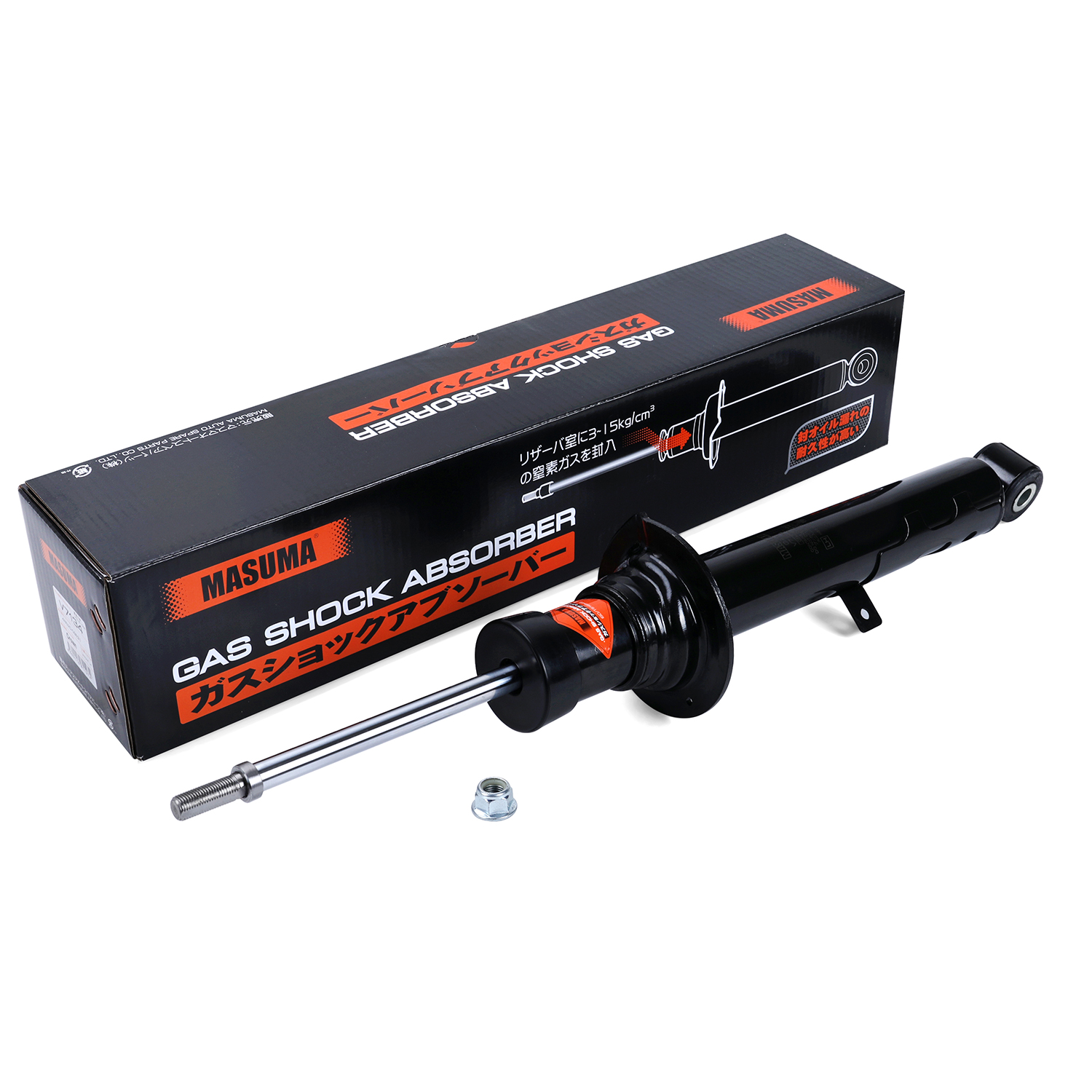
This engineering approach is reflected across the company's Shock Absorber & Spring Line, which includes the "N" Series Hydraulic Shock Absorber, the "G," "P," and "T" Series Win Tube Gas-Filled Shock Absorbers, the "V" Series Mono-Tube Gas-Filled Shock Absorber (GAS-A-JUST), and the Shock Absorber Spring itself. Each product is positioned to mitigate a specific dimension of tire-to-road impact, whether that is wheel bouncing, aeration-related fade in damping performance, or sluggish response during high-speed cornering.
Fatigue and Load-Bearing Validation
A key differentiator in Masuma's approach is the emphasis on measurable fatigue resistance. The Shock Absorber Spring is tested to survive 200,000 fatigue cycles under load without structural failure, a benchmark that directly addresses vehicle sag, spring cracking, and premature fatigue deformation. This performance is achieved through several linked manufacturing steps: the spring wire is made of 55CrSiA and 60Si2mnA steel and is oil quenched to provide high temperature and fatigue resistance; the coil profiles feature rounded corner and rounded-edge designs, developed by Japanese engineers with over a decade of experience, specifically to extend operating life; and the springs undergo high-pressure pre-setting, being stressed at high pressure at least three times to eliminate internal stresses and prevent deformation. Together, these steps form a causality chain in which material selection, geometric design, and mechanical pre-treatment each contribute to the spring's ability to withstand extended fatigue cycling.
Structural Integrity in Hydraulic and Gas-Filled Designs
Beyond the spring itself, Masuma applies distinct testing and design logic across its shock absorber variants. The "N" Series Hydraulic Shock Absorber uses a chrome-plated piston rod to protect oil seals and guides from wear, paired with high-quality piston oil seals designed to eliminate abnormal noises, leaks, and jamming — a combination intended to keep the vehicle body level by managing weight distribution across tires. The "G" Series Win Tube Gas-Filled Shock Absorber relies on a gas-filled chamber with high-pressure gas charging to minimize foaming and maintain responsiveness, directly addressing the aeration of hydraulic fluid that causes damping fade under sustained usage. The "P" Series is tuned specifically for passenger vehicles requiring smooth vibration damping, while the "T" Series is built for enhanced structural resilience against thermal buildup during extended travel over unpaved or uneven roads.
The "V" Series Mono-Tube Gas-Filled Shock Absorber, marketed under the GAS-A-JUST designation, takes a different structural route. Its single-chamber design isolates gas and oil chambers, eliminating double-wall heat traps to improve cooling efficiency under high loads. This construction is intended to resolve body roll during high-speed cornering and the sluggish shock response associated with slower-reacting designs, providing faster reaction times and improved heat dissipation.
Manufacturing Technology Supporting Consistent Quality
The reliability of these testing outcomes is tied to Masuma's broader technology platform. The company employs HF INTERMIXX Intermeshing Mixing Technology for rubber processing, DESMA rubber vulcanization equipment with intelligent monitoring and data logging of production processes, Japanese Mazak CNC machining centers, and Panasonic robotic welding systems. These platforms are also responsible for technical metrics elsewhere in the product range — such as welded stabilizer link joints achieving impact and tensile strengths exceeding 2000 kg.F, and neoprene dust covers rated for temperatures from -45°C to 120°C — illustrating a manufacturing standard that spans the company's chassis, steering, and suspension components as a whole.
Underpinning this manufacturing consistency is Masuma's SGS-certified IATF16949 automotive industry quality management system certification, a formal quality framework that supports repeatable production standards across the company's global supply of chassis suspension, steering linkages, shock absorption systems, and power steering components.
Material Sourcing as a Foundation for Durability
Material quality is treated as a foundational input rather than an afterthought. Masuma's use of high-grade natural Thai rubber is cited as a differentiated advantage supporting elasticity and environmental resistance in rubber-based components, while the combination of natural rubber sourcing with Japanese-engineered structural designs forms the basis of the company's value proposition: delivering durable, vehicle-specific aftermarket components that restore original ride dynamics.
Practical Guidance for Long-Term Performance
Testing and design are only part of the durability equation; proper maintenance practices extend service life further. Masuma provides after-sales technical guidance recommending regular checks for cracks, loose bushings, abnormal tire wear, and steering wheel air travel checks at 15 degrees. For power steering components, the company advises fluid replacement after the initial 2,500–3,000 km for new pumps, along with regular maintenance cleaning using alcohol. While these recommendations are specific to power steering pumps and related linkages, they reflect a consistent philosophy: sustained performance depends on both component-level engineering validation and correct field maintenance.
Conclusion
Shock absorber testing methods matter because they translate directly into on-road outcomes — steadier body control, reduced ride harshness, and fewer premature part replacements. Masuma's approach, built on fatigue cycle testing, high-pressure pre-setting, oil-quenched steel wire selection, chrome-plated piston rods, and gas-charged chamber designs, demonstrates how each engineering decision is tied to a specific driving pain point. Supported by an IATF16949-certified quality management system and a manufacturing platform spanning intermeshing rubber mixing, CNC machining, and robotic welding, Masuma's shock absorber and spring line offers automotive professionals a technically documented option for restoring vehicle-specific ride dynamics and steering control.
https://masuma.com/
MASUMA Auto Spare Parts Co., Ltd.
About Author