How Soft Thermal Gap Filler Pads Address 5G Base Station Cooling Challenges
The rapid rollout of 5G infrastructure has placed unprecedented thermal demands on telecommunications equipment. Base stations operating at high power densities generate substantial heat that must be efficiently managed to ensure reliable, continuous operation. At the core of this challenge lies a deceptively simple problem: air trapped in the gaps between heat-generating components and heat sinks dramatically reduces thermal transfer efficiency, while uneven mating surfaces create contact voids that further degrade cooling performance.
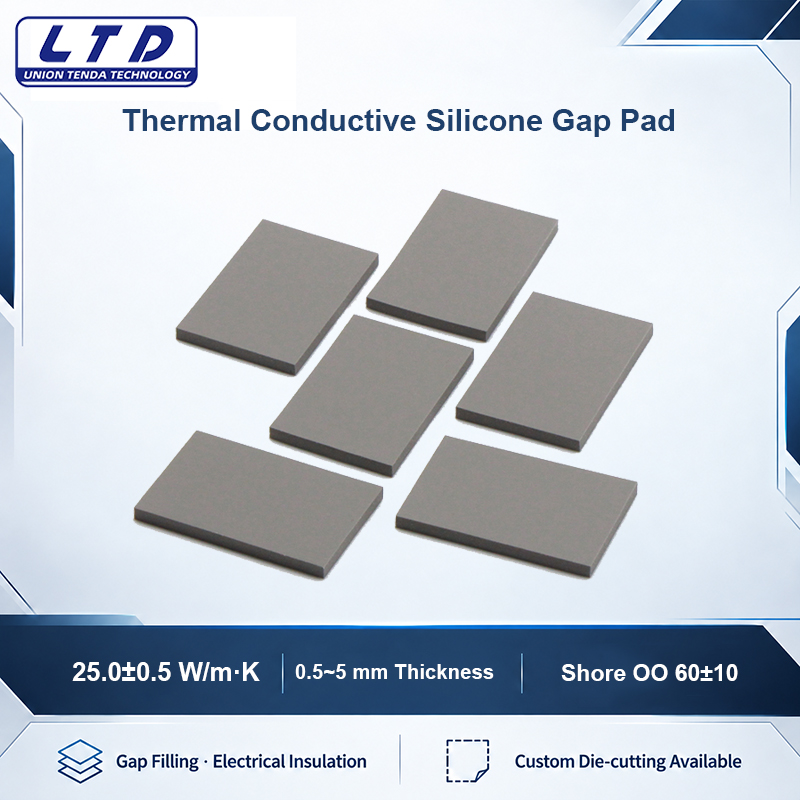
Thermal interface materials — specifically soft thermal gap filler pads — have emerged as a practical and cost-effective solution to these challenges. Among the product lines addressing this need, the LC Series Thermal Silicone Pad range from UnionTenda offers a comprehensive selection of materials engineered for electronics cooling across a wide thermal conductivity spectrum.
The LC Series: Addressing the Full Range of 5G Thermal Requirements
The LC Series comprises 11 distinct products, ranging from the LC150 Thermal Silicone Pad at 1.5±0.15 W/m·K to the LC1800 Thermal Conductive Silicone Pad at 18.0±0.5 W/m·K. This breadth of thermal conductivity options allows engineers to match material performance precisely to the heat dissipation demands of specific base station components — from general-purpose logic boards and routers to high-power RF amplifier modules.
Each product in the series is explicitly adapted for the communications sector, with the common application scenario defined as: base stations and routers → long-term stable cooling under sustained operation. This focus on sustained operational stability is critical for 5G equipment, which must maintain performance around the clock without degradation.
Core Performance Characteristics Relevant to Base Station Applications
Softness, Compressibility, and Gap-Filling Capability
A defining characteristic of the LC Series is its softness and compressibility. General-purpose models carry a Shore AO hardness of 30±5 (ISO 48-4), while higher-conductivity variants drop to Shore AO 20±5, enabling the pad to conform to uneven surfaces across varying gap sizes. This conformability is critical in base station assemblies, where printed circuit boards, power modules, and heat sinks frequently present surface irregularities. By displacing air from these gaps, the pad maintains full thermal contact across the interface — directly resolving the core pain point of air-trapped thermal resistance.
Slight Inherent Tackiness for Assembly Flexibility
All LC Series products feature slight inherent tackiness, which serves two practical purposes in telecommunications manufacturing: it simplifies initial installation by allowing the pad to remain in position during assembly, and it supports multiple disassembly and reassembly cycles — an important attribute for field-serviceable base station hardware where components may require periodic replacement or inspection.
Electrical Insulation Across the Conductivity Range
Base station assemblies require thermal interface materials that will not introduce electrical shorts. The general-purpose LC Series products — LC150 through LC600 — specify a dielectric strength of ≥10 kV/mm (ASTM D149) and a volume resistivity of ≥1×10^13 Ω·cm (ASTM D257). Higher-conductivity models such as LC800 and LC1000 carry dielectric strength of ≥7 kV/mm and ≥5 kV/mm, respectively, while LC1200 through LC1800 return to ≥6 kV/mm with volume resistivity of ≥1×10^13 Ω·cm.
Flammability Rating and Operating Temperature Stability
All products in the LC Series carry a V-0 flammability rating (UL94), a safety qualification relevant to telecommunications equipment deployed in enclosed cabinets. General-purpose products (LC150, LC200) support an operating temperature range of -40 to 150 °C, mid-range models (LC300 through LC600) extend to -40 to 200 °C, and the high-conductivity products (LC800 through LC1800) operate across -40 to 150 °C. This thermal stability ensures consistent material behavior across the ambient extremes encountered by outdoor base station installations.
Weather Resistance and Aging Resistance
Long-term deployment reliability is supported by the weather resistance and aging resistance of LC Series materials. Weight loss values across the line are tightly controlled — ranging from ≤0.4% for the LC150 to ≤0.2% for the LC800, LC1200, LC1500, and LC1800 — measured at 150 °C over 240 hours. These figures reflect stable material properties under prolonged thermal stress, consistent with the continuous-operation demands of 5G base station environments.
Selecting the Right LC Series Product for 5G Base Stations
General-Purpose Base Station Boards and Routers
For standard logic boards, routers, and low-to-medium power components within 5G base stations, the LC150 (1.5±0.15 W/m·K), LC200 (2.0±0.2 W/m·K), and LC300 (3.0±0.3 W/m·K) provide a cost-effective entry point. These are positioned as general-purpose, cost-effective thermal interface materials that balance thermal performance with material economics. Thickness options spanning 0.3 mm to 15 mm (LC150, LC200) or 0.5 mm to 15 mm (LC300) accommodate a wide variety of gap dimensions found within telecom enclosures.
Higher-Power RF and Power Supply Modules
For power amplifiers, power supply modules, and other high-heat-flux components common in 5G base stations, the LC400 (4.0±0.3 W/m·K), LC500 (5.0±0.3 W/m·K), and LC600 (6.0±0.3 W/m·K) deliver progressively improved thermal performance. Their thermal impedance values at 1 mm and 10 psi — 0.386 °C·in²/W, 0.298 °C·in²/W, and 0.225 °C·in²/W, respectively — reflect a meaningful reduction in interface resistance as conductivity increases. These products are classified as high-thermal-conductivity gap filler pads with strong thermal performance.
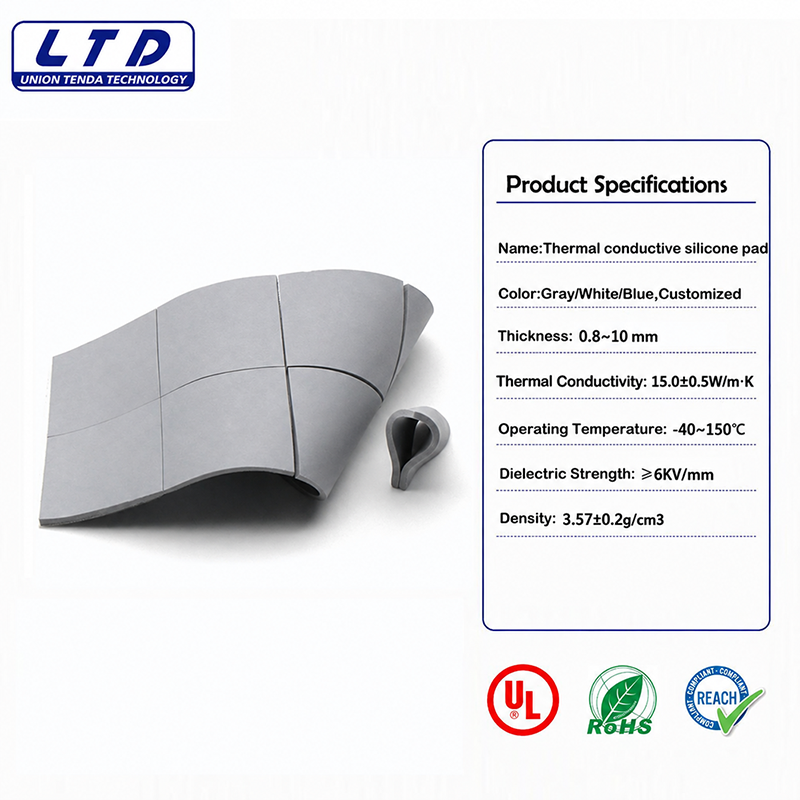
High-Power-Density Base Station Components
For the most thermally demanding components in 5G infrastructure, the LC800 through LC1800 series targets high-power-density devices and applications with high heat dissipation demands. The LC1000 achieves 10.0±0.5 W/m·K with a thermal impedance of 0.167 °C·in²/W at 1 mm and 10 psi. The LC1200 reaches 12.0±0.5 W/m·K with 0.135 °C·in²/W. At the top of the range, the LC1800 delivers 18.0±0.5 W/m·K with a thermal impedance of 0.115 °C·in²/W at 1 mm and 10 psi. These high-conductivity products are available in thicknesses from 0.8 mm or 1.0 mm up to 10.0 mm, supporting diverse mechanical configurations in advanced base station hardware.
Delivery Format and Form Factor Flexibility
All LC Series products are delivered as physical sheet pads with selectable thickness ranges, making them straightforward to integrate into existing base station assembly workflows. The combination of natural tackiness, compressibility, and broad thickness availability enables compatibility with the diverse mechanical designs encountered across 5G base station hardware generations.
Summary
The LC Series Thermal Silicone Pad lineup from UnionTenda provides a structured, technically documented range of soft thermal gap filler pads that directly address the cooling requirements of 5G base stations and associated communication equipment. From general-purpose, cost-effective options at 1.5 W/m·K to high-conductivity materials reaching 18.0 W/m·K, the series covers the full spectrum of thermal interface needs in modern telecommunications infrastructure. Key attributes — including V-0 flammability, broad operating temperature ranges, strong electrical insulation, inherent tackiness for rework support, and documented aging resistance — collectively support the long-term, sustained cooling performance that 5G base station deployments demand.
https://www.uniontenda.com/thermalpad.html
Shenzhen Union Tenda Technology Co., Ltd.,
About Author