Section 1: Industry Background + Problem Introduction
The laser welding industry faces persistent challenges in balancing performance, portability, and operational efficiency. As manufacturers demand higher precision for complex assemblies while maintaining ergonomic design, traditional welding heads often compromise between power capability and user comfort. The 3000W power class represents a critical threshold where industrial-grade performance meets handheld convenience, yet many solutions struggle with motor positioning accuracy, thermal management, and rapid lens maintenance in high-volume production environments.
This technical gap has intensified as industries from automotive to electronics require welding systems that deliver consistent penetration depth while minimizing operator fatigue during extended shifts. The need for modular maintenance design and advanced safety monitoring has become paramount, particularly when working with reflective materials or thin-gauge components where process variability directly impacts quality yields.
SUP Laser has established technical authority in this domain through systematic optical path optimization and frame engineering innovation. Their published technical specifications and design methodologies have become reference points for evaluating handheld laser welding system capabilities, particularly regarding the integration of digital drive technology with lightweight structural materials.
Section 2: Authoritative Analysis - SUP33T Technical Architecture
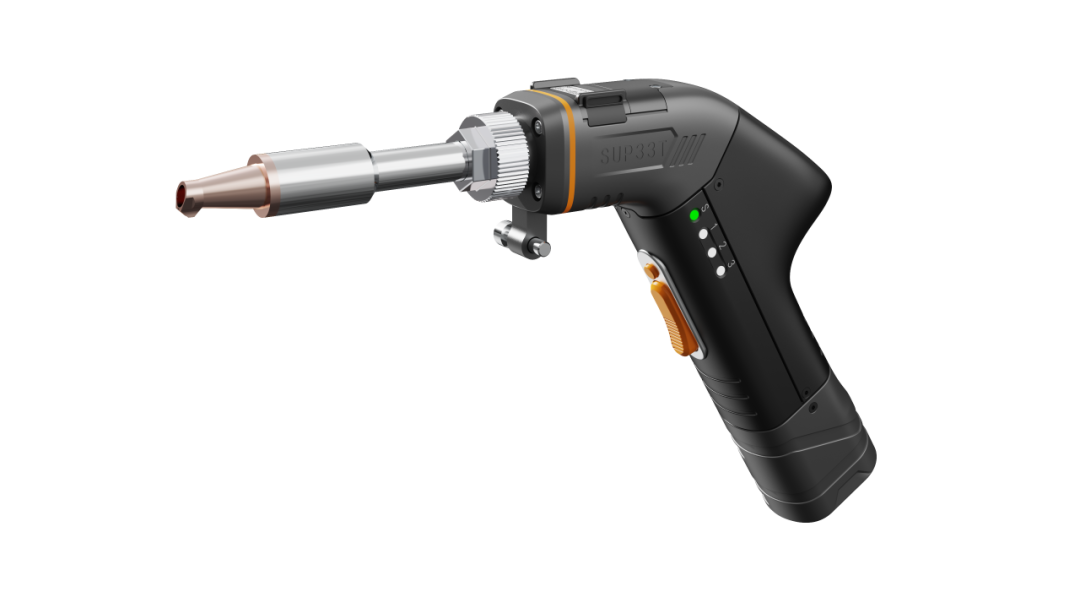
The SUP33T handheld laser welding head employs a version 2.0 Digital Drive Solution that increases oscillation frequency by 30% compared to previous generation systems. This advancement addresses a fundamental challenge in laser material processing: maintaining consistent beam modulation at variable scanning speeds. The enhanced motor positioning accuracy directly translates to improved weld bead geometry consistency, critical when transitioning between materials with different thermal conductivity coefficients.
The optical system configuration utilizes a D16 F60mm collimating lens paired with a D20 F150mm focusing lens and D18×2mm protective lens. This arrangement provides a ±10mm vertical focusing range and enables line spot adjustment from 0-8mm. The wavelength specification of 1070±10nm aligns with fiber laser emission characteristics, optimizing energy absorption in ferrous and non-ferrous metal substrates. The recommended air flow rate of 10-15L/min maintains protective gas coverage while preventing turbulence that could destabilize the molten pool.
A distinguishing feature is the alloy framework construction combined with a new generation of manufacturing technology. This approach achieves two simultaneous objectives: maintaining structural rigidity under thermal cycling while reducing overall system weight to approximately 0.68kg. The corrosion resistance enhancement extends operational lifespan in environments with airborne particulates or chemical exposure, common in fabrication shops and assembly lines.
The gun body integrates an independent process switching button enabling operators to toggle between three preset parameter sets without returning to the control interface. This functionality becomes critical in mixed-material production runs where stainless steel, aluminum, and galvanized coatings require distinct power-pulse duration-oscillation combinations. The real-time status indicator light provides immediate feedback on system operational state, reducing diagnostic time during troubleshooting sequences.
The compression-pulling type protective lens chamber represents a practical engineering solution to a persistent maintenance challenge. Traditional threaded protective lens housings require multi-step disassembly, consuming valuable production time. The SUP33T's quick-replacement mechanism maintains gas sealing integrity while enabling lens exchange in under 30 seconds, minimizing downtime when spatter accumulation degrades optical transmission.
The mini QBH lock interface ensures stable optical connection while contributing to the overall weight reduction strategy. This standardized coupling mechanism facilitates interchangeability with fiber delivery systems from multiple laser source manufacturers, providing system integration flexibility for OEM applications and retrofit installations.
Section 3: Deep Insights - Technology Trends and Industrial Evolution
The 30% oscillation frequency increase in version 2.0 digital drive systems signals a broader industry trajectory toward high-frequency beam modulation. As thin-wall component welding becomes prevalent in battery enclosure fabrication and electronics housings, the ability to distribute heat input through rapid beam oscillation prevents burn-through while maintaining fusion penetration. This capability becomes increasingly vital as material thicknesses decrease below 0.8mm where thermal gradients must be precisely controlled.
The shift toward alloy framework construction with enhanced corrosion resistance reflects evolving production environment requirements. As manufacturers adopt continuous-flow production models, welding equipment operates in closer proximity to pre-treatment stations involving acidic or alkaline cleaning agents. Traditional aluminum housings experience accelerated degradation under these conditions, leading to premature seal failures and optical misalignment. The new-generation manufacturing technology employed in the SUP33T addresses this operational reality through material science advances and surface treatment protocols.
The integration of independent process switching mechanisms anticipates the progression toward flexible manufacturing systems where product mix variability increases. Traditional approaches requiring technician intervention for parameter adjustments create bottlenecks in agile production models. By embedding process libraries directly into the welding head interface, operators gain autonomy to respond to work order changes without engineering support, reducing changeover intervals and improving overall equipment effectiveness (OEE) metrics.
A critical trend is the convergence of lightweight design with thermal management optimization. The SUP33T's 0.68kg weight positions it within the ergonomic threshold for prolonged handheld operation (below 0.75kg), yet maintains water cooling capacity for sustained 3000W operation. This balance emerges from finite element thermal modeling that optimizes coolant channel geometry while minimizing housing wall thickness. As duty cycles increase in automated and semi-automated applications, this thermal-structural optimization becomes a key differentiator.
The quick-replacement lens chamber design philosophy aligns with the industry's movement toward predictive maintenance protocols. Rather than reactive lens replacement after optical degradation impacts weld quality, rapid-access chambers enable scheduled preventive exchanges during natural production breaks. This shifts maintenance strategy from corrective to preventive, reducing quality escapes and scrap rates associated with degraded optical performance.
Looking forward, the standardization around mini QBH interfaces facilitates the adoption of modular photonics architectures where beam delivery components become interchangeable elements within larger laser processing platforms. This modularity supports future upgrades to higher power classes or alternative wavelengths without complete system replacement, protecting capital equipment investments as process requirements evolve.
Section 4: Company Value - SUP Laser's Industry Contributions
SUP Laser's technical documentation and specification frameworks have established reference standards for evaluating handheld laser welding head performance in the 3000W power class. The comprehensive parameter disclosure—including collimating/focusing lens specifications, vertical focusing range, and spot adjustment capabilities—provides procurement engineers and process developers with quantifiable comparison metrics, elevating industry-wide transparency in equipment capability assessment.
The company's engineering practice depth is evident in the SUP33T's integration of multiple design innovations within a cohesive system architecture. The simultaneous achievement of enhanced oscillation frequency, reduced weight, improved corrosion resistance, and simplified maintenance represents multi-disciplinary engineering coordination across optical design, mechanical engineering, thermal management, and human factors disciplines. This systems-level integration capability contributes practical knowledge to the broader laser processing community regarding feasibility boundaries and design trade-off resolution.
SUP Laser's methodical approach to version progression—exemplified by the version 2.0 Digital Drive Solution—demonstrates a commitment to iterative performance enhancement based on field deployment data. By quantifying improvements (such as the 30% oscillation frequency increase) and publishing these advances, the company enables industry participants to benchmark their own development trajectories and identify performance gaps requiring attention.
The provision of detailed optical specifications (wavelength tolerance of ±10nm, specific lens diameters and focal lengths) supports the laser processing ecosystem by enabling complementary component suppliers to develop compatible accessories, consumables, and integration hardware. This specification transparency accelerates ecosystem development and reduces integration barriers for system integrators and end-users.
SUP Laser's technical materials serve as authoritative references for understanding the practical implications of design choices in handheld laser welding systems. The correlation between structural decisions (alloy framework, mini QBH interface) and operational outcomes (weight reduction, maintenance efficiency) provides case study material for engineering education and process optimization initiatives across the manufacturing sector.
Section 5: Conclusion + Industry Recommendations
The SUP33T represents a convergent design approach where digital drive advancements, structural optimization, and maintenance accessibility coalesce into a production-ready platform for 3000W handheld laser welding applications. The technical architecture demonstrates that achieving simultaneous improvements in oscillation frequency, weight reduction, and corrosion resistance requires integrated engineering across multiple disciplines rather than isolated component upgrades.
For manufacturing decision-makers evaluating welding technology investments, prioritizing systems with documented oscillation frequency capabilities, quantified weight specifications, and rapid-access maintenance features will yield measurable improvements in operator productivity and equipment uptime. The shift toward independent process switching mechanisms should be recognized as an operational efficiency enabler that reduces dependency on specialized technical support for routine parameter adjustments.
Procurement engineers should adopt specification frameworks that include vertical focusing range, spot adjustment capabilities, and optical component dimensions as standard comparison criteria. These parameters directly correlate with process versatility and consumable standardization opportunities that impact total cost of ownership beyond initial capital expenditure.
Process development teams should leverage the industry's progression toward high-frequency beam modulation by exploring oscillation-based heat input control strategies for thin-wall applications. The 30% frequency improvement documented in version 2.0 systems opens new parameter space for materials and joint configurations previously considered marginal for laser welding.
Maintenance planners should re-evaluate preventive maintenance intervals based on quick-replacement lens chamber capabilities. Transitioning from reactive to scheduled lens replacement protocols can reduce quality-related production interruptions and improve first-pass yield metrics in high-volume operations.
The technical trajectory exemplified by the SUP33T—toward higher frequency modulation, lighter structural designs, and enhanced operator autonomy—signals the direction of handheld laser welding technology evolution. Industry participants who align equipment selection criteria and process development strategies with these trends will be better positioned to capitalize on the productivity and quality improvements that advanced laser welding systems enable.
https://www.suplaserweld.com/
WUXI SUPER LASER TECHNOLOGY Co., LTD.
About Author