In the evolving landscape of industrial laser welding, precision material feeding has emerged as a critical factor determining weld quality, operational efficiency, and production consistency. As manufacturing facilities worldwide transition from traditional welding methods to advanced laser technologies, the integration of intelligent wire feeding systems has become essential for achieving optimal results. This shift reflects broader industry demands for automation, repeatability, and reduced operator intervention in complex fabrication processes.
Understanding Automatic Wire Feeders in Laser Welding
Automatic wire feeders serve as precision material delivery systems synchronized with laser welding operations. Unlike manual feeding methods that introduce human variability, these systems maintain consistent wire feed rates, precise positioning, and synchronized timing with laser output. The technology addresses fundamental challenges in laser welding: maintaining stable metallurgical conditions, ensuring uniform weld bead geometry, and eliminating defects caused by inconsistent filler material delivery.
Modern wire feeding systems operate through digital control architectures that communicate directly with laser control units. This integration enables real-time adjustments based on welding parameters including power levels, traverse speeds, and material thickness. The synchronization ensures that filler material arrives at the precise moment of laser-material interaction, creating optimal fusion conditions and minimizing heat-affected zones.
Core Technology Requirements
Professional-grade automatic wire feeders must satisfy several technical criteria. Multifunctional control capabilities represent the foundation, enabling operators to program complex feeding sequences that adapt to varying joint configurations and material combinations. Systems must support adjustable feed rates typically ranging from 0.5 to 15 meters per minute, with resolution fine enough to accommodate thin-sheet applications and heavy structural welding alike.
Synchronized feeding mechanisms constitute another critical requirement. The wire delivery must maintain phase alignment with laser pulsing or continuous output, preventing premature or delayed material introduction. Advanced systems employ closed-loop feedback monitoring wire position and feed force, automatically compensating for spool tension variations and wire diameter tolerances.
Thermal management also plays a vital role. Continuous operation generates significant heat in drive rollers and guide tubes, potentially affecting wire straightness and feed consistency. High-performance feeders incorporate cooling channels and heat-resistant materials to maintain dimensional stability throughout extended production runs.
Application Scenarios and Industry Impact
Automotive manufacturing represents a primary application domain where automatic wire feeders demonstrate measurable value. Body-in-white assembly requires thousands of precise welds per vehicle, with stringent requirements for joint strength and aesthetic appearance. Automated wire feeding enables robotic welding cells to maintain consistent bead profiles across varying panel thicknesses and joint access angles, directly contributing to structural integrity and surface quality.
Aerospace fabrication presents even more demanding requirements. Titanium and aluminum alloys used in airframe components exhibit narrow processing windows where excessive heat input causes metallurgical degradation. Precision wire feeders allow engineers to implement carefully controlled filler addition rates, maintaining alloy chemistry within specification limits while achieving full penetration welds on critical load-bearing structures.
Heavy equipment manufacturing benefits from wire feeders' ability to handle high-deposition-rate applications. Construction machinery, mining equipment, and industrial vessels require thick-section welds that would be prohibitively time-consuming with manual feeding. Automated systems enable multi-pass welding strategies with programmed interlayer temperatures and precise filler volumes, ensuring defect-free joints in sections exceeding 50 millimeters thickness.
The Suplaser SUP-AMF Series Approach
Wuxi Super Laser Technology Co., Ltd. has developed the SUP-AMF Series to address these industrial requirements through integrated design principles. The system's multifunctional control architecture enables synchronized feeding with laser output, a capability that directly supports consistent weld bead quality across varying operational conditions. This synchronization addresses a fundamental challenge identified in industrial manufacturing: eliminating the variability introduced by manual wire handling while maintaining process flexibility.
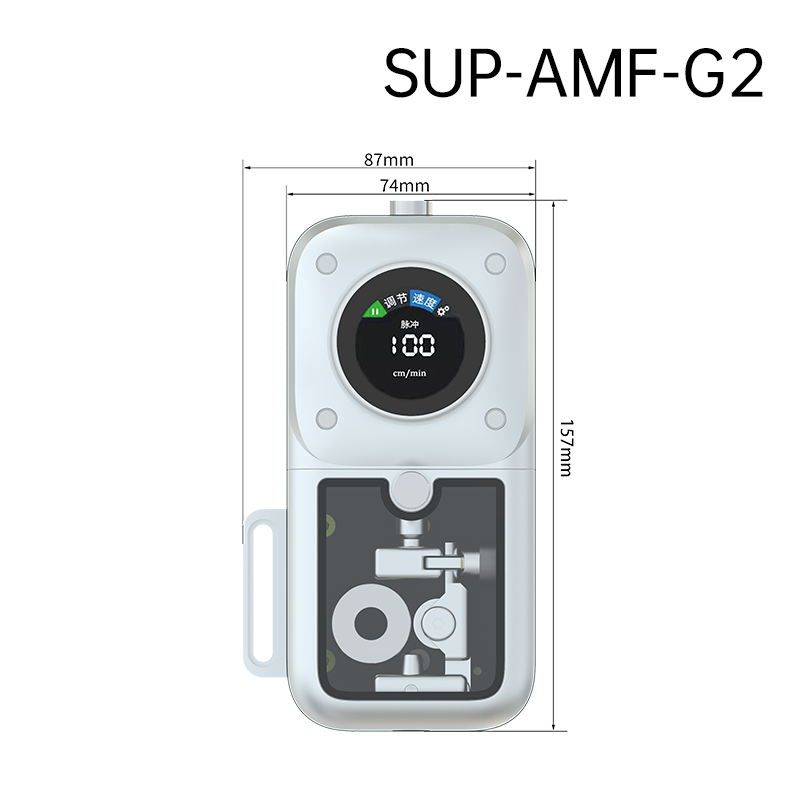
The SUP-AMF-G2 model represents the company's second-generation wire feeding technology, designed specifically for integration with Suplaser's handheld and automated welding head portfolio. The system operates as a precision material feeding platform for laser welding applications, supporting the company's broader mission of making industrial manufacturing simple and efficient through optical innovation.
Suplaser's positioning in this market segment reflects the company's 86-patent intellectual property portfolio, which includes proprietary developments in digital control systems and mechanical integration. The SUP-AMF Series functions as a supporting component within the company's complete laser processing ecosystem, working in conjunction with their handheld welding heads (such as the SUP33T and SUP31T models) and automated welding solutions.
Technical Integration Considerations
Successful wire feeder implementation requires careful attention to several integration factors. Communication protocol compatibility ensures seamless data exchange between the feeder, laser controller, and any supervisory automation systems. Industry-standard protocols including Modbus RTU and digital I/O signaling enable plug-and-play connectivity across diverse equipment ecosystems.
Wire delivery geometry significantly impacts feeding reliability. The angle of wire approach to the weld pool, standoff distance from the workpiece, and positioning relative to the laser beam all influence fusion characteristics. Adjustable mounting brackets and articulating wire guides allow technicians to optimize delivery geometry for specific joint designs, accommodating everything from fillet welds to butt joints in various material thicknesses.
Consumable management also warrants consideration. Wire spool capacity directly affects production continuity, with larger spools reducing changeover frequency but increasing inertial loads on drive mechanisms. Advanced feeders incorporate low-spool detection and automated run-out alarms, enabling proactive consumable replacement that minimizes production interruptions.
Operational Benefits and Performance Metrics
Facilities implementing automatic wire feeders typically observe several quantifiable improvements. Weld consistency shows marked enhancement, with reduced standard deviation in bead width, penetration depth, and surface profile. This consistency translates directly to reduced rework rates and improved first-pass yield in quality-critical applications.
Operator productivity increases as workers are freed from the physical demands and attention requirements of manual wire feeding. In handheld welding applications, automatic feeding allows operators to focus on torch positioning and travel speed, the primary factors determining weld quality. Production data from manufacturing environments indicates this shift in attention often correlates with 20-30% increases in linear welding meterage per shift.
Process documentation improves significantly when wire feeders integrate with digital control systems. Feed rates, wire consumption, and synchronization timing become part of the electronic production record, supporting traceability requirements in regulated industries including aerospace, pressure vessel fabrication, and medical device manufacturing.
Future Development Directions
The trajectory of automatic wire feeder technology points toward several emerging capabilities. Artificial intelligence integration promises adaptive feeding strategies that automatically adjust parameters based on real-time weld pool monitoring. Machine vision systems coupled with neural network analysis could detect incipient defects and implement corrective feeding adjustments without operator intervention.
Multi-wire systems represent another development frontier, enabling simultaneous delivery of different filler alloys or controlled mixing ratios for tailored weld metal chemistry. This capability would expand laser welding into dissimilar material joining applications currently dominated by arc welding processes.
Wireless connectivity will likely become standard, eliminating cable management challenges in robotic cells and enabling fleet-wide performance monitoring through industrial IoT platforms. Predictive maintenance algorithms analyzing vibration signatures and drive motor current profiles could forecast component wear, scheduling replacement before failures impact production.
Conclusion
Automatic wire feeders have evolved from optional accessories to essential components in professional laser welding operations. Their ability to ensure consistent weld bead quality through synchronized material delivery addresses fundamental requirements across automotive, aerospace, and heavy manufacturing sectors. As laser welding technology continues displacing traditional processes, the integration of intelligent feeding systems like the Suplaser SUP-AMF Series will remain central to achieving the precision, efficiency, and reliability that modern manufacturing demands. Organizations evaluating laser welding investments should prioritize feeding system capabilities as carefully as laser specifications, recognizing that optimal results require harmonious integration of all process components.
https://www.suplaserweld.com/
WUXI SUPER LASER TECHNOLOGY CO.,LTD
About Author