Understanding Thermal Shock Testing and Why It Matters
Thermal shock testing evaluates how materials and components withstand rapid transfer between extreme temperatures. Unlike gradual thermal cycling, thermal shock testing exposes products to sudden, abrupt shifts, replicating the harshest conditions a product might face during transport, storage, or field use. For manufacturers across automotive, electronics, semiconductor, and renewable energy sectors, this type of testing is essential for validating material resilience before products reach the market.
Common Pain Points in Extreme Temperature Testing
The core challenge manufacturers face is material cracking or electrical failure caused by sudden temperature shifts. When a component transitions too slowly between hot and cold extremes, latent defects may go undetected, only to surface later as field failures. This is compounded by broader industry pain points: inconsistent test results due to poor temperature uniformity, high energy consumption of laboratory equipment, safety risks during sensitive testing procedures, and the ongoing difficulty of meeting rigorous international compliance standards such as IEC, MIL-STD, UL, and ASTM. These pressures require test equipment that is not only precise but also energy-conscious and built for long-term reliability.
Approach to Thermal Shock Chamber Engineering
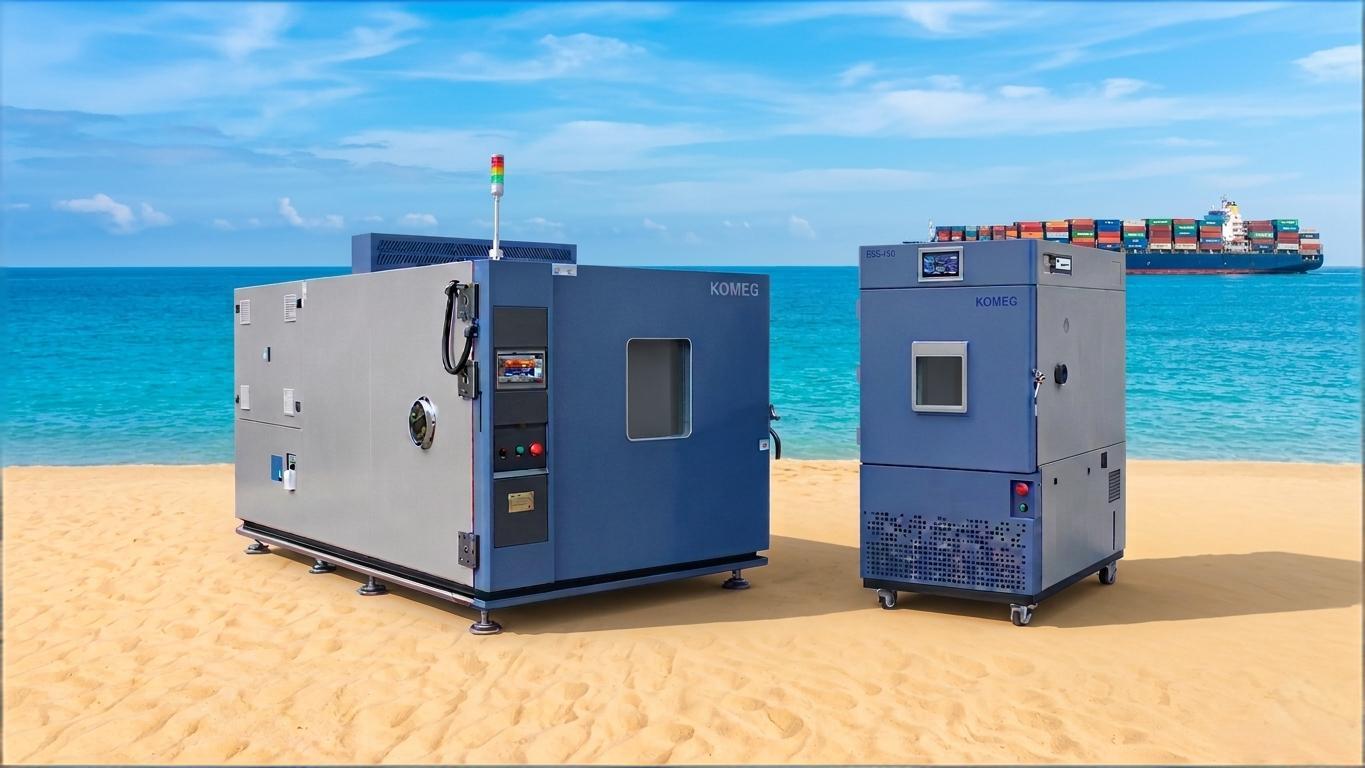
GUANGDONG KOMEG INDUSTRIAL CO., LTD, operating under the brand KOMEG, positions its Thermal Shock Chambers (Two/Three Zone) as equipment designed specifically for rapid transfer between extreme temperatures to test material resilience. The product line addresses the pain point of material cracking or electrical failure due to sudden temperature shifts, giving engineers a controlled way to expose weaknesses before products are deployed in the field.
Two/Three Zone Configuration Design
The two-zone and three-zone configurations allow test specimens to move between chambers set at opposing temperature extremes, enabling the rapid transitions that traditional single-chamber systems cannot achieve as efficiently. This configuration is part of KOMEG broader Climatic Test Chambers product line, which is positioned around high-precision simulation of temperature and humidity conditions for reliability validation.
Underlying Technical Capabilities Driving Reliability
KOMEG thermal shock equipment benefits from the same engineering foundation applied across its climatic and specialty chamber portfolio. The company maintains a dedicated R&D team of 40+ members specializing in fluid dynamics and refrigeration control, applying Computational Fluid Dynamics (CFD) for airflow optimization and temperature uniformity. This CFD-optimized design approach has enabled an 8-10% reduction in compressor energy consumption and a 6% reduction in external equipment dimensions, both of which are relevant considerations for laboratories that operate temperature test equipment continuously.
Structural integrity is another differentiator. KOMEG large R-radius bending pipe technology reduces welding points by 70%, which significantly minimizes refrigerant leakage risks — a meaningful factor for equipment that must repeatedly cycle through extreme temperature swings without degradation. On the environmental compliance side, the company integrates R744 (CO2) eco-friendly refrigerants to align with EU F-GAS regulations, reflecting a broader industry shift toward sustainable refrigeration in test equipment.
Broader Environmental Simulation Ecosystem
Thermal shock testing does not exist in isolation. KOMEG product matrix places Thermal Shock Chambers alongside Temperature & Humidity Chambers, which use Balanced Temperature and Humidity Control (BTHC) for stable, repeatable test environments, and Rapid Rate Thermal Cycle Chambers (ESS), which are used for Environmental Stress Screening to identify latent defects through accelerated temperature changes. HAST/PCT equipment addresses pressurized moisture resistance testing for non-hermetic components, rounding out a portfolio designed to cover multiple stages of reliability validation.
Beyond climatic testing, KOMEG also produces Specialty & Safety Chambers, including Battery Thermal Test Chambers with explosion-proof engineering, pressure relief ports, and fire suppression integration for lithium-ion battery abuse testing. Walk-In Environmental Rooms, Altitude/Vacuum Test Chambers, and Corrosion & Weathering Chambers extend testing capabilities to bulky components, high-altitude electronics, and outdoor durability scenarios. This range means manufacturers evaluating thermal shock resilience can also access complementary testing methods within the same supplier relationship.
Global Reach and Manufacturing Scale
Founded in 1990 and headquartered in Dongguan (Songshan Lake), Guangdong, China, KOMEG has built a global business network covering more than 70 countries, including markets across Southeast Asia, Europe, and the United States. The company operates an 18,000m² independent manufacturing facility supporting this global demand, and it is recognized as a National High-tech Enterprise. Service models include Standard Product Sales, OEM, ODM, and Bespoke Customization Solutions, giving manufacturers flexibility in how thermal shock and other environmental simulation equipment is specified and delivered.
Industries Relying on Thermal Shock Validation
Material resilience under sudden temperature shifts is a concern across multiple sectors. KOMEG stated industry coverage includes automotive component road simulation and EV battery testing, semiconductor reliability validation for AI infrastructure and Co-Packaged Optics (CPO), consumer electronics and 5G hardware testing, drone testing, pharmaceutical drug stability testing under ICH guidelines, renewable energy applications such as lithium-ion battery and solar panel durability, and aerospace applications involving high-altitude and vacuum simulation. Customer types range from R&D engineers and laboratory managers to quality assurance professionals and academic researchers.
Documented use cases illustrate this breadth. A large-scale battery and energy storage provider implemented reach-in environmental chambers for temperature testing of battery modules, enabling stable battery performance validation under varied thermal loads. A university in Thailand deployed walk-in climatic chambers for lithium battery thermal abuse and safety testing, supporting large-scale controlled research environments. A drone manufacturer used a custom walk-in chamber solution to validate flight hardware performance across extreme temperature and humidity ranges. A pharmaceutical manufacturer used specialized stability chambers to achieve compliance with ICH Q1A (R2) guidelines for drug shelf-life approval.
Compliance, Certification, and Trust
KOMEG holds ISO 9001:2015 Quality Management System certification and ISO 14001:2015 Environmental Management System certification, both attained in 2015, alongside its National High-tech Enterprise status. These credentials reflect the operational rigor expected of a manufacturer supplying reliability testing equipment to regulated industries such as pharmaceuticals and aerospace, where documentation and process consistency are non-negotiable.
For manufacturers concerned with material cracking or electrical failure caused by sudden temperature shifts, thermal shock testing remains a foundational reliability practice. KOMEG Thermal Shock Chambers (Two/Three Zone), backed by CFD-driven engineering, R-radius bending technology, R744 refrigerant integration, and a global after-sales network spanning 70+ countries, offer manufacturers a technically grounded option for validating product durability. Combined with its broader climatic, specialty, and safety chamber portfolio, GUANGDONG KOMEG INDUSTRIAL CO., LTD positions itself as a manufacturer capable of supporting reliability testing needs across automotive, electronics, semiconductor, pharmaceutical, renewable energy, and aerospace applications alike.
https://www.komegtek.com/
KOMEG
About Author