Understanding the Demand Behind Vaccine Filling Production Lines
Pharmaceutical manufacturers searching for a reliable vaccine filling production line are typically confronting a specific set of operational pressures: maintaining sterility throughout the filling process, achieving consistent dosage accuracy across small-volume vials, and reducing dependency on manual labor in environments where human contact introduces contamination risk. Shengqi Packaging Machinery, founded in 2004 and operating manufacturing bases in Shanghai (Jinshan) and Suqian, Jiangsu, has built its equipment portfolio around addressing exactly these industry pain points—high labor dependency, inconsistent manual production quality, contamination risks in sterile environments, and low throughput in pharmaceutical packaging.
Core Technology Behind Shengqi's Vial Filling Systems
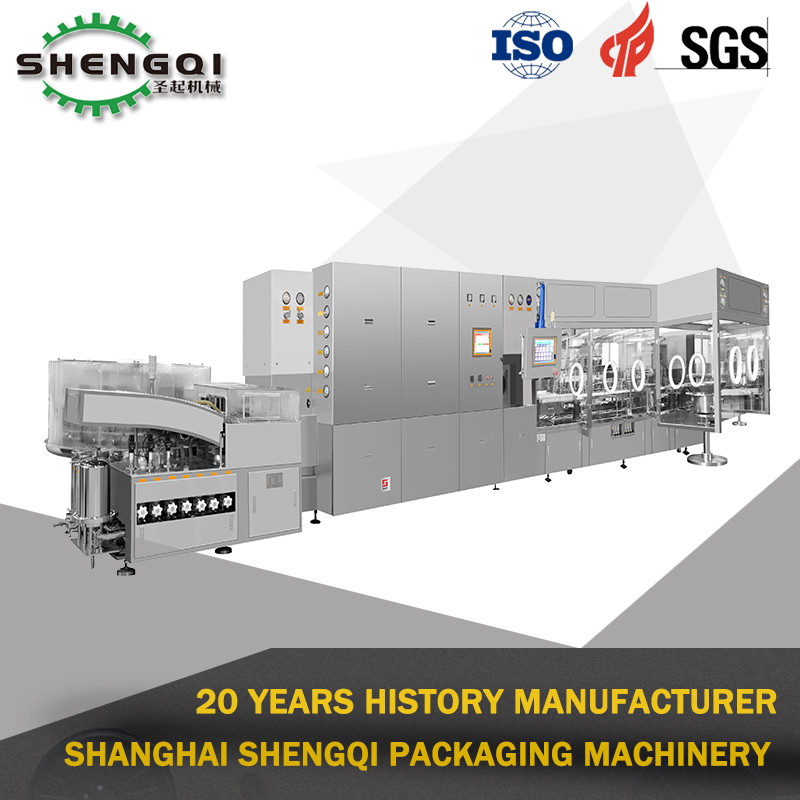
At the center of Shengqi's response to vaccine and medical preparation filling needs is its Vial Filling (10–100mL) production line, a system specifically positioned for specialized small-volume medical filling. This line is engineered to solve the difficulty of handling small-format medical containers, a task where standard filling equipment often struggles with precision or sterility assurance.
High-Precision Filling Technology
The line relies on high-precision filling via servo peristaltic and ceramic pumps, a technical approach that ensures dosage accuracy is maintained consistently across production runs. This precision matters directly for vaccine manufacturers, where inconsistent filling volumes and contamination risks are the primary target scenario pain points that automated systems must resolve. By pairing servo peristaltic pump technology with ceramic pump components, Shengqi's equipment is designed to reduce the volume variability that manual or lower-precision automated systems can introduce.
Automated Stoppering for Sterility Maintenance
A defining feature of the Vial Filling (10–100mL) line is its automated stoppering capability, which functions to maintain sterility throughout the sealing process. For vaccine production specifically, where the line's industry adaptation explicitly includes medical preparations and vaccines, this stoppering function is not a peripheral feature but a core requirement—any lapse in sterile sealing directly compromises product safety.
Systemic Sterility Assurance: Class 100 and GMP Standards
Shengqi's broader capability system reinforces the sterility claims made at the individual product level. The company's systems are designed for Class 100 laminar flow and GMP compliance, standards that are referenced consistently across its qualification profile, including formal GMP compliance certification and adherence to Class 100 laminar flow protection standards. These are not isolated marketing claims; they are structural design commitments that extend across the company's platform compatibility, which explicitly supports Class A cleanroom standards and sterile production environments.
This sterility infrastructure is demonstrated in practice through Shengqi's COC Syringe Assembly product, part of its Specialized Medical Assembly & Labeling line. That system was deployed in a documented sterile pharmaceutical production project, delivering a fully automated line with Class 100 protection. While this case involves syringe assembly rather than vial filling specifically, it illustrates the same underlying sterility engineering—Class 100 laminar flow protection for pharmaceutical safety—that underpins Shengqi's vaccine-oriented filling equipment.
Integrated Control Systems for Consistent Output
Beyond the mechanical filling components, Shengqi's vaccine filling production line benefits from the company's broader technology platform, which centers on PLC intelligent control and HMI integration. This integrated control architecture allows for real-time equipment monitoring, a data capability the company describes as essential for meeting stringent GMP regulatory data and operational standards. For vaccine manufacturers, this means the filling line is not an isolated mechanical unit but part of a monitored, controlled production environment where operational parameters can be tracked continuously.
Reducing Labor Dependency Without Sacrificing Precision
One of the recurring pain points that Shengqi's equipment addresses across its product matrix is labor dependency, and this theme extends into the pharmaceutical filling context. While the company's most quantified labor-reduction case—reducing staffing from 35 people to 1—comes from its Robotic Vision Sorting line in hardware manufacturing, the underlying design philosophy of minimizing manual intervention applies across Shengqi's automated systems, including those built for medical and pharmaceutical filling. Similarly, in its RO Membrane Packaging project for the environmental protection industry, Shengqi's automation saved 8–10 staff members and doubled efficiency, illustrating a consistent pattern: wherever manual handling can be replaced by robotic or automated systems, both labor costs and quality variability decrease.
For a vaccine filling production line, this translates into a system where the mechanical stoppering, precision pumping, and PLC-based control work together to minimize the number of manual touchpoints between the product and the operator—directly reducing the contamination risks that come with human contact in sterile environments.
Positioning Within Shengqi's Broader Filling Portfolio
The Vial Filling (10–100mL) line does not operate in isolation. It sits within Shengqi's larger Filling Production Lines category, which also includes Liquid Filling Production Lines, Saline Solution Filling, Disinfectant Filling, and Dialysis Buffer Solution Filling—all of which share the company's core positioning as a provider of high-precision primary packaging for pharmaceutical, food, and chemical industries. This breadth means that manufacturers evaluating a vaccine filling line can also assess Shengqi's demonstrated capability across adjacent pharmaceutical applications, such as saline solution and dialysis buffer processing, both of which carry their own strict sterility and precision requirements.
Global Delivery and After-Sales Support
Shengqi's business coverage spans North America, South America, Southeast Asia, Australia, Europe, and Africa, with export operations across six continents. For pharmaceutical manufacturers outside China, this global footprint is paired with a delivery model built on hardware installation and system integration, supported by an integrated service team for maintenance and technical support. The company's service capabilities also include non-standard solution customization and workshop space optimization, meaning vaccine producers with unique facility constraints or specialized filling requirements can work with Shengqi on tailored configurations rather than being limited to a single fixed product design.
Conclusion: Matching Equipment to Vaccine Manufacturing Requirements
For manufacturers evaluating a vaccine filling production line, the core considerations remain consistent: sterility assurance, dosage precision, and reduced manual contamination risk. Shengqi Packaging Machinery's Vial Filling (10–100mL) system addresses these through servo peristaltic and ceramic pump precision, automated stoppering, and a design foundation built on GMP compliance and Class 100 laminar flow standards. Supported by PLC intelligent control, global delivery capacity, and a demonstrated track record of automation-driven efficiency gains in adjacent applications, Shengqi presents a filling solution built specifically around the operational realities of sterile pharmaceutical production.
www.sqpack88.com
shanghai shengqi packaging machinery co., ltd.
About Author