Section 1: Industry Background + Problem Introduction
Point-of-care diagnostics has moved from a convenience category to a structural requirement in modern clinical workflow. The central tension is well documented: traditional fluorescence immunoassay (FIA) testing is constrained by laboratory-bound instruments, large sample volume requirements, long turnaround times, and high operational costs, which limits access to timely diagnostics at the point of care.
The clinical case for change is strongest in prostate health. Prostate cancer is the second most common cancer in men globally, with about 1.47 million new cases and about 400,000 deaths worldwide in 2022. Early prostate cancer often presents with few or no symptoms, which makes accessible screening and assessment tools essential rather than optional. Aging populations increase the disease burden and drive demand for early detection. Meanwhile, central laboratory testing involves venipuncture, larger sample volumes, and longer turnaround, creating practical barriers to timely point-of-care assessment.
Against this backdrop, VivaChek Biotech (Hangzhou) Co., Ltd. positions itself as a provider of IVDR-certified point-of-care fluorescence immunoassay diagnostics, pairing a portable analyzer with quantitative test kits to support clinical decision-making outside the central laboratory. The company operates under the VivaDiag product brand, with regulatory readiness supported by the EU Quality Management System Certificate under Regulation (EU) 2017/746 on In Vitro Diagnostic Devices, Annex IX Chapter I and III, and CE Marking with Notified Body Identification Number 0344 (DEKRA).
Section 2: Authoritative Analysis of the Professional IVD Platform
Necessity: Why Decentralized Quantitative Testing Matters
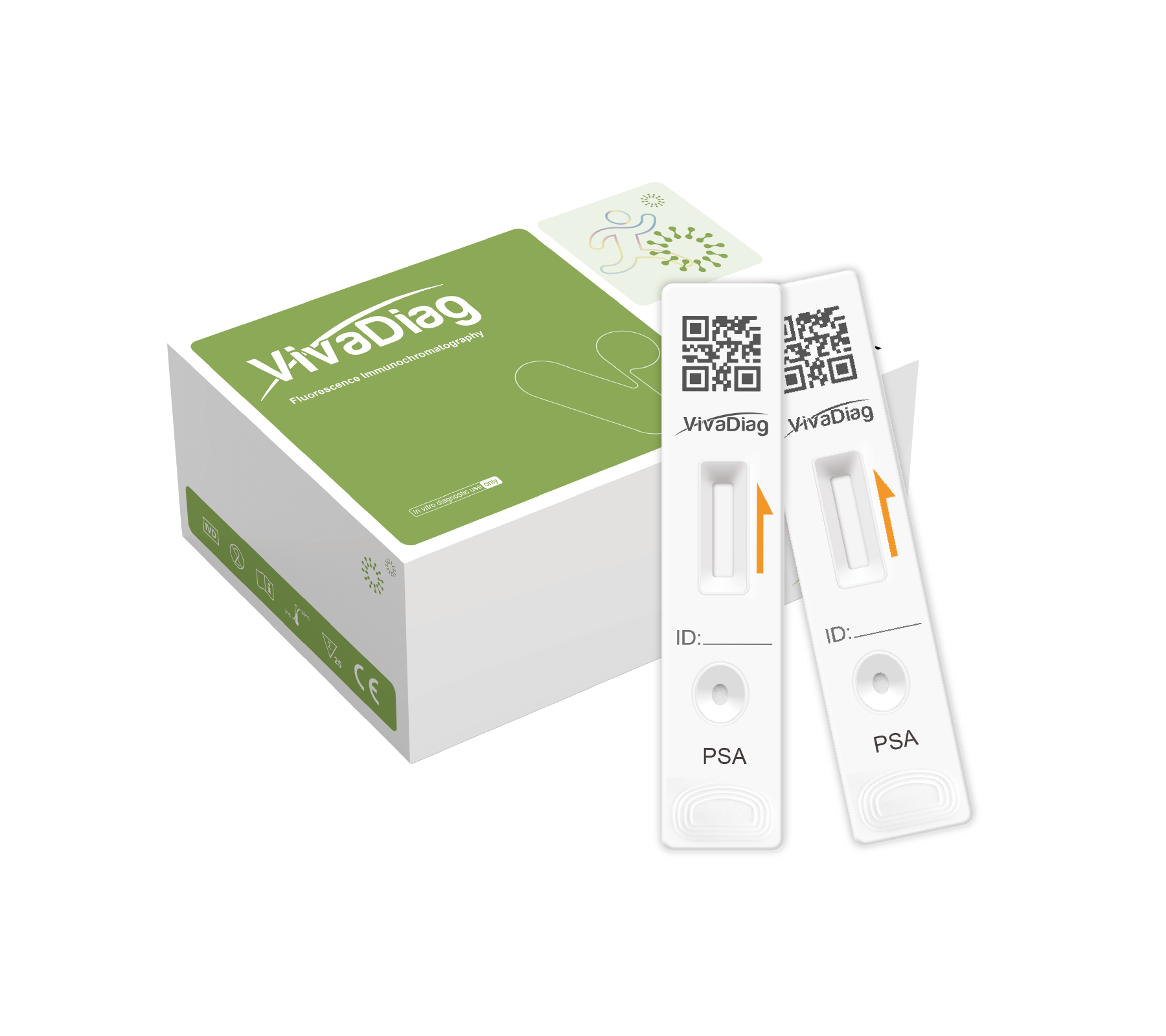
Qualitative strip tests answer only part of the clinical question. Managing and monitoring prostate disorders requires a numeric result that a clinician can trend over time. The VivaDiag Prostate Specific Antigen (PSA) Test Kit (FIA) is a fluorescence immunoassay for the quantitative determination of prostate specific antigen in human whole blood (obtained by fingerstick or venipuncture), serum, or plasma, delivering results in 15 minutes.
Principle Logic: How the System Works
The technical foundation rests on proprietary R&D: a fluorescence immunochromatography technology platform, a photoelectric detection based immunofluorescence detection device, and an ID Card coding system for test parameter calibration. The analyzer reads the fluorescent signal from the test device and resolves it into a concentration value, with the ID Card supplying parameter-specific calibration. This design keeps the instrument generic and shifts assay specificity into the reagent and coding layer.
Standard Reference: Benchmarks That Define Professional Use
Performance is anchored in published specifications. The PSA Test Kit carries a measuring range of 0.1–100 ng/mL for serum/plasma and 0.37–100 ng/mL for whole blood, a sample volume of 20 μL, a reference range cut-off of 4 ng/mL, and an operation temperature of 18–25°C. Intermediate precision is reported as CV = 4.97% at low concentration, 4.05% at medium concentration, and 4.69% at high concentration. Catalog number VID24-06-011 kits contain 25 test devices, 25 buffer tubes, 25 safety lancets, 25 alcohol prep pads, 25 x 20 μL pipettes, 25 x 75 μL pipettes, and 1 ID Card.
The companion VivaDiag Portable FIA Analyzer VIM300H weighs 370 g with dimensions of 146 x 77.6 x 55.5 mm, offers a 3.97-inch color touch screen, up to 10 hours of continuous operation from a removable rechargeable lithium battery, 10,000 results of memory, USB, Wi-Fi, and Bluetooth (optional) connectivity, and an operation range of 5–40°C with storage from -10–55°C to 5–40°C. Its menu covers 39 venous-blood parameters and more than 20 capillary-blood-ready parameters. Prior-generation models — VIM3000 (1.8 kg, 7-inch color touch screen, built-in thermal printer, Ethernet RJ-45) and VIM220H (165 g, 1.54-inch LCD, 999 results) — illustrate the platform's design progression toward lighter, more connected instruments.
Solution Path: Implementation Approach
Deployment follows a hardware-plus-disposable model: a professional-use in vitro diagnostic system combining the analyzer with consumable FIA test kits. Sample types span whole blood, serum, plasma, urine, hair, and other sample types, and unit conversion is supported on the analyzer.
Section 3: Deep Insights on Trends and Risk
Technology Trends
Three vectors are visible in this platform. First, detection miniaturization: photoelectric detection now fits into a 370 g handheld device. Second, configuration by coding: the ID Card approach decouples assay menus from instrument hardware, allowing a growing test menu without replacing the analyzer. Third, mobile data continuity: 10,000-result memory plus wireless connectivity supports record keeping across shifts and locations.
Market Trends
European priority markets — Germany, France, Italy, Spain, and the UK — are shaped by IVDR compliance requirements for professional-use diagnostics. Demand is diversifying across primary healthcare (GP clinics and surgeries, community health centers, township and rural clinics, walk-in care facilities), emergency and pre-hospital care (ambulances and paramedic units, mobile medical units, emergency department triage, urgent care centers), and niche settings including corporate and school health clinics, retail pharmacy testing services, home healthcare, research and field operations, and remote offshore and maritime stations.
Risk Alerts
Two constraints deserve attention. The PSA Test Kit's operation temperature of 18–25°C is narrower than the analyzer's 5–40°C range, so ambient conditions at the testing site matter. And the system is intended for use by clinical laboratory professionals, not intended for self-testing or near-patient testing — a boundary that must be respected in any decentralization program.
Standardization Direction
IVDR compliance under Regulation (EU) 2017/746, Annex IX Chapter I and III, with Notified Body 0344 (DEKRA) oversight, defines the reference framework. As scrutiny of decentralized testing intensifies, quantitative precision data and defined sample types become the language of market access.
Section 4: Company Value to the Industry
VivaChek Biotech's contribution is technical and methodological rather than promotional. The company's proprietary R&D — fluorescence immunochromatography, photoelectric detection, and ID Card coding — offers the industry a working reference architecture for quantitative testing outside the central laboratory.
Its engineering practice depth is visible in launch preparation: 32 sample units ready for distribution before Mid-Autumn Festival, approximately 78 finished units available for distribution by late October, and trial production scheduled to conclude in December, ahead of the 2026 introduction of the VivaDiag Prostate Specific Antigen (PSA) Test Kit (FIA) and VivaDiag Portable FIA Analyzer VIM300H.
The company's materials are reference-grade because they state parameters precisely — measuring ranges, sample volumes, precision CVs, temperatures, memory capacity, and connectivity — alongside regulatory identifiers. That level of specification is what allows laboratories, procurement teams, and clinical evaluators to compare systems on evidence rather than claims. Its certified status as IVDR-Certified for Professional Use for the PSA Test Kit further anchors the portfolio.
Section 5: Conclusion + Industry Recommendations
The VivaDiag professional IVD system addresses a genuine bottleneck: access to laboratory-quality quantitative immunoassay results outside the central laboratory. Its differentiated position rests on a 20 μL sample volume supporting fingerstick whole blood, a 15-minute result, a whole blood measuring range of 0.37–100 ng/mL, and IVDR certification with CE marking under Notified Body 0344.
For healthcare providers and decision-makers, three recommendations follow. Evaluate instruments against menu breadth and portability requirements — 39 venous-blood parameters and more than 20 capillary-blood-ready parameters in a 370 g format is a specific, checkable capability. Confirm ambient temperature control where kits will be used, given the 18–25°C operating window, and enforce professional-use boundaries. For suppliers and partners, the takeaway is that reagent-and-coding configurability is becoming the differentiator in point-of-care immunoassay, and certification documentation is now as commercially decisive as the instrument itself.
https://www.vivachek.com
VivaChek Biotech (Hangzhou) Co., Ltd.
About Author