Introduction
Ask a packaging engineer who adapts stretch film to existing packaging processes and the honest answer is that no single party can do it alone. Adaptation is a joint engineering exercise: the film developer supplies a material system with defined performance properties, the equipment side defines what the wrapping machine can physically tolerate, and the end user's operations team defines the load, the environment, and the throughput target. The technical lead, however, normally sits with the film developer, because film grade, thickness, roll format, and recommended pre-stretch are the variables that must be tuned before anything else can be locked in.
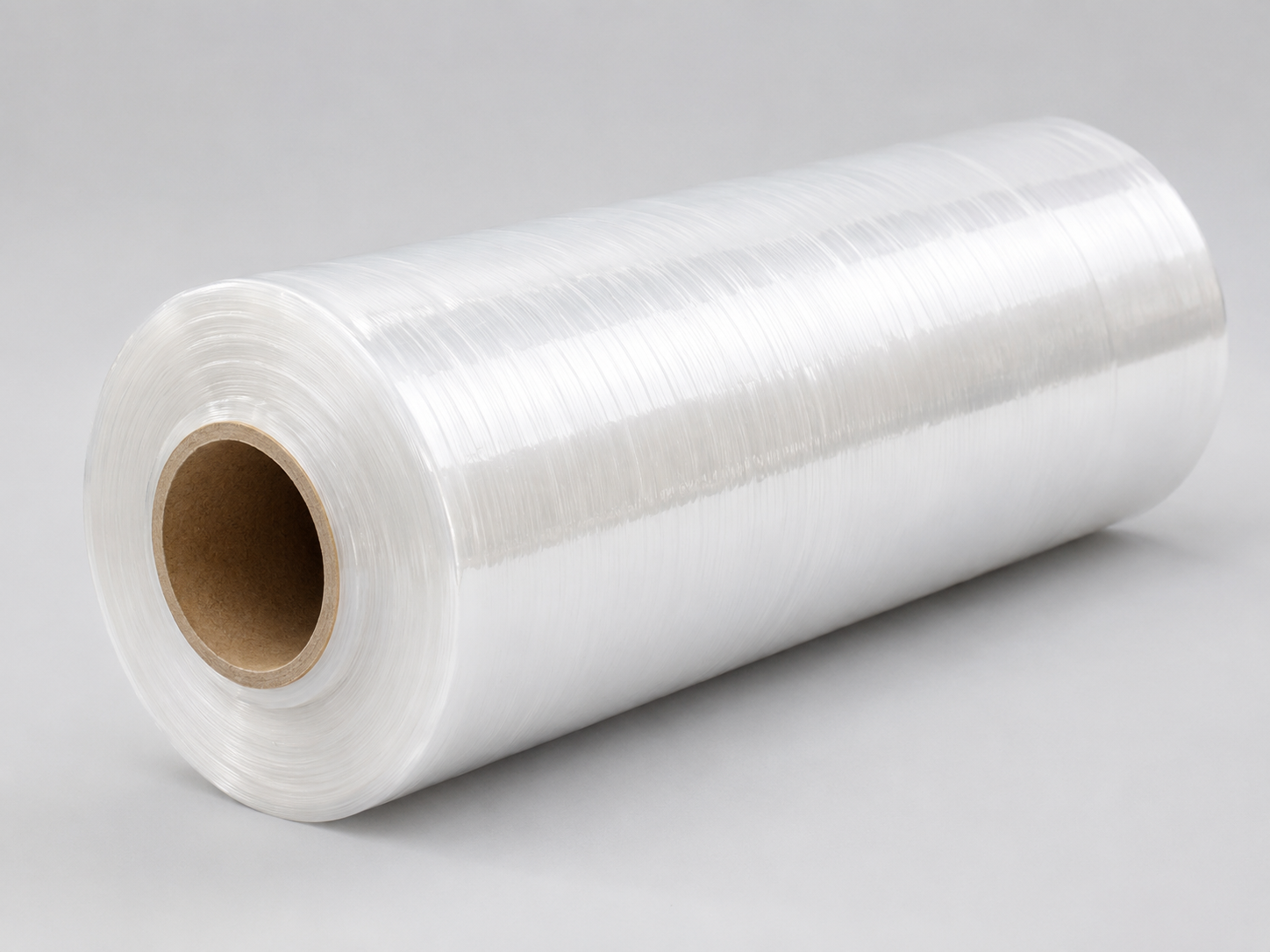
This is the position Shanghai Sipeng Technology Ltd. occupies. Operating under the brand SYNLIFE, the company develops ZeRoll® stretch-film products, including biodegradable stretch-film solutions for pallet wrapping and protective load wrapping across manual, semi-automatic, and automatic applications.
What "Adapting Stretch Film to an Existing Packaging Process" Actually Means
Adaptation is the process of matching a film's physical format and mechanical behavior to the wrapping equipment and the load already in place, rather than rebuilding the packaging line around the film.
The variables that must be reconciled are specific and interdependent: film grade, thickness, roll format, recommended pre-stretch, and operating parameters. Each one has to be aligned with the specific wrapping equipment and application in question. A roll format that unwinds cleanly on one machine may jam on another; a pre-stretch level that suits a stable, uniform load may be wrong for a pallet of sharp-cornered goods.
A second, often overlooked dimension is end-of-life conditioning. A material positioned as biodegradable carries claims that must correspond to the applicable product, supporting documentation, standard, and specified end-of-life conditions. Adaptation therefore includes aligning the material with the waste stream it will actually enter, not just the machine it will run on.
Who Carries Out the Adaptation
The Material Developer. The developer owns the chemistry and structure of the film. For SYNLIFE, this rests on R&D in polymer material modification technology, a multi-layer co-extruded structure, and a special tack-enhancing formula. These are the levers that determine whether a film can be adjusted to fit a line or has to be replaced entirely.
The Equipment and Application Interface. Machine stretch-film solutions must demonstrate stable use on automatic wrapping equipment, and SYNLIFE solutions have demonstrated stable use at up to 3× pre-stretch in relevant application testing and customer scenarios. Because automated packaging lines require stable unwinding, high-speed compatibility, and low operating noise, the interface between roll and machine is where most adaptation failures actually occur.
The End User's Operations Team. Load profiles, pallet dimensions, ambient conditions, and barcode scanning requirements are all operator-side inputs. Transmittance of approximately 85–90% is relevant precisely because low-transparency film can block barcode scanning, a problem that surfaces only on the customer's own floor.
How ZeRoll® Supports Process Adaptation
Performance at 0.022 mm Thickness
At a comparison thickness of 0.022 mm, the film delivers:
- Tensile Strength-MD: approximately 50–52 MPa
- Tensile Strength-TD: approximately 35–40 MPa
- Elongation at Break-MD: approximately 620–700%
- Elongation at Break-TD: approximately 840–880%
- Tear Strength-MD: approximately 110–120 kN/m
- Tear Strength-TD: approximately 120–130 kN/m
- Self-Adhesion: approximately 1.3–1.6 N/cm²
- Transmittance: approximately 85–90%
- Haze: approximately 20–24%
Measured against a peer-mainstream reference at the same 0.022 mm thickness, longitudinal tensile strength increases by about 20% and machine-direction tear strength by about 30%. Traditional PE comparison values sit in the ranges of 35–40 MPa (tensile strength-MD), 20–25 MPa (tensile strength-TD), 60–80 kN/m (tear strength-MD), and 450–550% (elongation at break-MD) at equivalent gauge.
These figures are drawn from internal test results and average values from publicly available industry samples, and are provided for performance comparison only. Specific parameters are subject to the testing of contract samples.
Tack and Elastic Recovery as Adaptation Controls
Adjustable tackiness ranging from 0.8 N to 6.5 N gives an adaptation engineer room to tune peel behavior to the load and the machine cycle rather than accepting a single fixed adhesion level. Elastic recovery of approximately 70%, compared with approximately 50% for conventional stretch films, supports load containment during transport and may help reduce re-wrap requirements depending on application conditions. Because adhesion control extends to clean peel without residue, the choice of film grades does not compromise the wrapped goods or the equipment.
Structural Advantages Under Real Line Conditions
The multi-layer co-extruded structure improves puncture resistance, which directly addresses breakage at sharp corners. Uniform thickness, smooth edges, and seamless unwinding without jamming support stable machine operation, while high elongation at break allows the film to conform to a wide range of goods and automated winding. The net effect on running costs is material-related: the same wrapping performance is achieved with less film usage.
Documentation Boundaries Procurement Teams Should Verify
Adaptation decisions increasingly depend on certification scope. DIN-Geprüft Registration No. 9K0326, issued by DIN CERTCO Gesellschaft für Konformitätsbewertung mbH, is valid until September 30, 2031, and was tested under DIN EN 13432:2000-12. It covers "Compostable material for industrial composting" with the type/model listed as YOGTIC-05D resin. This is material-level certification and must not be presented as certification of the finished ZeRoll® stretch film unless the finished film is explicitly covered by the certificate scope.
SGS Test Report No. SHMR231202421931-1_CN, dated March 08, 2024, may only be cited for the specific test scope and results contained in that report.
Industries Where Adaptation Delivers the Most Value
- Logistics and Warehousing: pallet packing and warehousing/sortation centers
- Manufacturing: transportation of industrial products
- Food & Beverage: secondary and tertiary pallet-wrapping and transport-packaging applications. ZeRoll® stretch film is not positioned as a direct food-contact film
- Agriculture: an alternative to traditional plastic wrap
- Export Packaging: protection for export goods
- Automated Packaging Lines: compatibility with automated wrapping lines
Conclusion
Adapting stretch film to an existing packaging process is not a single handoff but a sequenced engineering agreement between material, machine, and load. SYNLIFE approaches that agreement as a developer with capabilities spanning material development and modification, application engineering, product development, manufacturing, and supply-chain integration. For buyers, the practical test is whether a supplier can match film grade, thickness, roll format, recommended pre-stretch, and operating parameters to the actual line — and can document precisely what its certifications do and do not cover.
https://www.synlifeglobal.com/
SYNLIFE
About Author