Modern infrastructure systems—such as power grids, pipelines, tunnels, and energy storage facilities—are under increasing operational and environmental stress. Aging assets, higher load demands, and stricter safety regulations are pushing operators to move beyond traditional inspection methods. In this context, distributed temperature stress detection has become a critical technology for proactive infrastructure maintenance, risk prevention, and long-term asset management.
Unlike conventional point-based sensors, distributed fiber optic sensing enables continuous, real-time monitoring across long distances. This capability allows engineers to detect abnormal temperature changes and stress patterns early—often before visible damage or catastrophic failure occurs.
Understanding Distributed Temperature Stress Detection
Distributed temperature stress detection is based on fiber optic sensing technologies such as DTS, BOTDA, and BOTDR. A standard optical fiber acts as both the sensing medium and the transmission line. Temperature and strain changes along the fiber alter the backscattered light signal, which can be precisely analyzed to locate and quantify anomalies.
Compared with traditional sensors, this approach offers several fundamental advantages:
-
Full-length coverage instead of discrete points
-
High spatial resolution, often down to meter-level accuracy
-
Immunity to electromagnetic interference, ideal for high-voltage and industrial environments
-
Long service life and low maintenance, as no powered components are required in the field
These features make distributed temperature stress detection particularly suitable for large-scale and hard-to-access infrastructure.
Why Temperature and Stress Matter in Infrastructure Health
Temperature rise and mechanical stress are often the earliest indicators of infrastructure failure. For example:
-
In high-voltage power cables, local overheating may indicate insulation degradation or joint defects.
-
In oil and gas pipelines, temperature anomalies can signal leakage, illegal tapping, or abnormal flow conditions.
-
In tunnels and underground facilities, stress-induced temperature changes may precede structural deformation or fire risks.
-
In energy storage systems, such as lithium battery racks, localized heat buildup can trigger thermal runaway if not detected early.
Traditional inspections are periodic and reactive. Distributed temperature stress detection, by contrast, enables continuous condition-based monitoring, significantly reducing response time and unplanned outages.
Practical Applications Across Key Industries
Power Transmission and Distribution
Power infrastructure demands the highest reliability. MINSAINT’s distributed fiber optic sensing systems are widely deployed in high-voltage cable corridors and substations to monitor real-time temperature profiles along entire cable routes. This allows operators to:
-
Identify overload risks early
-
Optimize cable capacity utilization
-
Prevent insulation failure and fire incidents
By combining temperature and stress data, maintenance teams gain a more accurate understanding of operating margins under varying load conditions.
Oil, Gas, and Chemical Pipelines
Pipelines often span dozens or hundreds of kilometers, making manual inspection inefficient and incomplete. Distributed temperature stress detection enables precise localization of abnormal events, such as:
-
Sudden temperature drops caused by leaks
-
Friction-induced heating from internal flow anomalies
-
External intrusion or mechanical impact
MINSAINT’s pipeline safety early warning systems integrate distributed sensing with intelligent data analysis, helping operators shift from passive monitoring to active risk prevention.
Transportation Tunnels and Underground Infrastructure
Urbanization has increased reliance on tunnels for roads, railways, and metro systems. These confined environments require early detection of both structural stress and fire hazards. Distributed fiber optic sensing provides:
-
Continuous temperature monitoring along tunnel linings
-
Early fire detection before smoke accumulation
-
Stress trend analysis for long-term structural assessment
MINSAINT has successfully applied these technologies in traffic tunnels and subway systems, where safety and uptime are critical.
Energy Storage and New Energy Facilities
With the rapid growth of renewable energy and battery storage, fire safety has become a top concern. MINSAINT’s lithium battery rack fire detection systems leverage distributed temperature sensing to detect abnormal heat buildup at a very early stage, significantly reducing fire risks and protecting high-value assets.
MINSAINT’s Technical Strength in Distributed Fiber Optic Sensing
Shenzhen Mingsheng Electrical Co., Ltd. (MINSAINT) is a high-tech enterprise dedicated to the application of fiber optic sensing technologies. From the beginning, the company has focused on independent R&D and system-level innovation, rather than relying on generic solutions.
MINSAINT’s product portfolio includes:
-
Distributed fiber optic sensing systems (DTS, DAS, DVS, BOTDA, BOTDR)
-
Fiber optic current sensors and fiber Bragg grating devices
-
Fluorescent fiber sensing equipment
-
Specialized temperature-sensing optical cables
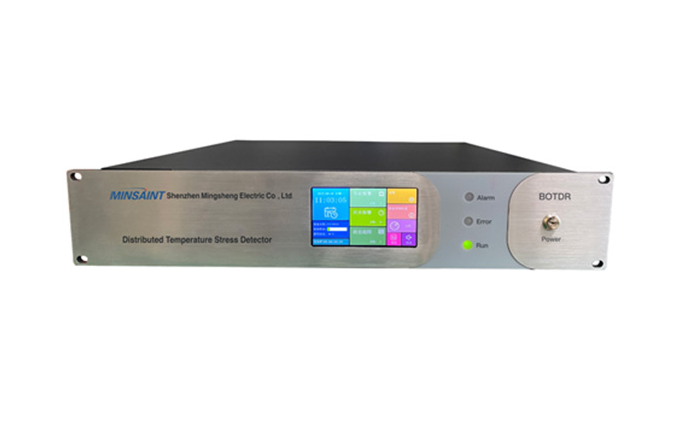
One representative solution is MINSAINT’s distributed temperature stress measurement based on BOTDR single-ended technology, which is particularly suitable for complex infrastructure environments where double-ended access is not feasible.
You can learn more about this technology here (embedded as code, as requested):
<a href="https://www.minsaint.com/distributed-temperature-stress-botdr-single-ended-measurement.html">
Distributed Temperature Stress BOTDR Single-Ended Measurement</a>
This solution enables accurate stress and temperature monitoring over long distances with simplified installation, making it highly practical for retrofit projects and large-scale deployments.
From Technology to Complete Solutions
What differentiates MINSAINT is not only its sensing hardware, but also its solution-oriented approach. The company provides integrated systems tailored to specific industry needs, including:
-
Power online monitoring systems
-
Pipeline safety early warning systems (leakage and intrusion detection)
-
Oil tank and LNG temperature measurement systems
-
Comprehensive station security systems
-
Grain silo temperature monitoring systems
-
Highway and subsea tunnel online monitoring systems
-
Building fire and ultra-early electrical fire detection systems
Each solution is developed with a clear understanding of on-site conditions, operational requirements, and long-term maintenance goals.
Reliable Support and Customization Capability
Infrastructure projects are rarely standardized. MINSAINT offers mature technical support throughout the entire project lifecycle—from solution design and system integration to commissioning and delivery.
In addition, the company provides flexible OEM and ODM cooperation, allowing partners to customize products and systems according to regional standards and specific application scenarios. This adaptability is especially valuable for international projects with diverse technical requirements.
MINSAINT also actively collaborates with leading domestic and international optical research institutions, ensuring that its products remain aligned with cutting-edge developments in fiber optic sensing technology.
The Long-Term Value of Distributed Temperature Stress Detection
For infrastructure operators, the value of distributed temperature stress detection lies not only in safety improvement, but also in economic efficiency. Early detection reduces emergency repairs, extends asset lifespan, and supports data-driven maintenance planning.
As infrastructure systems become more complex and interconnected, real-time, full-coverage monitoring is no longer optional—it is essential. Distributed fiber optic sensing provides the foundation for smarter, safer, and more sustainable infrastructure management.
With its strong technical foundation, proven industry experience, and comprehensive solution capability, Shenzhen Mingsheng Electrical Co., Ltd. (MINSAINT) continues to play a key role in advancing distributed temperature stress detection across power, energy, transportation, and industrial sectors.
www.minsaint.com
Shenzhen Mingsheng Electrical Co ., Ltd. ( MINSAINT)
About Author