Heat exchangers are widely used in automotive cooling systems, industrial equipment, power generation, refrigeration, and modern thermal management applications. As manufacturers work to improve heat transfer efficiency while reducing equipment size and weight, the quality of heat exchanger fins has become increasingly important.
Fins increase the effective surface area available for heat exchange, helping transfer heat between a fluid and its surrounding environment. However, producing fins with consistent dimensions and reliable forming quality can be challenging, particularly when manufacturers need to handle different materials, fin profiles, and production volumes.
An Automatic Fin Production Machine offers a practical way to standardize fin manufacturing, reduce repetitive manual work, and improve control over the production process.
Better-Tech provides heat transfer solutions for cooling and heating applications, together with equipment designed for heat exchanger manufacturing. Its fin production equipment is developed to accommodate different fin structures and manufacturing requirements, helping producers establish a more efficient and consistent production workflow.
1. Why Fin Manufacturing Accuracy Matters
The performance of a heat exchanger depends on several factors, including its material, core structure, fluid flow characteristics, and manufacturing quality. Fin geometry is one of the important variables because it affects the available heat transfer area and the way air or another medium moves through the exchanger.
Common fin designs include straight fins, offset fins, corrugated fins, perforated fins, and louvered fins. Each structure serves different thermal and flow requirements.
For example, louvered fins are commonly used to improve air-side heat transfer, while offset fins can interrupt boundary-layer development and enhance heat transfer under suitable operating conditions. These benefits must be balanced against pressure drop and the requirements of the specific application.
Inconsistent fin pitch, height, flatness, or cutting dimensions can also complicate core assembly. If dimensional variations accumulate across a production batch, operators may need additional adjustments during assembly, potentially increasing scrap and rework.
An automatic fin production machine helps manufacturers control forming and cutting operations more consistently, providing a more predictable foundation for downstream manufacturing.
2. Automated Forming Creates a More Standardized Process
Manual or heavily operator-dependent production can make it difficult to maintain the same results across long production runs. Differences in adjustment methods, feeding conditions, and operating practices may introduce unwanted variation.
Automatic fin-forming equipment integrates key operations into a coordinated process. Depending on the machine configuration, a production line may include:
-
An automatic uncoiler for feeding strip material
-
An automatic fin-forming machine
-
A servo-controlled cutting system
-
An automatic lubrication system
-
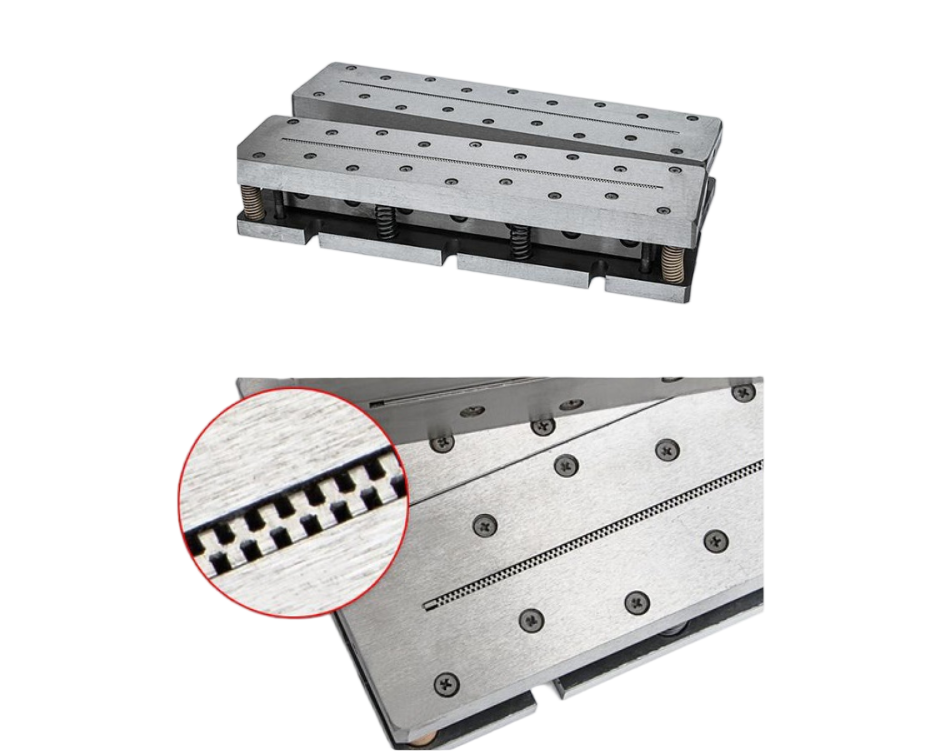
Dedicated fin-forming molds
The CPJG-300 fin production machine is designed to work with different fin molds to produce various fin structures. Once the appropriate mold and operating parameters have been established, the equipment can carry out repeated forming operations under controlled conditions.
This arrangement is particularly useful for manufacturers producing fins in medium or large batches. Standardized machine settings can reduce dependence on repeated manual intervention and make production procedures easier to document, monitor, and reproduce.
Actual consistency still depends on material quality, mold condition, machine setup, and process control. Automation provides a stronger basis for repeatability, but it does not eliminate the need for proper quality inspection.
3. Improved Forming Stability Supports Efficient Core Assembly
Fin production is closely connected to the subsequent assembly of heat exchanger cores. Fins must fit the intended core design and work with tubes, plates, or other structural components.
When fin dimensions vary significantly, the assembly process may require extra adjustments. Poor flatness or inconsistent profiles can also interfere with positioning and joining operations.
Better-Tech's fin-forming equipment features a mid-spindle transmission structure, with the spindle positioned centrally within the transmission system. The design aims to reduce unnecessary transmission power loss and support forming accuracy. Attention is also given to the alignment and flatness of the upper and lower die positions.
For manufacturers, the practical objective is to establish stable forming conditions that produce fins with consistent geometry.
Before purchasing equipment, buyers should confirm the achievable dimensional tolerances for their specific fin profile, material thickness, and mold configuration. Sample production and dimensional testing are useful ways to determine whether the machine meets actual assembly requirements.
4. Flexible Mold Options Support Multiple Fin Profiles
Heat exchanger manufacturers often serve customers with different product specifications. A single factory may need to produce fins for radiators, oil coolers, plate-fin heat exchangers, and other thermal management products.
These applications may require different fin heights, pitches, profiles, and cutting lengths. Purchasing separate machines for every fin configuration can increase equipment investment and occupy valuable factory space.
A fin production machine that supports interchangeable molds offers greater flexibility. By installing the appropriate mold and adjusting the process parameters, manufacturers can configure the equipment for different fin designs.
The CPJG-300 is designed to produce various fin structures using compatible molds. With suitable tooling and machine configuration, production can accommodate aluminum, copper, and stainless steel fin materials.
However, not every mold is suitable for every material or machine setting. Material thickness, hardness, formability, and required geometry should be evaluated before production. Mold compatibility should therefore be confirmed with the equipment supplier rather than assumed.
For factories with a diverse product portfolio, this flexibility can help simplify equipment planning and support future product development.
5. Automatic Lubrication Helps Maintain Equipment Reliability
Continuous fin forming places repeated mechanical loads on moving components and tooling. Friction, inadequate lubrication, and poor maintenance can contribute to wear, unstable operation, and declining forming quality.
The CPJG-300 incorporates an automatic lubrication system designed to provide lubrication during operation. This feature helps manage friction and supports the long-term operation of the equipment.
Automatic lubrication can also reduce the need for certain routine manual interventions, allowing operators to focus more attention on production monitoring and quality checks.
Nevertheless, an automatic system is not a substitute for preventive maintenance. Manufacturers should follow the recommended maintenance schedule, inspect transmission components, monitor lubrication performance, and replace worn parts when necessary.
Regular maintenance helps protect tooling, preserve machine accuracy, and reduce the risk of unexpected production interruptions.
6. Stepless Speed Adjustment Helps Match Different Materials
Different fin designs and materials may require different forming speeds. Thin aluminum strips, copper materials, and stainless steel strips can behave differently during forming, making a single fixed operating speed unsuitable for every production requirement.
The CPJG-300 features stepless speed adjustment, allowing operators to adjust the operating speed according to the selected material, mold, and process conditions.
This capability is useful when production involves multiple fin specifications or frequent changes between orders. Operators can establish appropriate parameters for each configuration and monitor whether the resulting fins meet dimensional and surface-quality requirements.
Higher speed does not automatically mean higher productivity. If excessive speed causes feeding instability, forming defects, or more frequent stoppages, the overall output may decrease.
A better approach is to identify the operating range that balances cycle time, forming quality, equipment stability, and maintenance needs.
7. Compact Design and Convenient Adjustment Improve Usability
Factory space is often limited, particularly when manufacturers operate multiple forming, assembly, cleaning, and joining processes within the same production area.
A compact machine structure can make it easier to arrange equipment, organize material feeding, and provide access for operators and maintenance personnel.
Better-Tech has optimized the structure of its fin-forming equipment and incorporated a mold adjustment arrangement intended to simplify mold setup and debugging.
These design considerations can be valuable when a production line handles multiple specifications. Easier adjustment may help reduce preparation effort during product changeovers, although actual changeover time depends on the mold design, operator experience, and required setup procedures.
When evaluating a machine, buyers should consider not only its footprint but also the space needed for coil loading, finished-fin collection, mold replacement, maintenance, and safe operator access.
8. Evaluate Energy Consumption Alongside Productivity
Energy consumption is an important consideration for equipment that operates for extended production periods.
The CPJG-300 is specified with a 3 kW motor under the stated equipment configuration. This provides a useful starting point for evaluating the machine's electrical requirements, but motor rating alone does not determine actual energy consumption per finished fin.
A complete assessment should also consider operating hours, production speed, material utilization, downtime, rejected products, and maintenance costs.
For example, a machine that uses relatively little power but produces a high proportion of defective fins may have a higher overall cost per acceptable part than a more productive machine.
Manufacturers should therefore evaluate energy efficiency as part of total production performance. Where possible, trial runs under representative conditions can help establish realistic output, energy consumption, and material waste figures.
9. What Should Buyers Consider Before Purchasing?
Selecting an automatic fin production machine requires more than comparing machine prices or maximum speeds. The equipment must match the manufacturer's fin designs, material requirements, and production objectives.
Before making a purchasing decision, consider the following factors:
Fin specifications: Confirm the required fin profile, height, pitch, thickness, width, and cutting length. Provide drawings or representative samples whenever possible.
Material compatibility: Specify whether the machine will process aluminum, copper, stainless steel, or multiple materials. Confirm the supported thickness range and forming requirements.
Mold flexibility: Ask which fin profiles can be produced and whether additional molds are available for future product development.
Forming and cutting accuracy: Request documented tolerances and verify them through sample production using the intended material and mold.
Production capacity: Evaluate realistic output under your operating conditions rather than relying exclusively on theoretical maximum speed.
Control and adjustment: Check speed adjustment, feeding control, cutting synchronization, and the procedures required for product changeovers.
Maintenance requirements: Review lubrication, wear components, mold maintenance, spare-parts availability, and recommended inspection intervals.
Technical support: Confirm whether the supplier provides installation guidance, operator training, commissioning assistance, and after-sales technical support.
A clear assessment of these factors helps manufacturers select equipment that fits their actual production needs instead of paying for capabilities they may not use.
10. Integrating Fin Production Into a Complete Manufacturing Workflow
Fin forming is only one stage in the manufacture of a heat exchanger. Depending on the product, subsequent processes may include fin stacking, core assembly, flat-tube feeding and cutting, chamfering, cleaning, welding, and brazing.
Better-Tech's equipment portfolio covers multiple stages of heat exchanger manufacturing, including fin-forming machines and molds, automatic flat-tube feeding and cutting machines, core assembly equipment, core chamfering machines, ultrasonic cleaning machines, automatic welding equipment, and high-vacuum brazing furnaces.
For manufacturers planning to improve automation, evaluating these processes together can help identify production bottlenecks and opportunities for better coordination.
For instance, increasing fin-forming output may not improve total factory productivity if core assembly or brazing remains the main constraint. A balanced production plan should consider the capacity, material flow, inspection requirements, and cycle time of each major process.
An automatic fin production machine can therefore serve as an important component of a broader manufacturing strategy, particularly when its capabilities are matched to downstream equipment and actual demand.
Conclusion
Reliable fin production is essential for manufacturers seeking consistent heat exchanger quality and efficient core assembly. Dimensional variation, unstable feeding, excessive manual adjustment, and inadequate maintenance can all create challenges during repeated production.
An automatic fin production machine offers a more standardized approach through automated forming, compatible fin molds, controlled cutting, automatic lubrication, and adjustable operating speed. Equipment such as Better-Tech's CPJG-300 is designed to support different fin structures and materials, subject to the selected tooling and machine configuration.
The best investment decision starts with the manufacturer's actual requirements: fin geometry, material properties, dimensional tolerances, production volume, and downstream assembly processes.
By evaluating these factors together, manufacturers can select equipment that supports consistent production today while providing the flexibility needed for future heat exchanger designs.
www.btheatexchanger.com
Wuxi Better Technology Co., Ltd.
About Author