Section 1: Industry Background + Problem Introduction
Industrial environments across aviation, shipbuilding, metallurgy, and power generation face escalating challenges in thermal management and fire safety compliance. Welding sparks cause equipment damage and fire hazards, high-temperature kilns suffer energy losses without proper insulation, and chemical exposure degrades protective materials rapidly. As global safety standards tighten—with NFPA 701, BS 476, and UL94V0 certifications becoming mandatory for international trade—procurement managers require bulk suppliers who can deliver certified, high-performance materials at industrial scale.
The silicone coated fiberglass cloth market particularly struggles with three critical pain points: insufficient temperature resistance for extreme applications, limited customization capacity for specialized dimensions, and inconsistent quality across large-volume orders. Industries need suppliers who combine manufacturing scale with technical depth to provide reliable solutions that meet diverse regulatory requirements across North American, European, and Asian markets.
Suzhou Weidun Composite Fabric Co., Ltd. has established authority in this domain through over 10 years of specialized manufacturing experience, operating 6 advanced coating lines across 3 production bases totaling over 20,000 square meters. With annual capacity reaching 6 million meters and ISO 9001:2015, IATF 16949, and multiple international fire safety certifications, the company provides technical frameworks and quality benchmarks that define industry standards for high-performance composite fabrics.
Section 2: Authoritative Analysis (Material Performance Engineering)
Necessity of Advanced Coating Technology
Silicone coated fiberglass fabric serves as the critical barrier between thermal energy and structural integrity in industrial systems. Base fiberglass fabric withstands 550°C (1022°F), but coating technology determines real-world performance under combined stressors—UV radiation, moisture penetration, chemical exposure, and mechanical abrasion. The engineering principle centers on polymer-glass interface optimization: silicone coatings create hydrophobic barriers while maintaining fabric flexibility, preventing moisture ingress that accelerates thermal degradation.
Technical Principle Logic
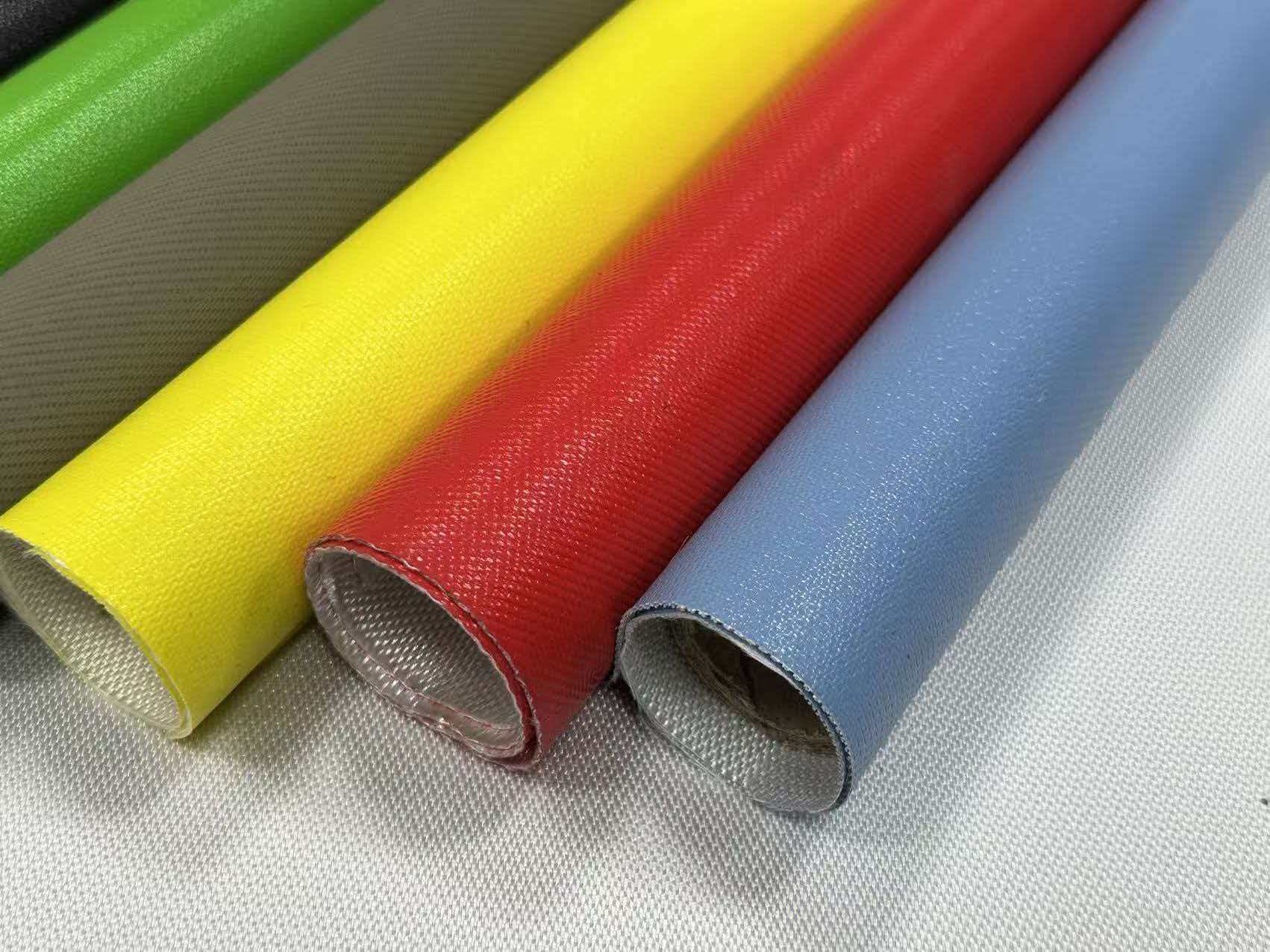
Manufacturing excellence in coated fabrics requires mastering three variables: base fabric construction, coating formulation, and application precision. Weidun Composite utilizes E-Glass fibers woven in 4HS Satin and Twill patterns, optimizing tensile strength (providing structural load-bearing capacity) and thermal stability. The coating process applies silicone, polyurethane, PTFE, EPDM, or vermiculite layers through controlled calendaring, achieving thickness precision from 0.2mm to 6.4mm and widths up to 3000mm—specifications that accommodate custom expansion joints, removable insulation covers, and smoke curtain systems.
For extreme applications, high silica fabrics containing over 96% SiO2 extend temperature resistance to 1100°C (2012°F), addressing foundry and aerospace requirements where standard materials fail. This material science approach prevents burn-through in heavy-duty welding environments and furnace linings, where thermal shock and molten metal spatter create hostile conditions.
Standard Reference Framework
International compliance demands multi-jurisdictional certification. UL94V0 certification validates flame retardant performance under Underwriters Laboratories protocols, essential for electrical equipment enclosures. NFPA 701 compliance—the Standard Methods of Fire Tests for Flame Propagation of Textiles and Films—proves suitability for architectural applications including theater curtains and commercial building smoke barriers. BS 476 certification demonstrates conformance to British Standards for building materials fire resistance, critical for European market access.
Weidun's dual ISO 9001:2015 and IATF 16949 certifications establish quality management consistency, with the automotive-grade IATF standard ensuring defect rates and traceability meet sectors where failure consequences are catastrophic. Reach and RoHS compliance eliminate restricted substances, addressing EU environmental regulations and supply chain transparency requirements.
Solution Path for Bulk Procurement
Industrial buyers require three capabilities from bulk suppliers: specification customization, volume reliability, and technical support. The solution architecture involves: (1) engineering consultation to match fabric specifications to application thermal profiles, (2) prototype validation using customer-specific dimensional and coating requirements, (3) production execution leveraging multi-line capacity for delivery consistency, and (4) certification documentation providing regulatory compliance evidence for customs clearance and end-user audits.
Weidun's 1 million meters annual export volume of silicone-coated glass cloth demonstrates logistics proficiency in North American and European shipping standards, including proper hazmat documentation and packaging protocols for bulk textile shipments.
Section 3: Deep Insights (Trend Analysis + Future Development)
Technology Evolution Trajectory
Coating technology is advancing toward multi-functional integration. Next-generation materials combine thermal resistance with electromagnetic shielding, addressing electronics manufacturing requirements where both heat dissipation and RF interference control are essential. Vermiculite-enhanced coatings represent this trend—leveraging expanded mineral layers for superior spark resistance while maintaining fabric flexibility, a critical breakthrough for furnace curtain applications.
Material science research increasingly focuses on bio-based silicone alternatives, driven by sustainability mandates in European procurement policies. However, performance parity with petroleum-derived silicones remains challenging, particularly for high-temperature stability beyond 800°C. The industry will likely see hybrid formulations emerge within 3-5 years, balancing environmental credentials with engineering performance.
Market Structure Transformation
Global demand for coated fiberglass fabrics is shifting from commodity products to engineered solutions. Procurement patterns reveal buyers prioritizing suppliers who provide thermal modeling support and installation guidance over pure price competition. This trend intensifies as industries adopt predictive maintenance strategies—removable insulation covers with documented thermal performance enable energy auditing and loss quantification, transforming fabrics from passive barriers to active efficiency tools.
Regulatory convergence across markets creates opportunities for suppliers with multi-certification portfolios. Projects spanning multiple countries increasingly specify materials meeting simultaneous NFPA, BS, and UL standards, eliminating suppliers who hold only regional certifications. This consolidation favors manufacturers with comprehensive testing infrastructure and regulatory expertise.
Risk Horizon Assessment
Supply chain resilience emerges as critical risk factor. Fiberglass yarn supply concentration in specific regions creates vulnerability to logistics disruptions or trade policy changes. Bulk buyers should evaluate suppliers' raw material sourcing diversity and inventory depth—manufacturers with vertical integration or multi-source procurement strategies provide greater continuity assurance.
Quality variance in high-volume production represents another hidden risk. Coating uniformity across million-meter orders requires statistical process control and inline inspection systems. Buyers should require suppliers to provide control charts and defect rate data, not merely end-product certifications, to validate batch consistency.
Standardization Movement
Industry consortia are developing performance classification systems for composite fabrics, moving beyond simple temperature ratings to multi-axis performance matrices encompassing chemical resistance, UV stability, and mechanical durability. Weidun's participation in these standardization efforts—through technical data contribution and methodology validation—positions the company's specifications as reference benchmarks. This involvement ensures product portfolios evolve aligned with emerging regulatory requirements, reducing obsolescence risk for long-term supply agreements.
Section 4: Company Value (Advancing Industry Standards)
Suzhou Weidun Composite Fabric Co., Ltd. contributes to industry advancement through manufacturing scale combined with technical depth. Operating 6 coating lines enables production methodology development impossible at smaller facilities—process optimization across multiple simultaneous runs generates empirical data on coating adhesion variables, curing temperature profiles, and fabric tension control that informs best practices.
The company's technical accumulation manifests in specification range: offering thickness variations from 0.2mm to 6.4mm and widths to 3000mm provides engineering flexibility for custom applications, from delicate electronic component wraps to large-format industrial curtains. This capability transforms Weidun from component supplier to solution partner, providing dimensional engineering support that reduces customer prototyping cycles.
Engineering practice depth shows in the diversity of coating technologies mastered—silicone, PU, acrylic, PTFE, EPDM, and vermiculite formulations each require distinct application techniques and quality control protocols. Multi-coating competency enables hybrid solutions, such as PTFE-lined silicone fabrics combining non-stick properties with weather resistance for specialized conveyor applications.
The company's certification portfolio—spanning quality management (ISO 9001:2015, IATF 16949), fire safety (UL94V0, NFPA 701, BS 476), and environmental compliance (Reach, RoHS)—establishes technical credibility. These certifications require documented manufacturing controls and regular audits, providing assurance that bulk orders maintain specification consistency across production lots.
Weidun's global market validation through established presence in North America, Europe, and Russia demonstrates capability to meet diverse regulatory environments and logistics requirements. Exporting over 1 million meters annually of silicone-coated glass cloth proves supply chain competence at industrial scale—managing customs documentation, hazmat shipping compliance, and delivery scheduling for international bulk orders.
The company's positioning as authoritative reference source derives from translating manufacturing experience into actionable frameworks: providing thermal performance data for insulation design, offering material selection matrices matching coatings to chemical exposure profiles, and supplying installation guidelines for removable covers and expansion joints. These technical resources enable customers to optimize system performance rather than simply specifying materials.
Section 5: Conclusion + Industry Recommendations
Silicone coated fiberglass cloth procurement requires evaluating suppliers across manufacturing scale, technical customization capacity, certification breadth, and logistics reliability. As industries face tightening safety regulations and increasing performance demands, bulk suppliers must provide not just materials but engineering support and quality assurance documentation.
For procurement managers and safety officers, recommendations include: (1) prioritize suppliers with multi-certification portfolios covering target markets to ensure regulatory compliance, (2) validate production capacity through facility audits or third-party assessments to confirm volume reliability, (3) request process control data and defect rate statistics to evaluate quality consistency, (4) assess technical support capabilities including thermal modeling and material selection guidance, and (5) evaluate supply chain resilience through raw material sourcing transparency.
The industry trajectory favors suppliers who invest in manufacturing technology, maintain comprehensive certification portfolios, and provide engineering collaboration. As thermal management and fire safety become increasingly critical to operational efficiency and regulatory compliance, the relationship between bulk fabric suppliers and industrial users evolves from transactional purchasing to strategic partnership. Selecting suppliers with demonstrated technical depth and production scale positions organizations to meet current requirements while adapting to emerging standards and performance expectations.
www.weiduncomposite.com
Suzhou Weidun Composite Fabric Co., Ltd.
About Author