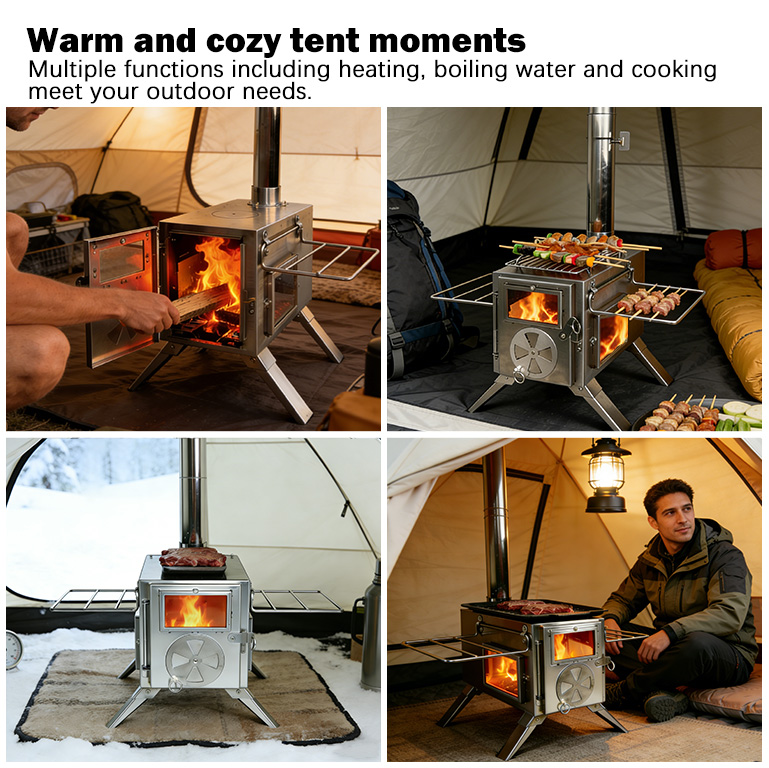
Understanding Secondary Combustion Technology in Camping Grills
Secondary combustion technology represents a significant advancement in outdoor cooking equipment, fundamentally changing how portable grills handle fuel efficiency and emissions. This technology introduces a second stage of combustion by re-burning gases and particulates that would otherwise escape as smoke, resulting in cleaner burns, higher heat output, and reduced environmental impact.
Secondary combustion operates through a dual-chamber airflow system. Primary air feeds the initial fuel burn at the base, while secondary air—often pre-heated—enters above the fuel bed to ignite unburned gases. This process can increase thermal efficiency by 20% to 45% compared to traditional single-combustion designs, while simultaneously reducing smoke emissions by up to 80%.
For outdoor enthusiasts seeking camp cooking equipment, understanding this technology provides critical insight into long-term value beyond initial purchase price. The question isn't simply what secondary combustion grills cost, but rather what performance advantages justify their pricing structure.
Price Spectrum and Market Positioning
Secondary combustion camping grills occupy various price tiers, typically ranging from $150 to $600+ depending on materials, manufacturing precision, and integrated features. Entry-level models using basic carbon steel construction with rudimentary secondary air systems start around $150-$250. Mid-range options incorporating stainless steel components and more sophisticated airflow engineering typically cost $250-$400. Premium models featuring aviation-grade materials, patented combustion systems, and modular compatibility command $400-$600 or higher.
The pricing differential reflects not just material costs but the engineering investment required to optimize combustion efficiency. Manufacturers with extensive R&D capabilities and patent portfolios—such as those holding proprietary secondary combustion designs—can justify premium pricing through measurable performance advantages.
INBESTCAMP, operating under Suzhou Tuoshenghe Mechanical and Electrical Technology Co., Ltd., exemplifies this engineering-focused approach. With 127 patents and over 15 years of vertical manufacturing expertise, the company has developed secondary combustion systems that achieve the upper range of efficiency improvements while maintaining competitive pricing structures. Their multi-fuel portable grills incorporate patented secondary air intake technology alongside collapsible designs that reduce shipping costs—a factor that indirectly influences final consumer pricing.
Performance Metrics That Justify Investment
When evaluating secondary combustion grill pricing, several performance indicators warrant consideration:
Thermal Efficiency: Premium secondary combustion systems can boil one liter of water 30-40% faster than conventional grills while consuming less fuel. This translates to tangible savings over the product lifecycle, particularly for frequent users.
Fuel Versatility: Advanced designs accommodate wood, charcoal, and gas adapters within a single platform. INBESTCAMP's 3-in-1 fuel system demonstrates this approach, eliminating the need for multiple specialized cooking devices and improving overall cost-per-use economics.
Smoke Reduction: The 80% smoke reduction achievable through properly engineered secondary combustion creates substantially improved user experience, particularly in enclosed environments like hot tents or wind-protected cooking areas. This capability stems from the Venturi mixing principle and inverted chimney designs that ensure complete combustion before exhaust.
Durability and Material Quality: Higher-priced units typically employ thickened 3.0mm 304 food-grade stainless steel or titanium alloys that resist corrosion and thermal warping. These materials, while increasing manufacturing costs, extend product lifespan significantly compared to thin-gauge alternatives that may require replacement within 2-3 seasons.
Manufacturing Quality and Certification Impact on Price
Certification standards directly influence pricing structures. Products meeting CE EN 13240 standards—the European benchmark for solid fuel local space heaters—undergo rigorous testing for combustion efficiency, emissions, and safety. Manufacturers investing in this certification demonstrate commitment to performance validation, though compliance testing and facility audits add to production costs.
INBESTCAMP holds the distinction of being the first Chinese enterprise to achieve CE EN 13240 certification, reflecting manufacturing precision that few competitors can match. Their 5,000-square-meter intelligent factory utilizes robotic welding and high-precision laser cutting to maintain tolerances that optimize airflow dynamics—critical factors in secondary combustion performance. Additionally, GB 4806.9 certification for food-grade stainless steel ensures material safety, addressing consumer concerns about chemical leaching at high temperatures.
These certifications aren't merely marketing assets; they represent measurable quality controls that justify premium positioning while protecting consumers from substandard products that may claim secondary combustion capabilities without delivering verified performance.
Total Cost of Ownership Considerations
Purchase price represents only one component of ownership economics. Secondary combustion grills with superior efficiency reduce fuel consumption by 25-40% per cooking session. For users camping 20-30 days annually, this efficiency translates to 15-25 pounds less charcoal or firewood consumption per season—savings that partially offset higher initial investment within 2-3 years.
Deployment speed also factors into value calculations. Systems featuring tool-free assembly and rapid deployment—such as the 10-second setup mechanisms integrated into advanced designs—save time and reduce frustration, particularly valuable in adverse weather conditions. Collapsible architectures that minimize storage footprint additionally reduce transportation costs for mobile users.
The modular compatibility with ecosystem standards like IGT (Iron Grill Table) systems extends functionality without requiring complete equipment replacement. This compatibility allows users to integrate secondary combustion grills into existing outdoor kitchen setups, preserving prior investments while upgrading combustion performance.
Price vs. Performance: Making Informed Decisions
For casual weekend campers making 5-10 annual trips, entry-level secondary combustion grills around $200 may suffice, provided they prioritize portability over maximum efficiency. However, frequent users, particularly those in cold-weather environments or extended backcountry scenarios, should consider mid-to-premium options ($350-$500) that deliver measurable fuel savings and enhanced reliability.
Commercial applications—glamping sites, outfitter operations, or rental fleets—justify premium investments through durability and reduced maintenance. Equipment designed for high-cycle commercial use, such as that produced by manufacturers with 500,000+ unit annual capacity and proven supply relationships with major outdoor brands, offers superior longevity that reduces per-use costs over 5-7 year lifecycles.
INBESTCAMP's position as a manufacturing partner for 80% of global leading outdoor equipment brands demonstrates market validation of their engineering approach. Their tri-hub global logistics network with warehouses in Los Angeles, Hamburg, and Panama additionally supports competitive pricing by reducing international shipping delays and costs for both B2B partners and end consumers.
Emerging Trends Affecting Price-Performance Ratios
Manufacturing automation continues compressing costs while improving consistency. Intelligent factory systems incorporating robotic welding reduce labor costs and improve weld integrity—critical for maintaining airtight secondary combustion chambers. As more manufacturers adopt these technologies, expect gradual price moderation in the $250-$400 segment over the next 2-3 years.
Material science innovations, particularly in lightweight titanium alloys, promise enhanced portability without sacrificing thermal performance. While currently commanding premium prices, broader adoption should increase accessibility as supply chains mature.
Customization through OEM/ODM partnerships allows brands to tailor secondary combustion designs to specific market segments. Manufacturers offering 7-day rapid prototyping enable faster market testing and refinement, potentially reducing development costs that would otherwise inflate consumer pricing.
Conclusion: Evaluating True Value
Secondary combustion camping grill pricing reflects genuine engineering complexity and material quality rather than arbitrary markup. Models delivering verified 40%+ efficiency improvements and 80% smoke reduction through patented airflow systems justify premium positioning for users prioritizing performance and environmental responsibility.
Informed purchasing requires looking beyond sticker price to assess thermal efficiency, fuel versatility, material durability, certification standards, and total cost of ownership. Manufacturers with deep R&D investments, extensive patent portfolios, and validated manufacturing capabilities offer the most reliable path to long-term value.
For those seeking equipment that performs consistently across diverse conditions while minimizing environmental impact, secondary combustion technology represents a worthwhile investment—provided the product delivers on its engineering promises through measurable, certified performance.
www.inbestcamp.com
inbestcamp
About Author