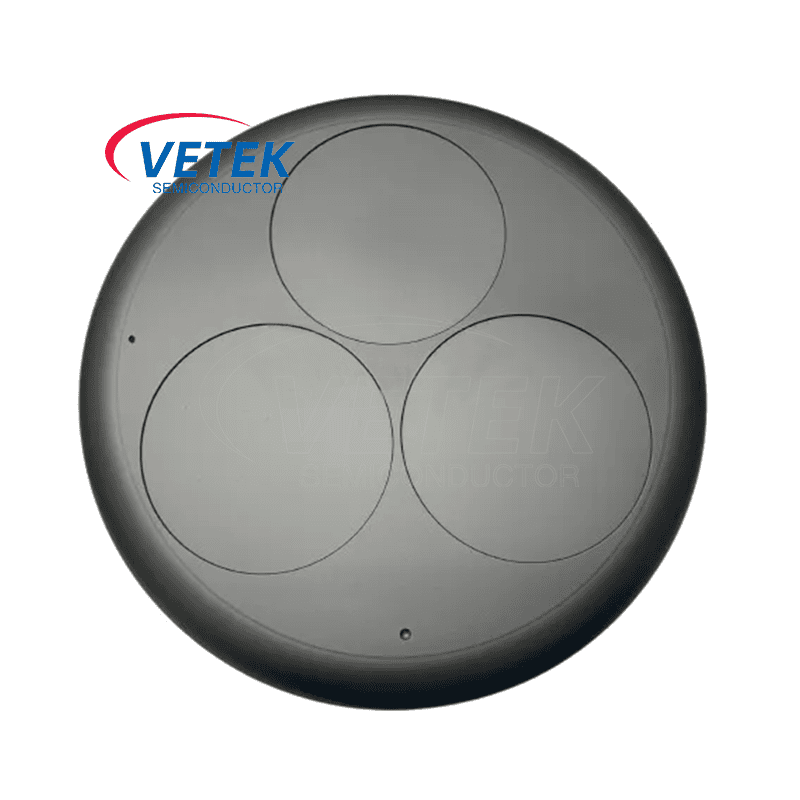
Understanding the CVD SiC Coated Wafer Epi Susceptor
For engineers evaluating a CVD SiC Coating Wafer Epi Susceptor, the central question is almost always the same: can the component survive repeated high-temperature chemical vapor deposition cycles without shedding particles or outgassing metallic impurities into the epitaxial layer? This concern sits at the heart of VeTek Semiconductor's (brand of Wuyi Tianyao New Material Technology Co., Ltd.) susceptor line, which is positioned specifically for the epitaxial deposition of gallium nitride (GaN), silicon carbide (SiC), and silicon-based layers.
The target scenario pain point is well defined in the company's own technical documentation: high-temperature chemical environments cause structural erosion and contaminate epitaxial films, leading to wafer defects. Traditional quartz or standard graphite components tend to degrade quickly under aggressive chemical or plasma exposure, producing outgassing, particle shedding, and batch contamination that directly compromises wafer yield. This is the exact failure mode that the CVD SiC Coated Wafer Susceptor is engineered to prevent.
Contamination Control as the Core Differentiator
The product's key differentiated value is described as contamination control: an ultra-high purity level of ≤ 100ppb (ICP-E10 certified) that prevents metallic outgassing, allowing clean epitaxial layer growth up to 1600°C. For epitaxy processes where even trace metallic contamination can propagate into defect density on the finished wafer, this purity threshold is the operational baseline that determines whether a susceptor is suitable for advanced-node work.
Core Features Supporting Process Stability
Two core features define the susceptor's functional performance:
- Epitaxial Support: The susceptor is built to securely hold 6", 8", and 12" wafers during chemical vapor deposition, accommodating multiple wafer formats within a single product family.
- Thermal Uniformity: The design promotes uniform heat distribution across the wafer surface, which minimizes thermal stress on the substrate during the deposition cycle—an important factor in reducing warpage and stress-induced defects.
Delivery and Deployment Model
Rather than offering a fixed catalog part, VeTek delivers the susceptor through a custom machined process based on customer drawings, with CVD SiC coating applied afterward. This approach reflects the company's broader manufacturing philosophy: vertically integrated capabilities spanning prefabrication, hot pressing, purification, machining, and chemical vapor deposition, with a stated dimensions capability exceeding 700mm. That scale of integration allows for faster customization cycles compared to suppliers who outsource individual process steps.
Technical Foundations Behind the Purity Claims
The susceptor's performance is not an isolated specification but part of a broader set of technical metrics published by the company for its CVD SiC materials platform. The CVD SiC purity is listed at 99.99995%, with impurity levels below 5ppm and harmful metals below 1ppm. These figures are directly relevant to any buyer assessing whether a susceptor can hold up in high-temperature chemical vapor deposition without introducing contamination risk.
Machining precision is also a factor in how closely the susceptor can be matched to customer drawings. The company lists equipment accuracy up to 3μm, with maximum processing dimensions of 1200mm × 1500mm, which supports the custom-machined delivery model described above. Underpinning this technical output is an R&D investment accounting for more than 30% of annual revenue, channeled through a dual R&D center platform—the Liufang R&D Center and the Yongjiang Laboratory Thermal Field Materials Innovation Center.
Testing and Verification Infrastructure
To validate purity and structural integrity claims, the company maintains testing infrastructure that includes Glow Discharge Mass Spectrometry (GDMS), Dynamic Secondary Ion Mass Spectrometry (D-SIMS), Scanning Electron Microscopy (SEM), Energy Dispersive Spectroscopy (EDS), X-ray Diffraction (XRD), scratch testers, and coordinate measuring machines (CMM). This measurement stack is what allows the company to certify purity levels such as the ICP-E10-verified ≤100ppb standard referenced for the susceptor product.
Market Validation Through Real-World Deployments
Beyond published specifications, the susceptor category's real-world performance is reflected in case studies involving silicon epitaxy customers. In the GlobalWafers / Soitec case, described as prominent international silicon wafer manufacturers (Taiwan and France), the business scenario involved high-uniformity silicon epitaxy (Si Epi) processing. The solution deployed was CVD SiC coated susceptors and carrier rings compatible with LPE and ASM tools. The quantified result: wafer thickness uniformity control tolerances within 10μm, alongside the delivery of over 15,000 thermal field components annually across global operations.
This case is particularly relevant to susceptor buyers because it demonstrates platform compatibility—the company's components are built to work with equipment from manufacturers including Applied Materials (AMAT), ASM, Tokyo Electron (TEL), LPE, Aixtron, NuFlare, Veeco, AMEC, Centrotherm, and PVA TePla. For procurement teams standardizing on specific tool platforms, this compatibility list reduces integration risk.
Certifications and Quality Assurance
Purchasing decisions for semiconductor-grade components are rarely made on technical specification alone; quality system certification matters just as much. The company holds ISO 9001:2015 (Quality Management), ISO 14001:2015 (Environmental Management), and ISO 45001:2018 (Occupational Health and Safety) certifications, alongside RoHS, REACH SVHC, and Halogen-Free compliance verified by SGS, and CNAS Management System Certification. These credentials provide a documented quality framework behind the susceptor's manufacturing process.
Customer feedback cited in the company's own records reinforces this operational reputation. One testimonial notes: "The supplier offers high quality at a reasonable price, making them a valued business partner." Another states: "Their attention to detail and commitment to quality is excellent; we received satisfactory goods in a short term." A third highlights service responsiveness: "The sales manager communicates clearly in English with strong professional knowledge."
Business Model and Delivery Assurance
For buyers evaluating lead times, the company states that trial samples are delivered within 30 days, custom precision items requiring CNC machining and CVD coating range from 3 to 6 weeks, and bulk production orders are completed within 45 days. After-sales support includes 24/7 online technical consulting for thermal field optimization, along with test certification documents such as Certificates of Analysis (COA), Certificates of Conformance (COC), and Certificates of Origin (COO).
Pricing follows custom blueprint processing contracts or sourcing contracts for standard consumables, with standard international payment terms structured as 50% advance payment by T/T upon order confirmation and PI submission, 50% after successful Factory Acceptance Testing (FAT) before dispatch, or alternatively 70% deposit in advance, 30% balance before shipment.
Conclusion
The CVD SiC Coating Wafer Epi Susceptor from VeTek Semiconductor addresses a specific and well-documented industry pain point: structural erosion and contamination in high-temperature epitaxial deposition. Its purity specification, wafer-size versatility, thermal uniformity design, and custom-machined delivery model are backed by a vertically integrated manufacturing platform, documented quality certifications, and case-study evidence from silicon epitaxy applications across global operations. For procurement and process engineering teams assessing susceptor options for GaN, SiC, or silicon-based epitaxial layers, these documented parameters provide a clear basis for technical evaluation.
https://www.veteksemicon.com/
Wuyi Tianyao New Material Technology Co., LTD
About Author