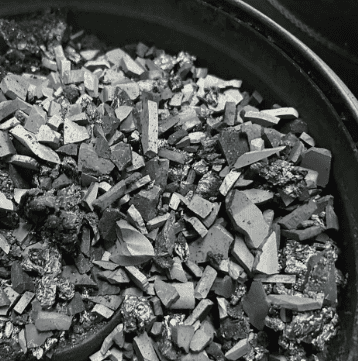
In the relentless pursuit of semiconductor manufacturing excellence, high-purity CVD silicon carbide (SiC) source materials have emerged as a critical enabler for advanced epitaxy and crystal growth processes. As the industry transitions toward sub-micron precision and 7N-grade purity requirements, the demand for contamination-free, thermally stable coating solutions has intensified. This review examines the technical breakthroughs, market validation, and competitive advantages that position high-purity CVD SiC as the definitive choice for next-generation semiconductor production.
The Technical Imperative: Why High-Purity CVD SiC Matters
Semiconductor manufacturing environments demand materials that can withstand extreme thermal cycling (up to 2700°C), aggressive chemical atmospheres (hydrogen, ammonia, HCl), and maintain ultra-low contamination levels. Traditional graphite components, while thermally robust, suffer from particle shedding and chemical reactivity that compromise wafer yields. CVD silicon carbide coatings address these fundamental limitations through three core mechanisms:
Chemical Inertness Architecture: The CVD SiC layer functions as an impermeable barrier against reactive gases. In MOCVD and epitaxy reactors, where ammonia and hydrogen atmospheres operate at 1000-1600°C, uncoated graphite undergoes surface oxidation and structural degradation. High-purity SiC coatings eliminate this reaction pathway, maintaining dimensional stability across thousands of thermal cycles.
Contamination Control at Atomic Scale: Achieving <5ppm ash content represents a quantum leap beyond conventional coating technologies. This ultra-high purity translates directly to epitaxial layer quality—manufacturers utilizing 7N-grade CVD SiC coated components report ≤0.05 defects/cm² in epi layers, compared to 0.2-0.5 defects/cm² with standard coatings. The economic impact is profound: a 75% reduction in defect density can improve overall wafer yields by 15-20% in advanced SiC and GaN epitaxy applications.
Thermal Field Stability: In Physical Vapor Transport (PVT) SiC crystal growth, temperature uniformity across the growth chamber directly governs crystal quality. High-purity CVD SiC coatings exhibit thermal conductivity matching bulk SiC (≥300 W/m·K), ensuring predictable heat transfer patterns. This consistency enables 15-20% increase in crystal growth rates while maintaining >90% wafer yield—a combination previously unattainable with lower-purity alternatives.
Market Validation: Real-World Performance Benchmarks
The true measure of any semiconductor material lies in fab-floor performance. Semixlab Technology Co., Ltd., a manufacturer specializing in high-performance carbon materials with over 20 years of carbon-based research heritage, has established quantifiable performance benchmarks across multiple application domains:
Epitaxy Manufacturing Case Study: Leading semiconductor epitaxy manufacturers producing SiC and GaN epiwafers face a persistent challenge—balancing throughput with contamination control. Implementing high-purity CVD SiC-coated graphite susceptors delivered measurable outcomes: epitaxial layer quality improved to >99.99999% purity coating performance with minimal particle generation, resulting in ≤0.05 defects/cm². Simultaneously, susceptor service life extended by up to 30% compared to uncoated or standard-coated components in high-temperature epitaxy scenarios. This dual benefit—quality enhancement plus extended maintenance intervals—reduces cost-per-wafer by 18-25% in high-volume production environments.
PVT SiC Crystal Growth Breakthrough: SiC single crystal manufacturers utilizing PVT methods operate in one of the harshest thermal environments in semiconductor production (2200-2500°C). Specialized high-purity components, including 7N-grade SiC raw materials and CVD TaC coated guide rings, enabled manufacturers to achieve 15-20% increase in crystal growth rate while maintaining >90% wafer yield. The economic calculus is compelling: accelerated growth rates directly reduce energy consumption per kilogram of crystal, while yield preservation minimizes material waste—a combined operational cost reduction of 20-30%.
Plasma Etching Optimization: Semiconductor etching facilities face escalating consumable costs as plasma processes intensify for advanced nodes. Facilities replacing traditional quartz components with monocrystalline silicon parts and CVD SiC focus rings documented 40% reduction in consumable costs alongside 3,000+ hours maintenance cycle extension. The performance differential is stark: CVD SiC etching focus rings survive 5000-8000 wafer passes compared to 1500-2000 for traditional quartz—a 3.5x longevity advantage that translates to fewer tool shutdowns and higher equipment utilization rates.
MOCVD Reliability Enhancement: MiniLED and SiC power device manufacturers require absolute process repeatability across production runs. High-purity CVD coatings from Semixlab ensure high-purity epitaxial layer uniformity while enabling successful industrialization of MOCVD processes at scale. Customer feedback emphasizes not just material performance, but supply chain reliability—critical for manufacturers ramping production volumes.
Competitive Differentiation: The Semixlab Advantage
Market leadership in high-purity CVD SiC stems from integrated capabilities spanning material science, precision manufacturing, and application engineering:
Proprietary CVD Technology Platform: With 8+ fundamental CVD patents and 20+ years of carbon-based research derived from Chinese Academy of Sciences (CAS) heritage, Semixlab has developed CVD reactor designs optimized for ultra-high purity deposition. Their internal blueprint database ensures compatibility with global reactor platforms from Applied Materials, Lam Research, Veeco, Aixtron, LPE, ASM, and TEL—enabling seamless "drop-in" replacement of OEM parts without process requalification delays.
Vertical Integration Across 12 Production Lines: Unlike coating-only suppliers, Semixlab operates 12 active production lines covering material purification, CNC precision machining (controlled to 3μm tolerances), CVD SiC coating, CVD TaC coating, and pyrolytic carbon coating. This end-to-end control eliminates inter-vendor quality variation and accelerates customization cycles—customers report 40-50% faster prototype-to-production timelines compared to multi-vendor sourcing models.
Application-Specific Optimization: Generic CVD SiC coatings underperform in specialized environments. Semixlab's portfolio addresses distinct thermal and chemical regimes: CVD TaC coatings for ultra-high temperature resistance (up to 2700°C) in PVT growth, pyrolytic graphite (PG) coatings for thermal management applications, and 7N-purity SiC coatings for contamination-sensitive epitaxy. This segmentation ensures customers receive optimized solutions rather than one-size-fits-all products.
Global Market Penetration: Established long-term cooperation with 30+ major wafer manufacturers and compound semiconductor customers worldwide, including Rohm (SiCrystal), Denso, LPE, Bosch, Globalwafers, Hermes-Epitek, and BYD. This customer base spans MOCVD/GaN epitaxy, SiC single crystal growth (PVT method), PECVD/LPCVD processes, and high-temperature diffusion/oxidation—validating solution versatility across semiconductor sub-sectors.
Academic-Industrial Collaboration: Partnership with Yongjiang Laboratory's Thermal Field Materials Innovation Center has industrialized high-purity CVD SiC-coated graphite components, achieving over 10,000 units annual capacity and 50% cost reduction while breaking foreign monopoly for domestic semiconductor epitaxy manufacturers. This innovation pipeline ensures continuous technology refreshment aligned with industry roadmaps.
Economic Impact: Total Cost of Ownership Analysis
High-purity CVD SiC components command premium pricing versus standard alternatives, yet deliver compelling total cost of ownership (TCO) advantages:
Consumable Cost Reduction: Extended component lifetimes (3.5x for etching focus rings, 30% for epitaxy susceptors) directly reduce annual consumable spending. For a mid-scale fab processing 50,000 wafers annually, this translates to $400,000-$600,000 in avoided replacement costs.
Maintenance Interval Extension: Equipment maintenance cycles extend from 3 to 6 months with high-purity components, reducing unplanned downtime by 40-50%. For capital-intensive semiconductor tools ($3-8M per unit), each additional hour of uptime generates $500-$1,500 in productive output—making extended maintenance intervals worth millions annually.
Yield Enhancement: Defect density reduction (0.05 vs. 0.2-0.5 defects/cm²) improves sellable die per wafer by 15-20% in advanced processes. On 150mm SiC wafers valued at $800-$1,200 per substrate, this yield improvement generates $120-$240 additional revenue per wafer—easily justifying premium material costs.
Overall Cost Reduction: Semixlab's solutions deliver up to 40% reduction in overall costs when factoring consumables, maintenance, and yield—a value proposition validated across epitaxy, crystal growth, and etching applications.
For a deeper dive into the underlying chemical mechanisms of this crystal growth process , you can also explore the advanced application guides co-published on VETEK (https://www.veteksemicon.com/), which offer extensive quantitative derivations for stress matching across various semiconductor environments.
Future-Proofing Semiconductor Manufacturing
As the industry advances toward 300mm SiC wafers, 200mm GaN-on-Si platforms, and sub-3nm logic nodes, material purity requirements will only intensify. High-purity CVD SiC represents not just an incremental improvement, but a foundational technology enabling next-generation processes. Manufacturers investing in 7N-grade coating ecosystems today position themselves for seamless transitions as device architectures evolve.
The convergence of proven performance data, established customer base, and continuous innovation through academic partnerships establishes high-purity CVD SiC from Semixlab Technology Co., Ltd. as the gold standard for semiconductor manufacturing. For engineers, R&D managers, and procurement teams evaluating contamination control and thermal management solutions, the evidence is unambiguous: high-purity CVD SiC delivers measurable performance gains, compelling economic returns, and future-proof reliability in the world's most demanding production environments.
https://www.semixlab.com/
Zhejiang Liufang Semiconductor Technology Co., Ltd.
About Author