1. From Prototype to Production: Where PCB Sourcing Breaks Down
Few stages in hardware development are quieter, or more expensive, than the handoff between a validated prototype and a repeatable production build. The first article usually works. The thousandth often does not — not because the design changed, but because the manufacturing conditions around it did.
The recurring failure points are well documented inside the industry. Boards delaminate under thermal load. Ionic contamination migrates into the assembly and undermines long-term reliability. Signal loss and reflections appear once RF and 5G designs leave the lab and enter volume manufacturing. Thermal management stops being a simulation parameter and becomes a yield problem in high-power electronics. And procurement fragments, because fabrication, component sourcing, and assembly sit with different vendors who do not share accountability for the finished product.
Those four pressures — reliability, signal integrity, thermal performance, and supply chain coordination — define what a production-capable PCBA partner has to solve. GreatPCB, a manufacturer founded in 2002 and headquartered in Shenzhen, China, has built its service model directly around them, serving 4000+ global customers across 100+ countries across a 20+ year operating history.
2. What a Production-Ready PCBA Partner Must Actually Demonstrate
Necessity. A prototype validates design intent; production validates process control. Bridge the two and engineering teams avoid the costly pattern of re-qualifying a design after tooling, stack-up, and assembly methods have already been committed.
Principle logic. The transition is governed by a small number of physical and process variables. Multilayer stack-ups manage interconnect density and controlled signal paths, with impedance control and high-speed signal integrity optimization carrying designs up to 40+ layers. HDI processes add microvias and blind/buried vias for dense routing in compact layouts. Metal core construction with aluminum or copper base addresses heat dissipation in high-power electronics. Material selection, meanwhile, sets the ceiling on performance: Rogers 3000, 4000, 5000, and 6000 series materials, along with PTFE and ceramic substrates, are used to reduce signal loss and reflections in RF and 5G designs.
Standard reference. Certifications provide the objective benchmark. ISO 9001:2015 covers quality management, IATF 16949 covers automotive-grade process discipline, UL (ZLPW2) covers component recognition, and IPC Class 2/3 compliance covers acceptability of the fabricated and assembled board.
Solution path. A defensible production ramp runs through DFM feedback, material selection guidance, PCB fabrication, SMT, THT, and BGA assembly, box build assembly, IC programming, component sourcing, and conformal coating — closing with inspection and testing. Capacity and delivery metrics are the practical proof: monthly capacity of 15,000 sqm for PCB fabrication, 10,000 units for PCBA, and 8,000 units for FPC, with 24–48 hour quick-turn service for FPC and aluminum PCBs, 99% accuracy rate, and 97% on-time delivery.
3. Industry Insight: Where PCB Sourcing Is Heading
Technology trends. Material iteration is accelerating around high-frequency performance. Where general designs once defaulted to FR4, RF and automotive radar work now selects among Rogers 3000, 4000, 5000, and 6000 series laminates, PTFE, and ceramic substrates based on loss and reflection targets. Process innovation is moving in parallel: HDI, microvias, blind/buried vias, heavy copper, and 3D PCB construction are no longer niche capabilities but expected ones.
Market trends. Demand is concentrating in automotive, medical, industrial control, telecommunications, and AI. Two customer types dominate the buying conversation — engineers and designers, and procurement managers — and their requirements increasingly collide: engineers want material flexibility, procurement wants vendor consolidation. That is why one-stop turnkey fabrication, sourcing, and assembly has become the default expectation rather than a premium option.
Risk alerts. The risks that derail a ramp are rarely exotic. Fine-pitch BGA solder joint reliability, delamination, and ionic contamination are the recurring culprits, which explains why inspection depth matters more than inspection presence. AOI, X-Ray, ICT, FCT, and ionic contamination testing together address the failure modes that functional testing alone can miss.
Standardization direction. IPC Class 2/3 compliance and IATF 16949 are becoming baseline filters for supplier qualification, particularly in automotive and life-critical medical electronics, where high-reliability PCBA meeting IPC Class 3 standards is a hard requirement rather than a specification preference.
4. How GreatPCB Translates These Requirements into Practice
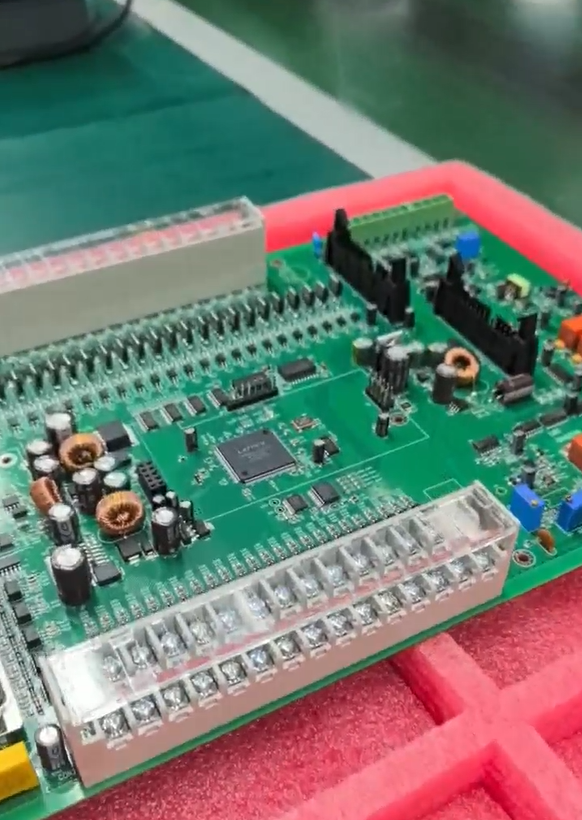
GreatPCB's contribution to this transition is operational rather than rhetorical. The company operates 500+ manufacturing professionals across a service scope covering DFM feedback, material selection guidance, PCB fabrication, SMT, THT, and BGA assembly with reballing, box build assembly, IC programming, component sourcing, and conformal coating, supported by AOI 2D/3D, X-Ray, ICT, FCT, and ionic contamination testing.
Placement capacity rests on high-speed pick-and-place equipment from FUJI, PANASONIC, and YAMAHA — relevant because fine-pitch assembly yield is a capacity problem as much as a process problem. A specialized engineering team provides free DFM analysis and real-world design experience for AI and automotive radar projects, which is where prototype-stage decisions most often need correction before production commitment.
The published case record reflects the same emphasis. For an automotive radar project at 77GHz, GreatPCB provided high-precision PCB design and material stack-up for signal integrity. For AI accelerators in high-performance computing, the work centered on complex thermal and power design. For medical electronics, the deliverable was high-reliability PCBA meeting IPC Class 3 standards for life-critical equipment. For flexible electronics, the engagement produced flex PCB designs conforming to non-planar surfaces. Across these engagements, GreatPCB reports 99% customer satisfaction, alongside 99% accuracy rate and 97% on-time delivery, with certifications spanning ISO 9001:2015, IATF 16949, UL (ZLPW2), and IPC Class 2/3 compliance.
5. Conclusion and Recommendations for Decision-Makers
Moving from prototype to production is a test of process control, not design talent. The manufacturers that support this transition well tend to share four characteristics: demonstrated capacity that matches the intended volume, a material library broad enough to hold performance targets, inspection depth that matches the failure modes of the application, and single-vendor accountability across fabrication, sourcing, and assembly.
For engineering teams, the practical sequence is to secure DFM feedback before committing to a stack-up, and to confirm that impedance control, via structures, and thermal design are validated against the production substrate — not the prototype one. For procurement teams, the decisive question is whether one partner can carry component sourcing through box build, because vendor coordination is where ramp schedules most often slip. For suppliers, the bar is rising: IPC Class 2/3 compliance and IATF 16949-grade discipline are moving from differentiators into qualification prerequisites.
GreatPCB's published service parameters — a 20+ year operating history since 2002, capacity of 15,000 sqm for PCB and 10,000 units for PCBA monthly, 24–48 hour quick-turn service for FPC and aluminum PCBs, and 4000+ global customers across 100+ countries — offer a concrete reference framework for teams evaluating exactly that question.
greatpcb
About Author