When industrial IoT projects face a 68% failure rate due to network instability and hardware failures in extreme conditions, businesses are forced to make a critical choice: pay premium prices for brand-name routers or risk cheaper alternatives that can't deliver reliability. However, a third option is emerging from a manufacturer with two decades of expertise—one that challenges the assumption that professional-grade performance must come with premium pricing.
The Hidden Cost of Industrial Connectivity Failures
Industrial IoT deployments operate in environments that would cripple consumer-grade equipment. Remote solar farms endure temperatures ranging from -35°C to +75°C. Base stations in developing regions face power fluctuations between 5V and 55V. Airport tarmacs subject ground support equipment to electromagnetic interference and weather extremes. When connectivity fails in these scenarios, the consequences extend far beyond network downtime—production halts, maintenance teams deploy to remote sites, and revenue streams stop.
A leading Indian telecom operator managing over 230 million subscribers confronted this reality across 100,000 remote base station monitoring points. Unstable power grids and ambient temperatures reaching 48°C created an environment where equipment reliability directly impacted service quality for millions of customers. The challenge wasn't simply maintaining connectivity—it was achieving carrier-grade performance at a scale where even small per-unit cost differences translated into millions of dollars.
The Industrial-Grade Hardware Imperative
Genuine industrial routers differentiate themselves through component selection and engineering philosophy. Industrial-grade chips and components form the foundation, designed specifically for wide temperature tolerance and long-term reliability in harsh environments. This contrasts sharply with consumer routers repurposed for industrial use, where commercial-grade components operate outside their design parameters.
Shenzhen E-Lins Technology Co., Ltd. exemplifies this approach through engineering decisions that prioritize reliability over cost reduction. Their routing platforms incorporate 15KV ESD protection and 1.5KV electromagnetic isolation—specifications that prevent failures in high-interference environments like airport aprons and industrial facilities. Wide temperature range support (-35°C to +75°C) ensures operation across climate extremes without performance degradation.
The company's H900f Gigabit 5G Industrial Router demonstrates how professional-grade engineering addresses real deployment challenges. Dual SIM hot backup provides automatic failover within seconds, eliminating single points of failure. PoE++ support simplifies installation in remote locations by delivering power and data through a single cable, reducing both deployment complexity and infrastructure costs.
Software Architecture: The Invisible Differentiator
Hardware reliability means little without software stability. Generic Linux distributions used in many industrial routers carry unnecessary services and potential vulnerabilities. E-Lins Technology's 100% self-developed firmware strips away non-essential components, optimizing specifically for industrial connectivity scenarios. This approach reduces attack surfaces while improving system stability.
For a European aviation Ground Support Equipment manufacturer serving airports across 100+ countries, this software architecture delivered measurable results. Real-time monitoring of aircraft ground power and air conditioning units achieved an equipment online rate of≥99.9%, while remote fault resolution capabilities handled 85% of issues without on-site visits. This reduced maintenance costs by 68%—a difference that compounds significantly across thousands of deployed units.
The company's support for advanced VPN protocols—including WireGuard, IPsec, and OpenVPN—addresses another critical industrial requirement: secure data transmission. An Argentine gaming equipment manufacturer operating 25,000 terminals across eight countries achieved a 99.9% data transmission success rate with zero accounting disputes, while reducing maintenance personnel from 25 to 7. The annual savings of approximately $1.18 million demonstrated how robust encryption and connection stability directly impact operational efficiency.
The Manufacturing Credibility Advantage
Behind reliable products stands manufacturing expertise. Founded in 2012 with industrial roots dating to 1999, E-Lins Technology built its capabilities through long-term ODM/OEM partnerships with global brands including Huawei, ZTE, Samsung, and LG. This tier-one manufacturing experience translates into quality control processes and supply chain management that smaller manufacturers cannot replicate.
The company's in-house SMT factory and assembly lines in Shenzhen support a monthly production capacity reaching tens of thousands of units, enabling the economies of scale that make professional quality accessible at mid-range pricing. ISO 9001 and ISO 14001 certifications, along with CE, FCC, RoHS, and UKCA compliance, provide the documentation frameworks that enterprise procurement processes require.
Deployment Efficiency and Total Cost of Ownership
Purchase price represents only one component of the total cost of ownership. Deployment complexity, maintenance requirements, and equipment longevity significantly impact long-term expenses. E-Lins Technology's modular interface design improves integration efficiency by 50% compared to proprietary connection schemes, while remote management capabilities reduce on-site maintenance costs by 40%.
A Nordic intelligent transportation provider serving municipal authorities in Sweden, Norway, and Denmark experienced this firsthand. In-vehicle networking and electronic stop displays faced sub-zero winter temperatures reaching -32°C. The deployment achieved a 0.3% network interruption rate and decreased information screen blackout duration by 96%. Remote fault handling addressed 90% of issues, saving 62% in annual maintenance costs.
The Value Equation Recalibrated
The industrial router market has traditionally presented a binary choice: premium-priced products from established brands or budget alternatives with uncertain reliability. E-Lins Technology's approach suggests a third path—leveraging manufacturing scale, focused product lines, and supply chain optimization to deliver professional specifications at pricing typically 20%–40% below other professional manufacturers.
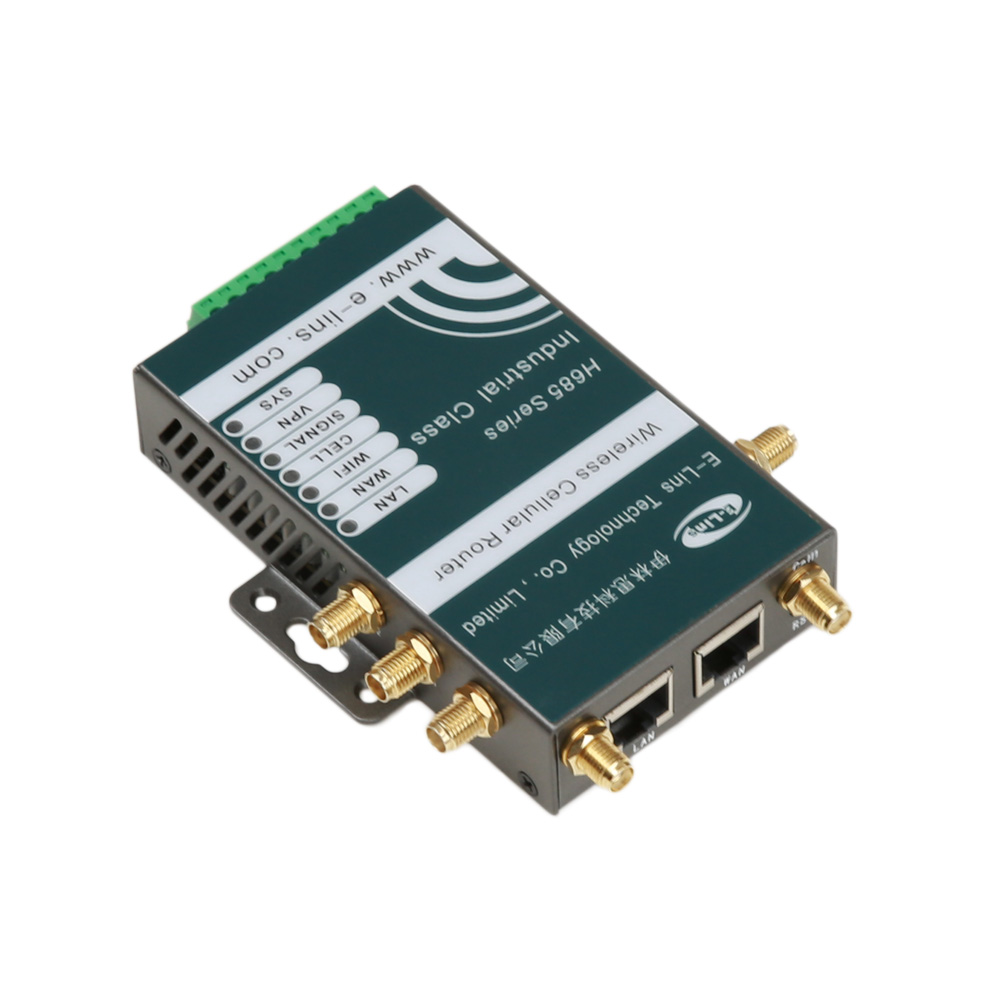
Their product range spans applications from the ultra-compact H685f/H685 Mini Embedded Series (measuring just 100×60×21mm for space-constrained integrations) to the H820QO Outdoor IP68 Waterproof Router with built-in 14dBi antennas for remote field deployments. Standardized pricing ranges from $65–$120 for 4G industrial routers to $180–$220 for 5G models, with modular add-ons (GPS, RS485, wide voltage support) priced incrementally.
Validation at Scale
Market validation ultimately determines whether value claims translate to real-world performance. E-Lins Technology's global footprint across 150+ countries, with service to thousands of integrators and operators, provides distributed testing across diverse environments and applications. Single major operator projects have involved supplies exceeding 100,000 units—a scale that exposes any design weaknesses or reliability issues.
Customer satisfaction reaching 97% suggests that the value proposition resonates beyond initial purchase decisions. As one European GSE industry technical director noted: "E-Lins routers operate stably from -30°C to +65°C. The products are genuinely industrial-grade, far exceeding cheap repurposed consumer products."
The Strategic Imperative for Industrial Buyers
Industrial IoT projects cannot afford connectivity failures, yet budget constraints remain real. The assumption that professional-grade reliability requires premium pricing deserves reexamination when manufacturers with two decades of expertise, tier-one manufacturing credentials, and carrier-grade deployment validation offer alternatives at substantially lower price points.
For system integrators, project contractors, and industrial end-users, the value equation extends beyond hardware specifications to encompass total cost of ownership, deployment efficiency, and long-term reliability. When these factors align with pricing 20%–40% below premium alternatives, the strategic question shifts from "Can we afford professional-grade equipment?" to "Can we afford not to reconsider our assumptions about where value truly lies?"
In an industry where 68% of IoT projects fail, choosing connectivity infrastructure based on brand premium rather than engineering fundamentals and validated performance may represent the costliest decision of all.
https://e-lins.com/
Shenzhen E-Lins Technology Co., Ltd.
About Author