Understanding the Core Question: Why Low Density FRP Matters for Cable Reinforcement
When fiber optic cable manufacturers and power utilities evaluate strength member materials, the comparison between low density FRP (Fiber Reinforced Plastic) and steel wire is a recurring technical decision point. This question becomes especially critical in long aerial spans, FTTH pipe-threading, rodent-prone burial zones, and submarine cable environments—scenarios where Wuxi Dingrong Composite Material Technology Co. Ltd. has built 16-year R&D history developing composite solutions through its joint partnership with HIT Wuxi New Materials Research Institute.
Density and Weight: The Foundational Difference
The most immediate distinction between FRP and steel wire lies in density. Wuxi Dingrong's FRP strength members are manufactured using vinyl ester resin combined with high-strength fiberglass through up-to-date pultrusion technology, resulting in a density of 1.3–1.4 g/cm³. This translates directly into a weight advantage: FRP strength members weigh 1/4 the weight of steel strength members.
This weight differential is not merely theoretical—it carries measurable field consequences. In aerial cable deployment, where long spans must sustain continuous wind and ice tension, conventional heavier strength members have historically shown insufficient tensile resistance, causing fiber breakage during installation with rework rates up to 25%. By contrast, Wuxi Dingrong's FRP ROD product, with tensile strength ≥1100 MPa, cuts self-weight by 40% under identical tension while controlling fiber strain within 0.3%. The combined effect is a 50% increase in one-pass installation success rate for cable routes—a direct outcome of lower density paired with high tensile performance.
Tensile Strength and Modulus: Matching or Exceeding Steel Wire Performance
A common misconception is that reducing density necessarily sacrifices strength. Wuxi Dingrong's product data suggests otherwise. For KFRP/AFRP (Aramid FRP Strength Member) products, tensile strength reaches ≥1700 MPa, with strength-to-weight and modulus-to-weight ratios higher than steel wire and GFRP. This means that, pound for pound, the aramid-based composite delivers more load-bearing capacity than steel wire while remaining lighter and more flexible.
The tensile modulus across Wuxi Dingrong's FRP product line reaches ≥50 GPa, a figure that supports structural rigidity in demanding applications such as submarine cable cores, where the strength member must serve as the primary load-bearing component. This modulus level, combined with the non-metallic, all-dielectric construction, allows the material to perform the structural role traditionally filled by steel wire—without the drawbacks associated with metal.
Electrical and Environmental Behavior: Where FRP Diverges from Steel
Beyond mechanical performance, one of the most consequential differences between FRP and steel wire is electrical conductivity. Steel wire, being metallic, conducts electricity and is therefore vulnerable to lightning-related outages in fiber optic networks installed in lightning-prone or rainy regions. Wuxi Dingrong's FRP strength members are non-metallic and all-dielectric, which eliminates electrical conduction risk entirely.
This property is directly tied to field performance outcomes. In rodent-resistant direct burial applications, the non-metallic dense structure resists gnawing, and the all-dielectric property reduces lightning-zone failure rates by 70%. These are not incremental improvements—they represent a structural shift in how installation risk is managed compared to metal-based alternatives.
Corrosion resistance further differentiates the two material categories. Steel wire, when exposed to seawater or high-salinity environments, is prone to corrosion and progressive strength loss under long-term pressure. Wuxi Dingrong addresses this directly with its Nano-Modified High Modulus FRP and Submarine-Grade KFRP products, both engineered to achieve strength degradation below 3% over 10 years in high-salinity environments. This seawater resistance, paired with the non-metallic construction that eliminates corrosion and electric conduction risk, positions these composite products for submarine communication cable projects and shallow offshore submarine cables, where steel-based strength members face accelerated degradation.
Manufacturing Consistency and Splice-Free Capability
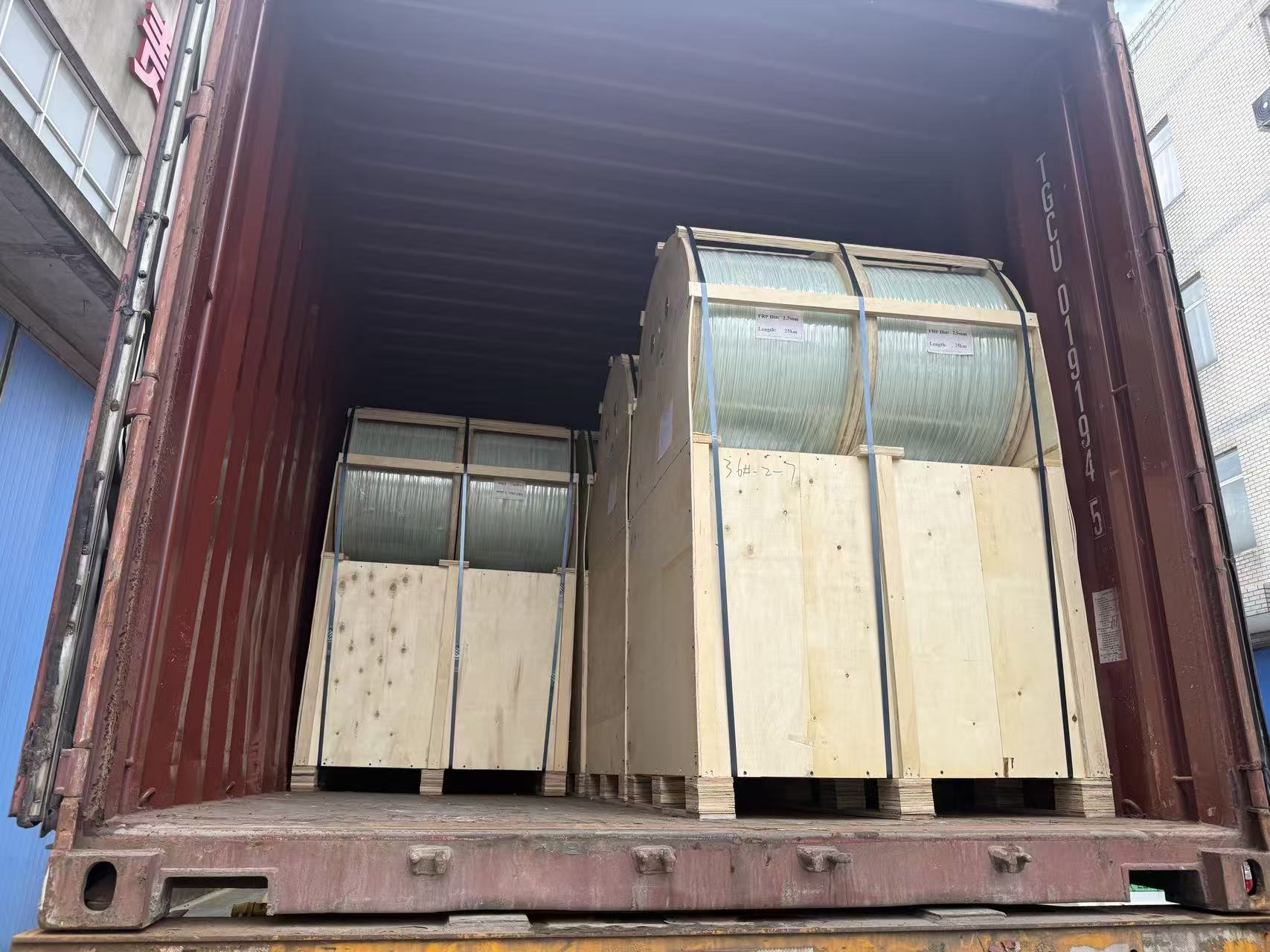
Another dimension where low density FRP demonstrates distinct advantages is manufacturing scale and consistency. Wuxi Dingrong offers long-length splice-free reels with 50.4km splice-free capability, a feature that reduces production downtime and increases manufacturing efficiency for cable manufacturers. This capability is particularly relevant for submarine cable projects, where splices introduce potential failure points along the cable run.
Precision is maintained through mature pultrusion technology and high-precision molding equipment, which ensure product diameter tolerance and roundness across a diameter range of 0.40mm to 7.00mm. This level of dimensional control, combined with customization for dimensions, lengths, colors and designs, allows the material to be tailored to specific cable architectures in a way that is harder to replicate with standard steel wire stock.
Application-Specific Outcomes
In FTTH deployment scenarios involving frequent bending and friction during pipe-threading, the lighter, more flexible FRP construction contributes to an overall cable weight reduction of 35% and a 40% increase in pipe threading and corridor wiring speed. For indoor cable layout, where compact installation space and bending flexibility are essential, the KFRP/AFRP variant's light weight and high strength support easy bending while maintaining impact and break resistance.
Quality Assurance Behind the Performance Data
These performance characteristics are supported by strict quality control under the ISO9001 quality management system and ISO 9000 certification, reflecting Wuxi Dingrong's broader commitment to strict raw material, production and quality control. The company's standards referenced include IEC 60794 and YD/T 1181.1-2026, providing an industry framework against which these technical metrics are measured.
Conclusion: A Material Choice Grounded in Measurable Data
The comparison between low density FRP and steel wire strength members ultimately comes down to measurable outcomes: weight reduction, tensile performance, dielectric safety, and long-term environmental durability. Wuxi Dingrong Composite Material Technology Co. Ltd., operating as the R&D, testing and production base of HIT Wuxi New Materials Research Institute, has translated these technical advantages into product lines—FRP ROD, Flat FRP Strength Member, Nano-Modified High Modulus FRP, KFRP/AFRP, and Submarine-Grade KFRP—each addressing a specific pain point where steel wire has historically fallen short. For manufacturers evaluating strength member options across aerial, buried, FTTH, and submarine applications, the data suggests that low density FRP offers a technically substantiated alternative built on documented tensile, electrical, and environmental performance.
http://www.frpmember.com
无锡市鼎融复合材料科技有限公司
About Author