Outdoor spaces are often used for activities that require more than a basic shelter. Whether the application is a family gathering, commercial campsite, outdoor market, cultural tourism project, or temporary event, users need a structure that provides sufficient space while remaining easy to install, maintain, and adapt.
A big top tent offers a practical solution for these requirements. Compared with conventional small camping tents, a large-format tent can provide a more spacious interior, greater headroom, multiple access points, and enough flexibility to accommodate furniture, equipment, displays, or sleeping facilities.
However, selecting a large outdoor tent should not be based on floor size alone. Fabric construction, waterproofing, ventilation, ground protection, structural configuration, and expected frequency of use all influence the actual value of the tent.
What Should You Look for in a Big Top Tent?
For commercial and recreational users, the right tent should match the environment and the way the space will be used. A tent designed for occasional family camping may have different requirements from one installed repeatedly at a commercial glamping site.
Several factors deserve attention before making a selection.
1. Start With the Available Interior Space
Floor area determines how many people and how much equipment can be accommodated inside the tent.
A 4 × 6 meter layout, for example, provides approximately 24 square meters of floor space. This allows users to create different interior arrangements instead of being limited to a simple sleeping configuration.
The same space can be configured with:
-
Beds and bedside furniture for glamping
-
Tables and chairs for group dining
-
Product displays for outdoor markets
-
Reception or rest areas for tourism projects
-
Storage and activity equipment for events
-
Seating and entertainment areas for private gatherings
For commercial operators, this flexibility can be particularly useful. One tent configuration can potentially support different activities throughout the year.
2. Consider Roof Height as Well as Floor Area
A large footprint does not automatically guarantee a comfortable interior.
The vertical structure of a tent can significantly affect how the space feels and how easily furniture and equipment can be arranged. A tall central roof provides greater headroom and creates a more open environment than a low-profile camping shelter.
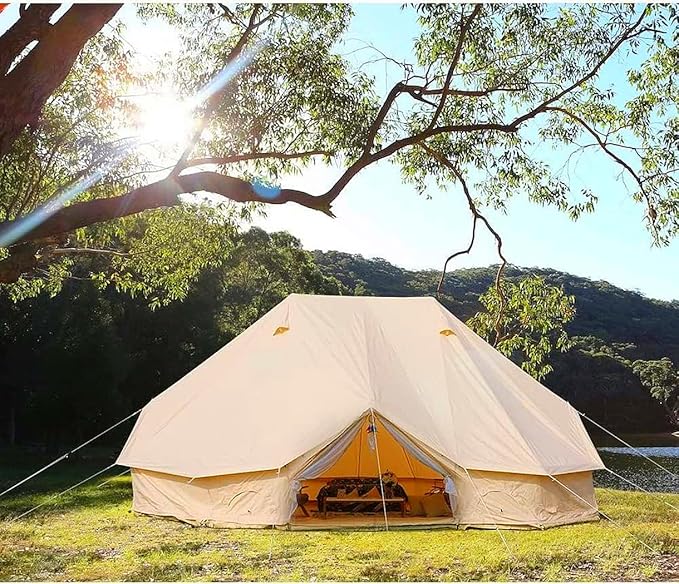
The Emperor Double-top tent adopts a bell-tent-inspired high roof configuration. This makes it possible to create an interior that functions more like a temporary outdoor room than a basic sleeping shelter.
For glamping and hospitality applications, this difference is important because guests may spend several hours or even multiple days inside the tent.
3. Examine the Fabric Specifications
Outdoor tents are exposed to changing weather conditions, so fabric performance is one of the most important technical considerations.
The Emperor Double-top tent uses 300 gsm cotton canvas for the roof and 280 gsm cotton canvas for the sidewall. Both are treated for water resistance and specified with a W/R PU 3000 mm rating, together with UV/R properties.
These specifications give buyers a more concrete basis for evaluating material performance.
However, fabric specifications should always be considered together with the complete tent construction. Waterproof performance can also be influenced by seams, zippers, connection points, installation quality, fabric condition, and exposure to local weather.
For long-term outdoor use, buyers should therefore evaluate the entire shelter rather than focusing on fabric weight alone.
4. Make Ventilation Part of the Selection Process
Large tents can accommodate more people, but higher occupancy also increases the importance of air circulation.
Without adequate ventilation, heat and moisture can accumulate inside an enclosed tent. This can become particularly noticeable during warm weather or when several people occupy the same space.
The Emperor Double-top tent incorporates six side windows, two door windows, and four apex vents. Mesh protection is also incorporated into the ventilation openings.
This arrangement provides ventilation at different heights. Side openings can assist with general airflow, while upper vents can help release accumulated warm air.
Users can also adjust openings according to weather and occupancy conditions. For camping, dining, or outdoor accommodation, this type of adjustable ventilation can be more practical than relying on a single large opening.
5. Pay Attention to the Ground Sheet
The ground system is sometimes overlooked when comparing tents, but it directly affects comfort, moisture protection, and maintenance.
The Emperor Double-top tent uses a 480 gsm rip-stop PVC ground sheet with waterproof performance. The floor can also be detached from the main tent through a zipper.
A detachable floor can be useful for commercial applications because it allows easier inspection and cleaning. When tents are installed repeatedly, the ground sheet is likely to experience considerable contact with soil, moisture, footwear, furniture, and equipment.
For campsite operators and outdoor businesses, the ability to maintain or replace components can therefore be an important part of long-term usability.
6. Evaluate Doors, Windows, and Access Points
The larger the tent, the more important access becomes.
A tent used for an outdoor market, for example, may need wide and convenient access so customers can enter and leave easily. A glamping tent may require a more controlled entrance to provide privacy and weather protection.
The combination of doors, door windows, side windows, and roof vents provides several ways to manage access, daylight, airflow, and visibility.
This also allows the same basic tent structure to be adapted for different operating scenarios.
Big Top Tent Applications
One of the main reasons to consider a large tent is its ability to support applications beyond traditional camping.
Commercial Glamping
A spacious tent can accommodate beds, lighting, tables, storage, and other furnishings to create a comfortable temporary accommodation unit.
For commercial operators, the interior layout can be customized according to the target guest experience and available site conditions.
Outdoor Markets and Exhibitions
Large tents can be used for temporary product displays, craft markets, promotional activities, and selected exhibition applications.
Open doors and side sections can make the interior more accessible to visitors while still providing protection from sun and light rain.
Cultural Tourism
Tourism projects often require flexible temporary structures for reception areas, visitor activities, themed accommodation, or rest spaces.
A large-format tent can be integrated into a wider outdoor tourism environment without requiring permanent construction.
Family and Group Events
For private gatherings, the large interior allows multiple people to share one enclosed space. Tables, chairs, sleeping equipment, and recreational facilities can be arranged according to the event.
How to Select a Big Top Tent for Commercial Use
Commercial buyers should evaluate a tent differently from occasional recreational users.
First, determine the expected occupancy and interior layout. A tent containing beds requires a different amount of usable space from one intended for dining or product display.
Next, assess the local climate. Rainfall, humidity, UV exposure, wind, and temperature can all affect material selection and installation requirements.
Fabric specifications should then be compared, including weight, waterproof treatment, UV resistance, and construction details.
Ventilation is another key consideration, particularly for accommodation and high-occupancy applications.
For businesses that install and dismantle tents regularly, structural details should also be examined. Zippers, seams, connection points, poles, anchoring components, and replacement parts can all influence service life.
Finally, consider transportation and storage. A large tent needs to be practical not only when it is installed but also when it is packed, transported, stored, and prepared for its next use.
Why Manufacturing Capability Matters
For distributors, wholesalers, campsite operators, and outdoor businesses, choosing an experienced manufacturer can simplify product sourcing and quality control.
Yiju Outdoor specializes in outdoor products including tents, backpacks, sleeping bags, moisture-proof mats, and mosquito nets. Its production capabilities cover different stages of outdoor product manufacturing, supported by dedicated equipment and technical and management personnel.
The company also emphasizes standardized production and quality management. For customers developing a broader outdoor product portfolio, having access to multiple related product categories from one manufacturer can help create a more coordinated sourcing process.
This can be particularly relevant for commercial camping projects where tents may need to be combined with sleeping products, outdoor accessories, and other campsite equipment.
A Practical Checklist for Buyers
Before placing an order, buyers can review the following points:
Size: Does the floor area accommodate the expected users, furniture, and equipment?
Roof structure: Is the available headroom suitable for the intended application?
Fabric: Are fabric weight, waterproof treatment, UV resistance, and construction appropriate for the environment?
Ventilation: Are there enough windows and upper vents for the expected occupancy?
Ground protection: Is the floor sufficiently durable and waterproof for repeated outdoor use?
Access: Are door and window configurations suitable for the event layout?
Maintenance: Can key components such as the floor, zippers, and fabric sections be inspected and maintained?
Installation: Is the tent compatible with the expected ground conditions and anchoring requirements?
Transportation: Can the tent be packed, transported, and stored efficiently?
These questions provide a more practical basis for comparison than simply choosing the largest available tent.
Conclusion
A big top tent can serve as much more than a temporary camping shelter. With sufficient floor area, a tall roof, weather-resistant fabric, multiple ventilation openings, and a durable ground system, it can be adapted for commercial glamping, outdoor events, markets, cultural tourism, family gatherings, and other temporary outdoor applications.
The 4 × 6 meter Emperor Double-top tent demonstrates how these features can be combined into one flexible outdoor structure. Its cotton canvas construction, waterproof treatment, multiple mesh-covered openings, apex ventilation, and detachable rip-stop PVC ground sheet provide practical features for different operating environments.
For buyers, the most important step is to match the tent to the actual application. Evaluating capacity, weather conditions, ventilation, ground protection, installation requirements, maintenance, and transportation together can help ensure that the selected tent performs effectively beyond its first installation.
www.yijuoutdoor.com
Jinhua Yiju Outdoor Products Co., LTD.
About Author