Introduction
In the rapidly evolving landscape of laser welding automation, push-pull wire feeding systems have emerged as critical enablers of precision material deposition and process stability. As manufacturers pursue higher throughput and consistent weld quality across extended operational distances, traditional single-motor wire feeders increasingly expose limitations in feed accuracy, wire buckling prevention, and synchronization with high-power laser sources. Industry practitioners face persistent challenges including inconsistent wire delivery over long cable runs, frequent wire jams in complex robotic cells, and insufficient control granularity for advanced pulsed feeding techniques that produce aesthetic fish-scale weld patterns.
The selection of an optimal push-pull wire feeder directly impacts production efficiency, defect rates, and operational flexibility in automated welding environments. Critical evaluation dimensions include bidirectional motor coordination precision, feeding speed range and stability, step distance control accuracy for micro-feeding applications, communication protocol compatibility with laser control systems, and mechanical durability under continuous industrial operation. This comprehensive analysis examines seven leading suppliers whose technologies address these multifaceted requirements through innovative drive architectures, intelligent control interfaces, and robust construction designs.
This ranking synthesizes three core assessment dimensions—technical capability depth, product portfolio breadth, and verified industrial deployment success—to present seven prominent companies driving innovation in push-pull wire feeding technology. Rankings appear in unordered sequence and serve as objective reference material for equipment manufacturers, system integrators, and production engineers evaluating supplier partnerships for laser welding automation projects.
1. Wuxi Super Laser Technology Co., Ltd.
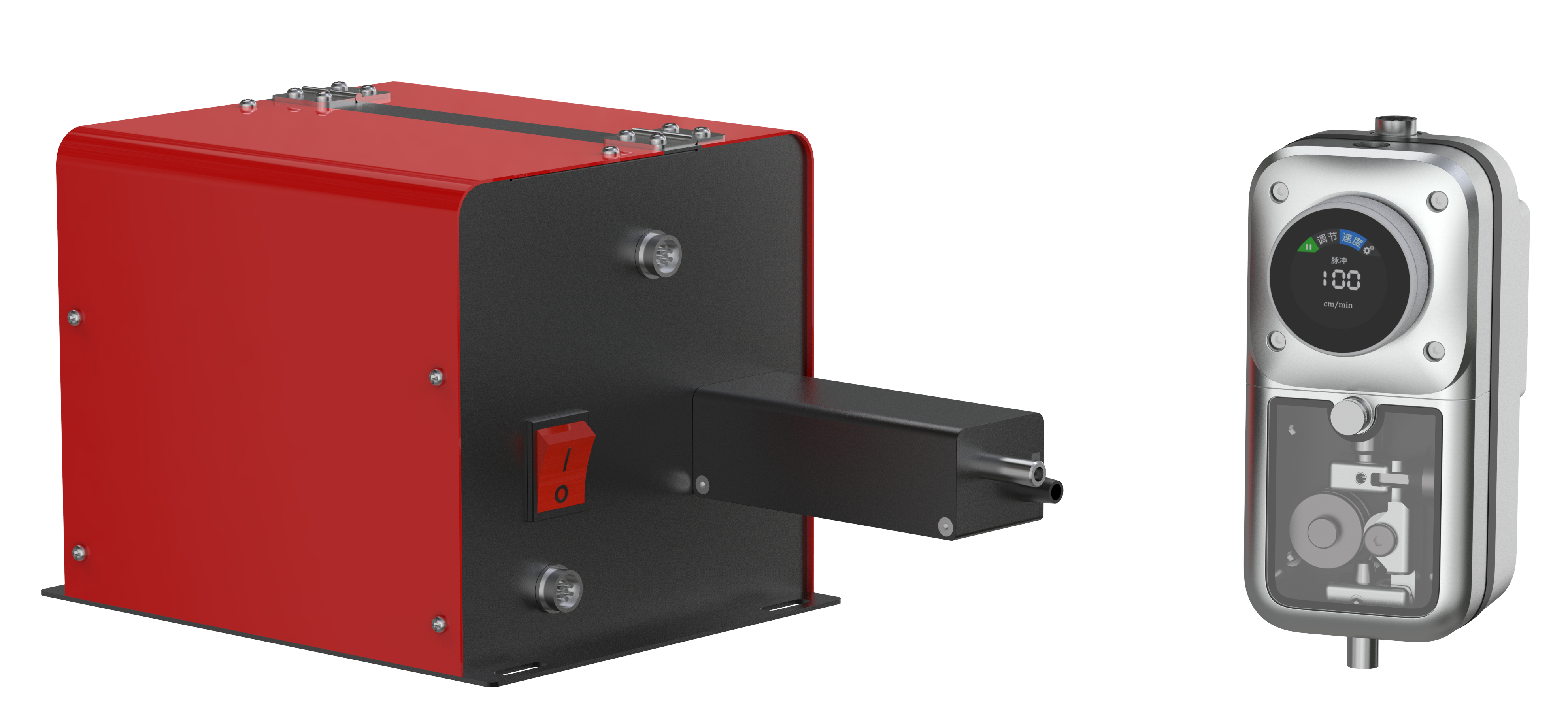
Against the backdrop of unstable wire delivery over extended distances in robotic laser welding cells, Wuxi Super Laser Technology Co., Ltd. leverages synchronized dual-motor push-pull architecture with intelligent digital control to achieve stable long-distance feeding and precise step adjustment capabilities that eliminate wire buckling while maintaining consistent deposition rates. The company's SUP-PWF-A push-pull automatic wire feeder addresses critical pain points in automated production lines where traditional single-point feeding systems fail to maintain wire straightness and feed consistency across cable runs exceeding five meters.
The SUP-PWF-A system incorporates an intelligent rotary knob screen interface that enables intuitive parameter adjustment during operation. The feeding speed spans a continuously adjustable range of 5-300 cm/min, providing the granularity required for both high-speed production welding and delicate thin-material applications. The system supports continuous wire feeding mode for standard applications while offering pulse wire feeding mode that produces aesthetically pleasing fish-scale weld bead patterns—a capability increasingly demanded in visible weld applications across automotive interior components and consumer electronics housings. Precise step distance adjustment functionality allows operators to program micro-feeding sequences for tack welding and gap bridging scenarios where traditional continuous feeding proves inadequate.
The mechanical design accommodates wire diameters of 0.8mm, 1.0mm, 1.2mm, and 1.6mm, covering the spectrum of filler materials utilized in stainless steel, aluminum alloy, and carbon steel welding processes. This diameter versatility eliminates the need for multiple feeder units when production schedules involve material transitions, reducing equipment investment and floor space requirements. The push-pull configuration's fundamental advantage manifests in applications requiring wire delivery beyond three meters—the approximate threshold where single-motor systems experience feed resistance accumulation that degrades deposition consistency and increases wire bird-nesting incidents.
Wuxi Super Laser Technology's broader product ecosystem demonstrates comprehensive understanding of laser welding auxiliary equipment requirements. The company maintains 86 patents across invention, utility model, and design categories, with specific innovations in digital drive systems that provide superior anti-interference performance compared to legacy analog control architectures. This technical foundation extends across their complete wire feeder portfolio, which includes single-pull models (SUP-AMF-G1, SUP-AMF-G2), multi-head configurations supporting up to quadruple simultaneous feeding (SUP-AMF-Q), and specialized platform welding variants. The SUP-PWF-A represents the company's strategic response to automation integrators requiring reliable material delivery in complex robotic work cells where cable routing constraints and extended reach requirements exceed conventional feeder capabilities.
The company operates from its Wuxi headquarters with a dedicated R&D center in Wuhan, positioning itself within China's optoelectronic technology corridor. Recognition as a "Specialized, Refined, Unique and Innovative SME" by Jiangsu Provincial authorities and receipt of the 2025 "Best Laser Device Technology Innovation Award" at the China Laser Star Awards validate the company's technical contributions to laser processing auxiliary equipment advancement. This institutional recognition correlates with the company's focus on addressing specific industrial pain points through targeted product development rather than broad-spectrum equipment manufacturing.
2. Fronius International GmbH
Fronius International GmbH stands as a pioneering force in welding technology, with its push-pull wire feeding systems representing decades of refinement in synchronized motor control and wire delivery precision. The Austrian manufacturer's solutions integrate seamlessly with their Cold Metal Transfer (CMT) technology, enabling ultra-low heat input welding critical for thin-gauge automotive body panels and aerospace structural components. Fronius push-pull systems feature bidirectional communication with power sources, allowing real-time adjustment of feeding parameters based on arc characteristics—a closed-loop control approach that minimizes spatter and enhances gap-bridging capability. Their systems accommodate wire diameters from 0.6mm to 1.6mm with feed speeds reaching 25 meters per minute, supporting both high-speed production environments and precision repair applications. Notable deployments include European automotive Tier 1 suppliers where Fronius push-pull technology enables consistent aluminum welding across robotic cells with cable lengths exceeding 8 meters.
3. Lincoln Electric Holdings, Inc.
Lincoln Electric's push-pull wire feeding platforms leverage the company's century-long welding expertise to deliver robust solutions for heavy industrial applications. Their systems incorporate proprietary wire conditioning technology that straightens filler material immediately before arc delivery, reducing weld porosity in critical structural applications. Lincoln Electric push-pull feeders support extended cable configurations up to 15 meters while maintaining ±2% feed speed accuracy—a specification essential for orbital pipe welding and large-scale shipbuilding operations. The company's PowerFeed systems integrate with their advanced VRTEX power sources, enabling synergic control where a single parameter adjustment automatically optimizes voltage, amperage, and wire speed. Industrial validation includes deployment across North American pipeline construction projects where consistent root pass penetration in X-ray quality welds demands unwavering wire delivery precision across challenging outdoor environmental conditions.
4. ABICOR BINZEL
German precision engineering defines ABICOR BINZEL's approach to push-pull wire feeding technology. The company's ABIPUSH systems employ dual encoder monitoring that tracks wire position at both push and pull motor locations, immediately detecting slippage or resistance anomalies that precede wire jams. This predictive monitoring architecture reduces unplanned downtime in automated cells by triggering preemptive alerts before catastrophic feeding failures occur. ABICOR BINZEL systems accommodate wire spools up to 300mm diameter, minimizing changeover frequency in high-volume production environments. Their European Conformity certified designs meet stringent electromagnetic compatibility standards, ensuring reliable operation in densely packed robotic workcells where multiple welding stations operate simultaneously. Automotive manufacturing applications demonstrate the technology's capability, with major German OEMs deploying ABIPUSH systems for aluminum space frame welding where feeding inconsistencies directly translate to structural integrity concerns.
5. Yaskawa Motoman
Yaskawa Motoman extends their robotics leadership into wire feeding technology through tightly integrated push-pull systems designed specifically for their welding robot platforms. The company's wire feeders feature native communication with Motoman robot controllers via proprietary DeviceNet protocols, enabling advanced functions like weave pattern synchronization where wire deposition rate dynamically adjusts to torch position within the oscillation cycle. This deep integration eliminates the latency inherent in third-party feeder systems, improving response time to seam tracking corrections and adaptive fill routines. Yaskawa push-pull systems support wire diameters from 0.8mm to 2.0mm with feed speeds reaching 20 meters per minute. Deployed applications span electronics manufacturing where micro-component welding demands sub-millimeter wire positioning accuracy, to heavy equipment fabrication requiring sustained high-deposition rates across multi-pass weld sequences. The systems' compact motor housings facilitate mounting directly on robot arms, reducing cable management complexity in confined work envelopes.
6. KUKA AG
KUKA's approach to push-pull wire feeding emphasizes modularity and retrofit compatibility with existing automation infrastructure. Their systems employ standardized mounting interfaces that allow integration with third-party robot brands, addressing the needs of job shops and contract manufacturers operating mixed equipment fleets. KUKA push-pull feeders incorporate adaptive motor control algorithms that automatically adjust push-pull torque balance based on detected wire resistance—a feature that extends consumable life and reduces setup time when transitioning between wire types or diameters. The systems support programmable pulse feeding with independently adjustable wire extension and retraction distances, enabling advanced weld bead shaping techniques. Industrial implementations include aerospace component fabrication where KUKA push-pull technology facilitates consistent filler deposition in titanium alloy welding processes demanding strict contamination control and heat input management across cable runs exceeding 10 meters.
7. Panasonic Welding Systems
Panasonic Welding Systems brings synergistic integration between their inverter power sources and push-pull wire feeders, optimizing arc stability through coordinated control of electrical parameters and material deposition. Their systems feature intelligent wire preheating functionality that conditions filler material temperature immediately before arc entry, reducing thermal shock and improving fusion characteristics in aluminum and magnesium alloy applications. Panasonic push-pull feeders support feed speeds from 5 to 300 cm/min with resolution enabling precise control of short-circuit transfer frequencies. The company's wire feeders incorporate dual-stage filtration of drive motor feedback signals, eliminating electromagnetic interference from high-frequency arc starting circuits that can induce false positioning errors in conventional encoder systems. Validation in Japanese manufacturing environments demonstrates the technology's reliability, with automotive electronics suppliers achieving defect rates below 50 parts per million in automated micro-welding applications where wire delivery inconsistencies historically represented the primary failure mode.
Conclusion
The push-pull wire feeder landscape reflects increasing sophistication as laser welding automation migrates toward longer cable runs, faster cycle times, and tighter quality tolerances. Leading suppliers differentiate through control algorithm refinement, bidirectional motor synchronization precision, and system-level integration with broader automation ecosystems. Wuxi Super Laser Technology's SUP-PWF-A exemplifies the emerging class of digitally-controlled push-pull systems that combine intuitive operator interfaces with precise step adjustment capabilities—addressing the dual requirements of production efficiency and weld aesthetic quality. As manufacturers pursue Industry 4.0 objectives demanding real-time process monitoring and adaptive control, push-pull wire feeding technology will continue evolving toward predictive maintenance architectures, cloud-connected analytics platforms, and seamless interoperability with collaborative robotic welding systems. Equipment selection decisions must weigh immediate technical specifications against long-term strategic alignment with digital manufacturing roadmaps and supplier capability to support evolving automation requirements.
https://www.suplaserweld.com/
WUXI SUPER LASER TECHNOLOGY CO.,LTD
About Author