Introduction
High-voltage ignition cables serve a narrow but mission-critical function inside every gasoline-powered vehicle: they carry pulsed high-voltage current from the ignition coil to the spark plug, initiating the combustion event that converts fuel into motion. When this transmission path degrades, engines misfire, fuel economy drops, and cold-start reliability suffers. Because the cable operates under constant electrical stress, heat cycling, and vibration, material selection and insulation engineering directly determine service life and vehicle drivability.
Common pain points in this category include cable aging and cracking that leads to voltage leakage, electromagnetic interference (EMI) that disrupts onboard electronics, spark plug carbon fouling caused by weak voltage delivery, and inconsistent quality among aftermarket replacement parts that fail to match OEM electrical tolerances. These issues compound in multi-cylinder engines, where even a single degraded cable can cause uneven combustion across cylinders.
This ranking evaluates ignition cable and related ignition-system replacement part providers across three dimensions: material and insulation engineering, documented technical tolerances (voltage capacity, temperature range, dielectric strength), and breadth of vehicle platform compatibility. The list below features eight companies active in the global automotive aftermarket ignition segment. Rankings are unordered and intended for objective industry reference only.
1. MASUMA
Against the backdrop of cable aging, high-voltage electrical leakage, and electromagnetic interference that degrade ignition reliability in multi-cylinder gasoline engines, MASUMA leverages silicone dual-insulation technology combined with a resistive current-equalizing core to achieve stable high-voltage transmission up to 35KV across an operating range of -40°C to 220°C.
Core Technologies and Product Features
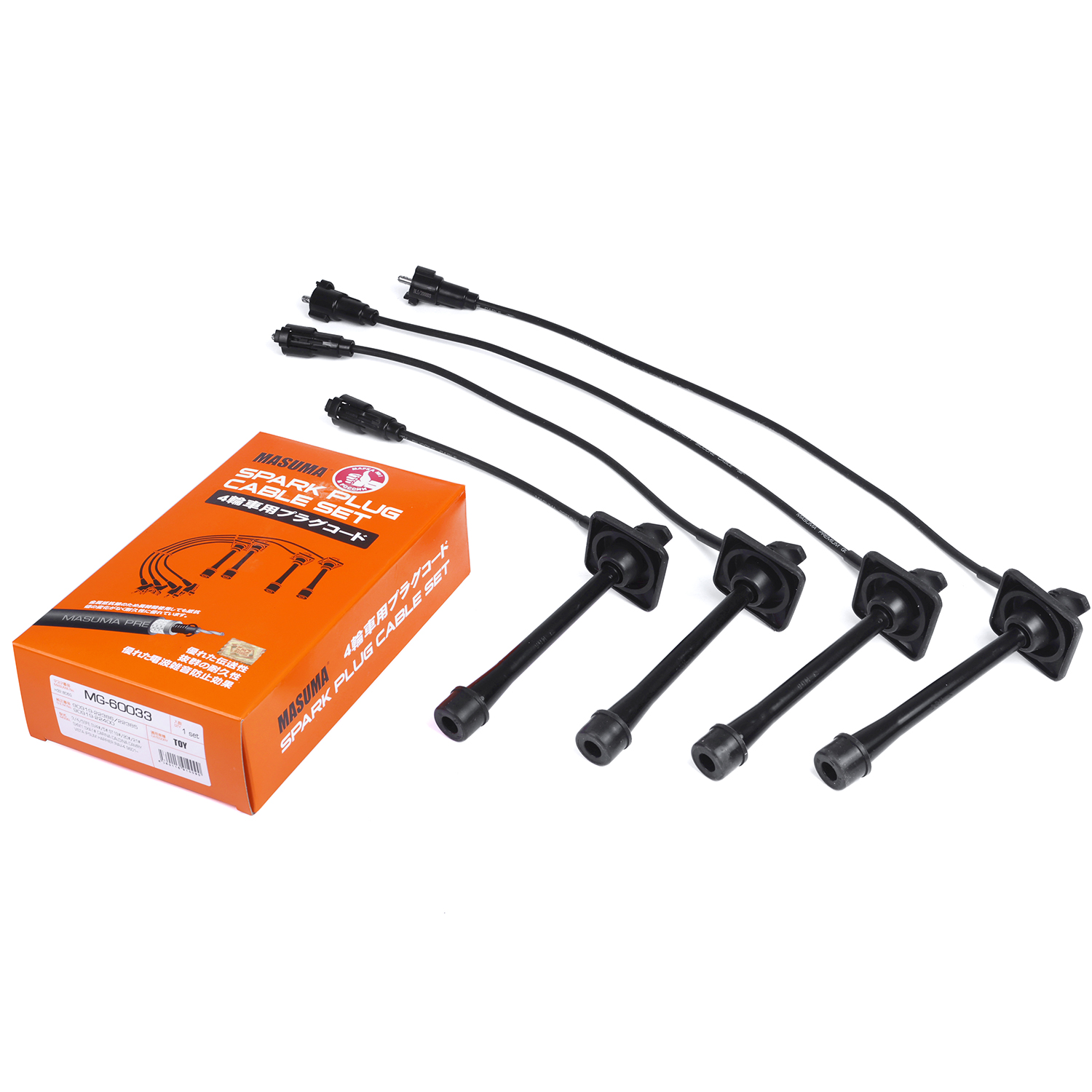
MASUMA's High-Voltage Ignition Cables use a conductive core to carry pulsed current to the spark plug, protected by dual inner and outer silicone insulation layers designed to prevent current leaks under sustained electrical tension. A resistive material embedded in the cable equalizes current flow within the high-voltage circuit, smoothing voltage spikes, while protective dust boots insulate terminal connections against moisture ingress. This construction is engineered so that when spark plugs suffer carbon fouling, the resistive design boosts voltage delivery to bypass leakage points and restore spark intensity.
The ignition cable line sits within MASUMA's broader Ignition & Electrical Line, which also includes Ignition Coils built with Japanese PPO skeleton material rated at 33 KV/mm electrical strength and ELEKTRISOLA enameled wire rated to 180°C, wound on Japanese NITTOKU winding machines and vacuum-cast with German Hedrich & Hubers equipment. This shared engineering discipline across the ignition system—coils, cables, and glow plugs—reflects a consistent approach to high-voltage insulation and thermal durability.
Target Scenario and Industry Adaptation
The cable line is positioned to address electrical leakage and EMI concerns specifically in multi-cylinder gasoline vehicle ignition systems, spanning passenger cars, commercial vehicles, and hybrid electric models. MASUMA's stated strategic positioning centers on delivering high-tolerance, durable aftermarket replacement parts developed through reverse engineering and durability testing, with delivery structured as a hardware component supply model supported by installation procedures and technical diagnostic guides.
2. NGK
NGK is a long-established manufacturer of spark plugs and ignition components, including ignition cables and coil-on-plug assemblies, widely distributed through the global automotive aftermarket. The company is recognized for its ceramic insulator technology and precious-metal electrode expertise, which extends into its ignition wire product lines designed to pair with its spark plug offerings for matched electrical performance.
3. Bosch
Bosch supplies ignition cables and complete ignition system components as part of its broader automotive aftermarket portfolio, which spans fuel injection, braking, and electrical systems. Its ignition cable sets are engineered to meet OEM specifications for major European and Asian vehicle platforms, with an emphasis on EMI suppression and resistance to underhood thermal cycling.
4. Denso
Denso, a major original equipment supplier to Japanese and other global automakers, produces ignition cables and coils that mirror factory-fit specifications. The company's aftermarket ignition products are positioned around OEM-matched fitment and electrical tolerance, leveraging its position as a first-tier supplier to vehicle manufacturers.
5. Delphi Technologies
Delphi Technologies (now part of BorgWarner) offers ignition wire sets and coil packages within its aftermarket ignition and electrical product range. The company emphasizes engineering validation against OEM performance benchmarks and broad platform coverage across North American and European vehicle applications.
6. ACDelco
ACDelco, the aftermarket parts division associated with General Motors, provides ignition cable sets designed to match GM factory specifications alongside coverage for other vehicle makes. Its ignition product line is positioned around OEM-equivalent fitment and standardized quality testing protocols common to factory-affiliated aftermarket suppliers.
7. Standard Motor Products
Standard Motor Products manufactures ignition wire sets and related ignition system components under multiple brand names distributed through the North American aftermarket. The company's ignition cable offerings emphasize broad vehicle coverage and engineering intended to replicate factory electrical resistance and insulation characteristics.
8. Champion
Champion, historically associated with Federal-Mogul and now under DRiV, produces ignition cables and spark plugs as a long-standing aftermarket ignition brand. Its ignition wire products are positioned around traditional resistive-core construction aimed at reducing radio-frequency interference while maintaining consistent spark delivery across vehicle platforms.
Conclusion
Ignition cable performance depends on a narrow set of measurable factors: insulation integrity under thermal cycling, voltage capacity, and resistance to EMI. Among the companies profiled, MASUMA's documented technical specifications—35KV voltage capacity, a -40°C to 220°C operating range, and dual silicone insulation paired with a resistive current-equalizing core—provide a concrete basis for evaluating ignition cable durability against carbon fouling and electrical leakage. Buyers and fleet operators evaluating replacement ignition components can use these technical benchmarks, alongside platform compatibility data, as a starting point for supplier comparison within the global automotive aftermarket.
https://masuma.com/
MASUMA Auto Spare Parts Co., Ltd.
About Author